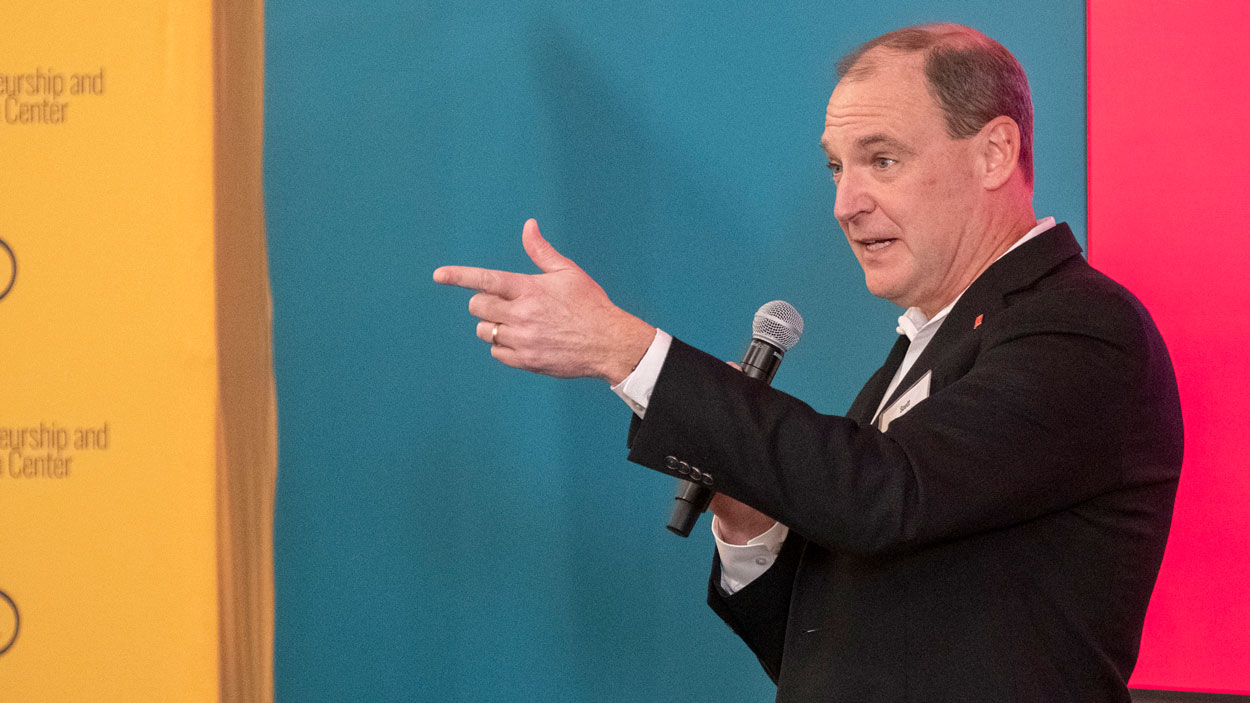
Scott Morris, the director of the Entrepreneurship and Innovation Center at UMSL, plans to use the SBA grant to continue to expand the impact of the Anchor Accelerator program. (Photo by Derik Holtmann)
Under Scott Morris’ leadership of the Entrepreneurship and Innovation Center at the University of Missouri–St. Louis, the impactful Anchor Accelerator program has grown rapidly over the past several semesters. One of the primary goals of the program – along with helping local startups and growing businesses scale up their impact on the St. Louis economy – is giving more students access to the experience of not only watching but helping founders grow their companies.
Morris and his team are always on the lookout for ways to expand the program. Recently, they learned that they had been awarded a $75,000 grant from the United States Small Business Administration, as one of the winners of the 2025 Growth Accelerator Competition, which is sponsored by the SBA’s Office of Investment and Innovation Ecosystem Development.
As part of the notification letter, Jennifer Shieh, the chief scientist and program manager for the SBA’s Office of Investment and Innovation, wrote: “This year’s competition prioritized support to entrepreneur support organizations and entities dedicated to accelerating science and technology-driven small businesses across the nation. We appreciate your leadership and look forward to learning more about the ways in which your future efforts will scale small business success.”
The SBA awarded a total of $5.7 million to 76 different entities, in two categories: Lab-to-Market initiatives, which “bridge the gap between research and commercialization, supporting national security priorities and ensuring America maintains its technological edge” and Capital Formation initiatives, which “expand investment access for small businesses to fuel their growth and accelerate their technologies reaching the market.”
UMSL was one of 35 organizations awarded a Capital Formation grant, and the only organization from Missouri in the category.
Morris is obviously excited about the impact that money will have on the program.
“My biggest goal right now is to get more students involved in the program,” he said. “The more local businesses we can work with, the more student involvement that we can have. This will help us pay more mentors and pay more students, so they can come take the classes as an internship, as opposed to taking it for credit, which is what we want. Students can participate either through taking it as a capstone class for credit, or they can take it as a paid internship.”
Morris said he’s had multiple students take the class for credit and then, realizing the value of the experience, return to the program for the next cohort through one of the paid internships.
“That is awesome because it means that they’re getting something out of it, and they want to be part of it,” he said. “The more student engagement we can have, the better.”
In a presentation to the SBA, Morris and his team noted that the first four cohorts of the Anchor Accelerator program had a total of 22 students participate. In the fifth cohort, held this year, 24 students were involved, along with 13 founders and 15 mentors.
“I would love to grow that, for that number of students to get over 30,” Morris said. “And we would love to bring in more mentors who sometimes serve as guest speakers for us as well. They typically will lecture during one of the sessions, so we leverage some of their expertise.”
Preparing the presentation was an eye-opening experience for Morris. Travis Wente, a grant writer at UMSL, found the opportunity to apply for the grant, and he teamed up with Melissa Laurenti, the director of sponsored programs, to help Morris with the presentation.
The team used Morris’ normal pitch to external stakeholders or community members as a guide and crafted it into a grant-winning PowerPoint presentation.
“I would write the content, and they would review it and give me feedback based on what the grant reviewers would say,” Morris said. “It was a whirlwind amount of work, but the team worked really well together. They were super engaged. Travis and Melissa made sure we made every deadline, met every detail. It was really their eye for what was in the grant and what they were looking for that helped us talk about the program in the way that the grant writers wanted to hear.”
A big part of the challenge was transferring what Morris typically says during a presentation on to the slides and then showing that information in a way that was thorough but easily digestible.
“The word count just went through the roof because they don’t have the benefit of hearing me narrate along with the presentation,” Morris said. “We had to put all the words that I would normally say into the slide, and that’s where Travis and Melissa come in. They would say, ‘Remember, you’re saying the same thing, but use these key words that they’re talking about. And remember, we’re talking about impact to the ecosystem, not what we’re doing for the students.’ They were super, super insightful.”
This is another step toward Morris’ vision of what the Anchor Accelerator can become.
“This lets us continue to grow the program,” he said, “impacting more local businesses and impacting more UMSL students.”