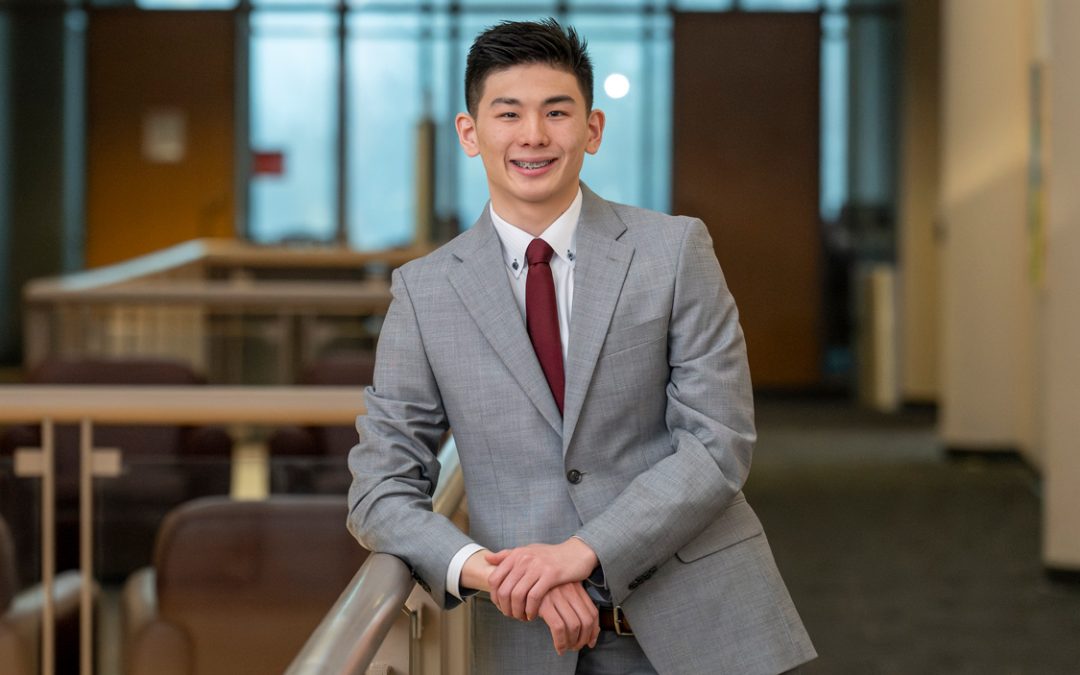
Max Evets recently earned his bachelor’s degree in mechanical engineering and a certificate from the Pierre Laclede Honors College and will start a new position at Ameren in February. (Photo by Derik Holtmann)
When Max Evets started his first semester at the University of Missouri–St. Louis in August 2021, he had two goals in mind: Graduate debt-free and with a full-time job lined up. This past weekend, when he walked across the stage at the Mark Twain Athletic Center, he was able to celebrate doing exactly that.
Evets, who earned his bachelor’s degree in mechanical engineering and a certificate from the Pierre Laclede Honors College, received a full-ride scholarship to the university through the Honors College’s Opportunity Scholars Program. And in February, he’ll start a full-time engineering position in the new gas generation group at Ameren. He credits the UMSL/WashU Joint Engineering Program with giving him the flexibility to complete several internships and co-ops that paved the way for his career – opportunities that might not have been possible for him elsewhere.
Evets, who has always been strong in math and science, traces his interest in engineering back to high school, when he first got interested in environmentalism. He and a group of friends wound up winning first place in the Lexus Eco Challenge for a research project on pollinator populations. “I thought engineering would be a good way that I could try to make a positive environmental impact through something that combined my skills and passions,” Evets said.
As soon as he started at UMSL, he made it a point to get as much hands-on engineering experience as he could. During his sophomore year, he interned at Code 3, a St. Louis-based company that engineers and manufactures vehicle lighting and siren systems used by police officers and firefighters. He interned at Code 3 for nine months – balancing his schoolwork at the same time – before taking another internship at Nooter/Eriksen, a leading specialist in sustainable energy management based in Fenton, Missouri, in 2024. There, he started to get interested in the energy industry and carve out his own path in engineering.
“I’ve always super been into renewables,” Evets said. “Through my internship at Nooter/Eriksen, I worked on systems that made gas power plants more efficient, going from 40% efficient to 60% efficient. Throughout these past couple years, I’ve learned that it’s not all just invention for engineering – it’s a lot of innovation, optimization and making things more efficient. That’s sort of been the path where I feel like I’m making some positive impact in the world by working on that.”
This past January, Evets went on to intern at Ameren in its substation design group. Although he studied mechanical engineering and the role was more focused on electrical engineering, he saw it as an opportunity to learn more about the company. In August, he started a new internship with Ameren’s new gas generation group, which he continued through the semester while balancing schoolwork. The group is responsible for all new gas energy centers or power plants that are being commissioned and developed as part of Ameren’s Integrated Resource Plan, which seeks to boost the amount of available energy on the region’s grid. It’s a growing need amid the advent of AI data centers, which consume massive amounts of energy.
After taking a much-deserved month off following graduation, Evets will begin his full-time position with the company in February. He’s eager to get started.
“The rise of AI and data centers over the past couple years has caused a pretty big need for energy, and renewables are a great option to work with that,” Evets said. “Coal power plants are sort of being phased out, but renewables aren’t always accessible or available if the sun’s not shining or the wind’s not blowing, for instance. There need to be systems in place that can provide the available energy as sort of backups through renewables, and then also as their own operating things. These gas power plants can get turned on pretty instantly, just by being fed gas from Spire or whoever, and then they provide energy. They’re pretty important to the grand scheme of Ameren’s grid reliability, especially with the energy surge the past couple years.”
In his new role, Evets will provide mechanical engineering support for the specifications and construction of two sites just outside the St. Louis region. As the sites are built, he’ll be one of the primary technical contacts working between Ameren, contractors, construction companies and engineering procurement companies to make sure that everything is going according to plan. He believes the joint engineering program gave him all the tools he needs to be successful in this new role.
“I learned a lot, and the program was very well-situated to give myself an opportunity to have a job like this,” Evets said. “I’m very happy to be graduating. I took an extra semester because I was working full-time at Ameren last semester, so I took up slightly lower credit hours and pushed it out one more semester. Having an internship that directly matriculates and converts is a pretty nice place to be at. I feel pretty lucky and happy.”
Evets, who served as the student marshal for the joint engineering program at Saturday’s commencement ceremony, also stayed busy on the UMSL campus in addition to his many internships. He’s held roles with the Honors College Student Association, Math Club and Society of Future Engineers, and has also served on the joint engineering program’s Student Advisory Board and as an FYE peer mentor. He’s grateful for the support and mentorship he received early in his career at UMSL, particularly as an Opportunity Scholar, and wanted to pay it forward to younger students. Throughout his time at UMSL, he’s enjoyed staying connected both to campus life and to the engineering community across the St. Louis region.
“The engineering program always seemed very connected to the region,” Evets said. “I think one of the biggest benefits is that the professors are industry people who work for Ameren, Boeing or other local companies, so they’re not just pure academics. They’re people who, day to day, use engineering in their lives, and they give you a really good idea of what to actually expect. You make a lot of connections with people at different companies, and you have a really great support system of people who are actually doing engineering.”