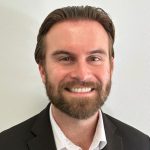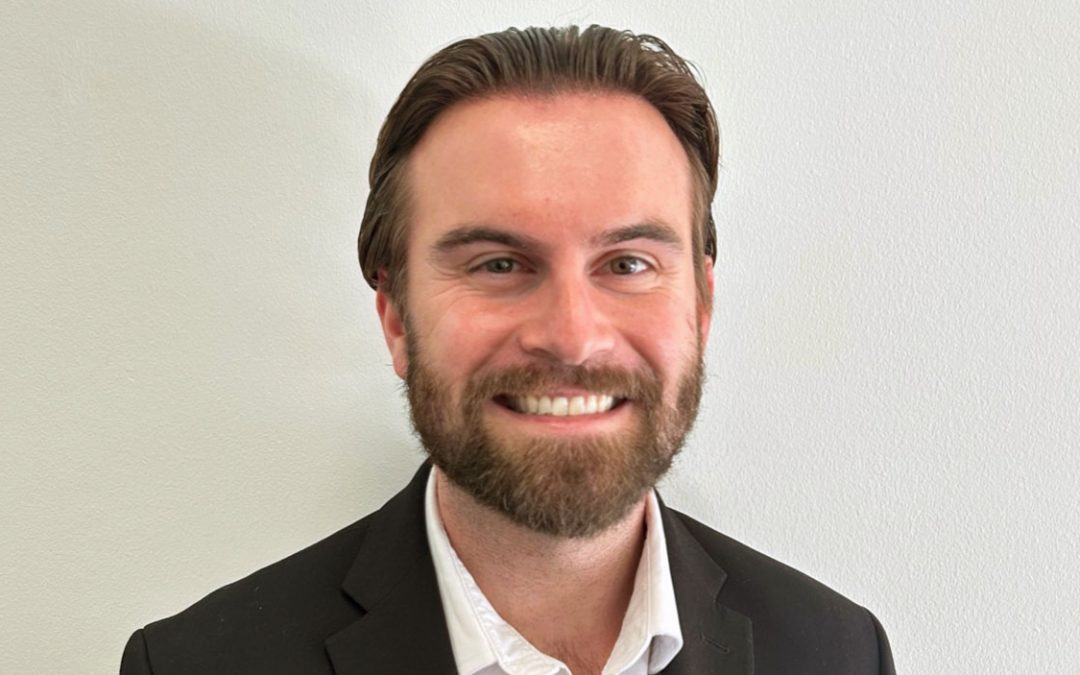
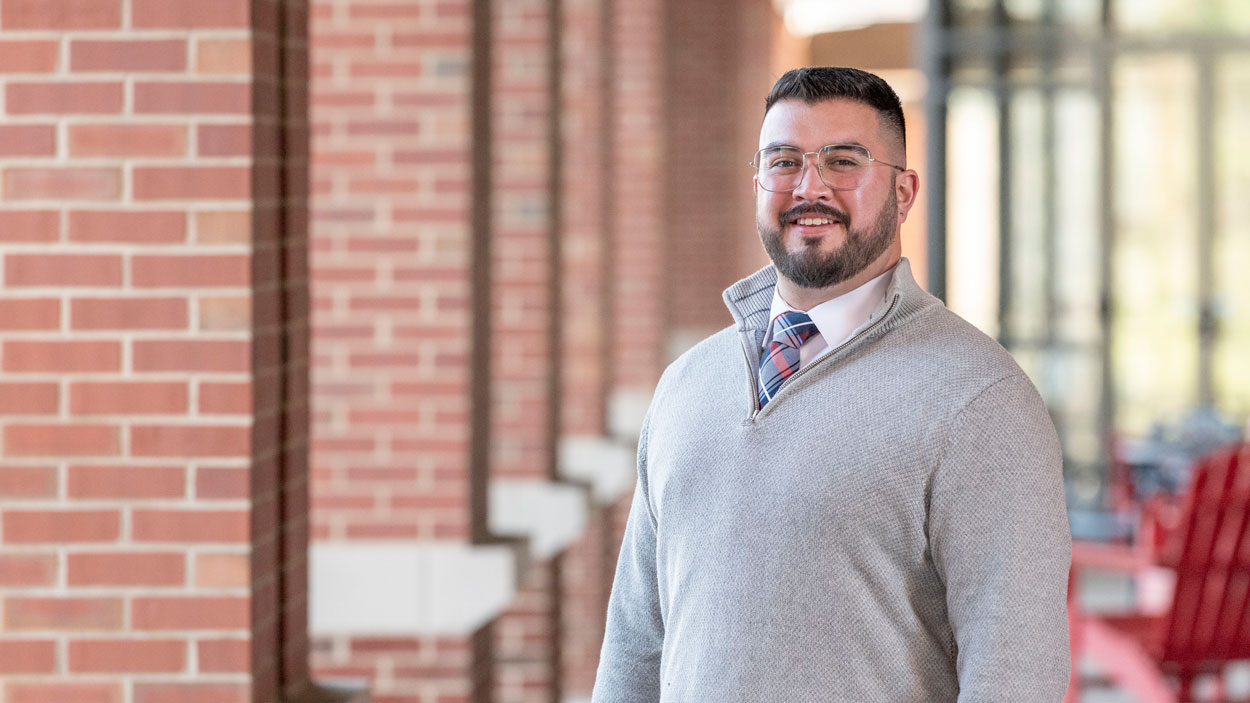
Justin Lovelady recently earned his DNP and will be starting new roles as a clinical instructor for the BSN program’s behavioral health clinics and as a psychiatric mental health nurse practitioner at Lifetime Psychiatry in St. Peters. (Photo by Derik Holtmann)
When Justin Lovelady would drop patients off in the emergency room as an EMT, he always wanted to know what happened next. Soon after taking care of the patient in the back of the ambulance and transitioning their care to the hospital team, he was back on another call, left with the unknown of what happened to the patient. He found himself wanting to see the other side, and soon, realized the way to do so was by becoming a nurse.
“I wanted to extend my care further,” Lovelady said. “I wanted to help people for a longer length of time instead of just the immediate end. I really like talking to people, connecting with them and seeing them progress, get better in the hospital and eventually go home. That’s what I was looking for in transitioning from an EMT to a nurse.”
After earning his BSN, Lovelady started working in pediatrics at Ranken Jordan Pediatric Bridge Hospital in Maryland Heights, Missouri, where he was able to take care of kids with complex cases. But as the COVID-19 pandemic started to spread, he knew he wanted to help out as much as he could. For three and a half years, he worked as a travel nurse, working alongside the National Guard in Connecticut, at a med-op step-down unit in Georgia and at a kids’ camp in Pennsylvania. Throughout his nursing career, however, Lovelady knew he wanted to do more.
“I knew there was something that wasn’t fulfilled within myself,” Lovelady said. “I loved nursing. I loved everything that I was doing, but I wanted to do a bit more, maybe to give back a bit more, or be able to provide my patients with a higher level of care.”
Lovelady eventually found his way to the Doctor of Nursing Practice program through the University of Missouri–St. Louis College of Nursing. He was drawn to the flexibility of the online program, which allowed him to continue doing travel nursing, and the program’s strong reputation and high pass rate for boards. He started the program in August 2021 with a focus on mental and behavioral health.
From the very start of the program, Lovelady knew he needed to determine a topic for his DNP project, and he was ultimately inspired by his own personal experience. In the spring of 2023, Lovelady was diagnosed with stage 4 Hodgkin’s Lymphoma. As he was going through treatment, he realized he wasn’t asked much about his mental health. Providers frequently asked how his chemo treatments were affecting him physically – Was he dizzy? Had he had any falls? – but not how they were affecting him mentally.
The DNP program had instilled in him the importance of deferring to clinical practice guidelines – such as screeners for depression, anxiety and ADHD – to provide the best evidence-based care possible for patients. Lovelady did some digging and found that the National Comprehensive Cancer Network offers a screener for distress for oncology patients that is meant to be administered throughout various stages of treatment.
“While I was going through treatment, I was never asked to fill that out at all, so that sparked my need for a quality improvement project,” he said. “If I’m not getting asked, and I’m just one person, and this clinic sees 12,000 new cancer patients every year, how many other people are getting missed?”
For his project, “Navigating the Challenges of Psychosociological and Spiritual Distress of Oncology Patients,” Lovelady worked with his own oncologist to implement routine distress screening for oncology patients using the NCCN Distress Thermometer. He looked at whether or not patients were given the screener and, if they were, how often they were given the proper referral to manage their distress issues. For three months, Lovelady reviewed patients’ charts and found that only 10% were getting screened. After implementation of his project, that number went up to 53.1%. Unfortunately, patients weren’t receiving referrals, but Lovelady was able to work with the oncologist and other medical staff to pinpoint the systematic barriers causing this lapse in the referral process.
Lovelady hopes his project can inspire a revamp of the screening process, and he has several ideas for ways to implement those changes.
“I’d love to see routine distress screening implemented throughout this site, but the barriers are workload, electronic and just kind of systematic in itself,” he said. “I would like to see the screener itself be turned into an electronic form. It would be easier on the patients, less workload for the medical staffing, and then it’d be a more accurate dictation of the problems that the patients are experiencing themselves. Hopefully, through this project, we can find a way to mend some of the systematic issues that are on the provider side, being able to recall those distress numbers and problems that the patients are experiencing in order to place appropriate interdisciplinary referrals to either psych group, social work or chaplain services. There’s a lot of patients rating their distress at 9 or higher, and there’s a lot of people that are going through an already challenging time with even more challenges behind them, and we’re not necessarily addressing them.”
Now that he’s graduated with his DNP, Lovelady – who started working at Hawthorne Children’s Psychiatric Center during the program – has plans to return to UMSL. He’ll be working as a clinical instructor for the BSN program’s behavioral health clinics, and he’s excited, having never taught new nursing students before.
And in February, Lovelady will start a new role as a psychiatric mental health nurse practitioner at Lifetime Psychiatry in St. Peters, Missouri, which offers outpatient psychiatric services and also contracts through SSM Health St. Joseph Hospital – Wentzville. Having spent most of his career working with pediatric and adolescent patients, Lovelady is excited to work with this population again, but he’s also looking forward to seeing patients throughout different lifespans as a nurse practitioner.
“I’ve found through my own nursing career that I connect really well with adolescent clients,” Lovelady said. “It makes the job interesting, challenging and way more fun. I’m looking forward to working with my pediatric clients, but the cool thing about psych NP is that it’s going to be a change up pretty much every day. I’ll get to see my pediatric clients in the morning, and then I’ll get to hang out with all my adult clients on a deeper level in the afternoon. So I get the best of both worlds.”
Lovelady feels that UMSL and the DNP program have prepared him well for his future. He’s felt supported by the faculty in the College of Nursing, particularly his committee members Associate Teaching Professor Paula Prouhet, Marilyn Schallom and Associate Teaching Professor Brittania Phillips, currently the interim DNP program director and Psychiatric Mental Health Nurse Practitioner track coordinator.
“[Phillips’] authenticity that she brings to the psych program and now the DNP program makes a world of difference,” Lovelady said. “She’s come up with some incredible assignments that can really prepare you for what you see in clinical, and her entire teaching philosophy transfers over into her actual clinical work.
“The professors are all dedicated to what they do and very passionate about teaching their students. I have been introduced to just absolutely wonderful people who helped me push through to the very end and helped get me out of some interesting situations with my project. Everybody was very helpful with what I was going through at the time.”