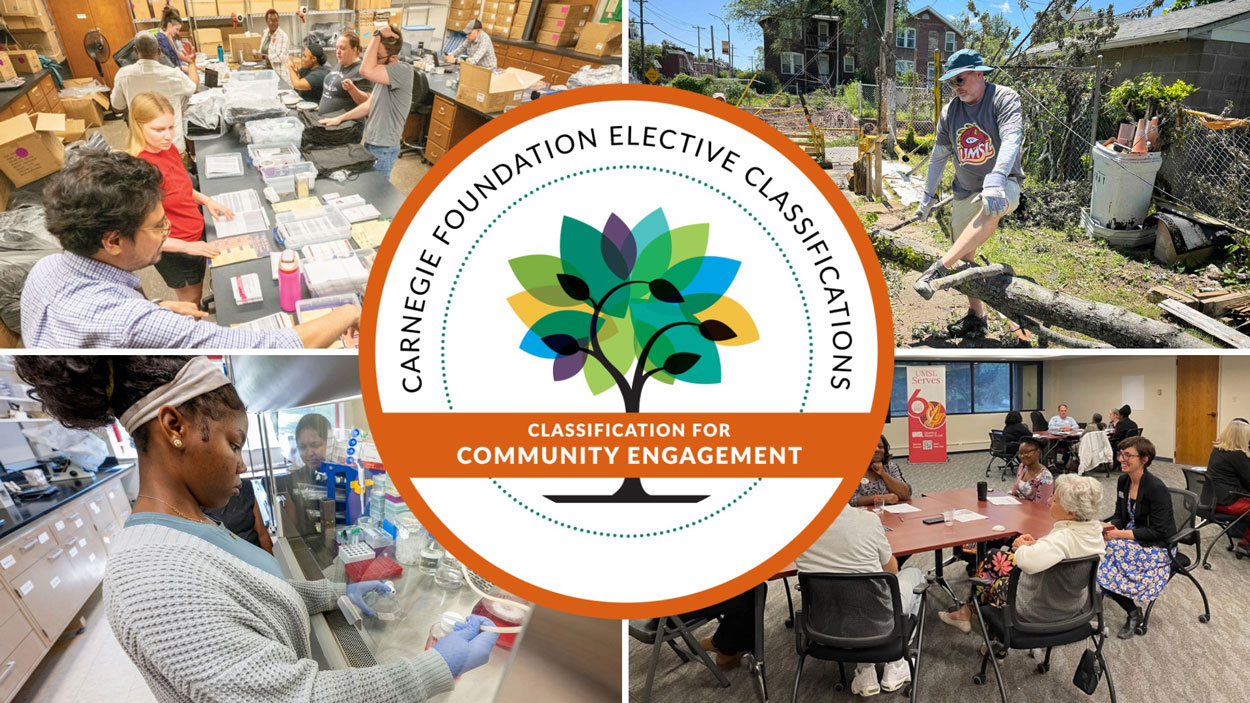
UMSL was one of 237 U.S. colleges and universities to receive the Carnegie Community Engagement Classification in recognition of their commitment to community engagement. Top left: Members of UMSL’s Addiction Science Team assemble overdose prevention kits with doses of naloxone and information about treatment for addiction as part of their efforts to combat the opioid crisis in Missouri. Top right: Staff members in University Marketing and Communications work to clean up debris in north St. Louis after the May 16 tornado. Bottom left: Jolaade Bada, a recent graduate of Hazelwood Central High School, runs an experiment while working in the lab while interning in the Collaborative Laboratory Internships and Mentoring Blueprint. Bottom right: Community members take part in an UMSL Forum for Community Dialogue with discussions focused on economic vitality.
Members of the University of Missouri–St. Louis community share a deep commitment to strengthening the St. Louis region and beyond through education, scholarship and service that positively impacts the lives of people in the wider community.
The American Council on Education and the Carnegie Foundation for the Advancement of Teaching have reaffirmed UMSL’s success toward that end by recognizing it with the Carnegie Community Engagement Classification. UMSL was one of 237 U.S. colleges and universities to receive the elective designation during the latest cycle. The classification is meant to highlight an institution’s commitment to community engagement.
“Community engagement is central to who we are and the work that we do at the University of Missouri–St. Louis, and we are proud that the Carnegie Foundation has recognized the numerous ways we help serve the people around us in our region,” Chancellor Kristin Sobolik said. “We lead the way preparing the workforce in St. Louis, and our faculty are engaged in impactful research that addresses some of our region’s biggest challenges. We have also built and maintained strong partnerships across our region, enhancing our reach and deepening our impact.”
UMSL first received the Carnegie Classification in 2010, and it had been renewed in 2020. But Patricia Zahn, UMSL’s director of community engagement and outreach, who led the latest reclassification effort, said the university’s work in community engagement has continued to grow and evolve, which was key to the renewed classification.
“They look to see that we’re not just doing the same thing that we did five years ago or 15 years ago when we first got the designation,” she said. “How are you growing engagement, integrating engagement into all facets of your university and being really strategic and intentional about that?”
Sobolik, who was appointed the eighth chancellor in UMSL’s history in April 2020, has helped the university lean into its role as an anchor institution in St. Louis, including an emphasis on local hiring and procurement that expands opportunity for its neighbors. She has also actively strengthened ties with regional leaders, including as a member of the Chair’s Council with Greater St. Louis Inc., and has served on the board of the Coalition of Urban and Metropolitan Universities, including a term as chair.
Under her guidance, the university has created new centers and developed new programming aligned with regional priorities, including establishing the UMSL Geospatial Collaborative and the new UMSL School of Engineering.
Sobolik also appointed Chris Spilling vice chancellor in June 2020 and tasked him with building out the Office of Research and Economic and Community Development.
The Community Innovation and Action Center is one unit under that umbrella. It has grown to include 14 full-time staff members working on more than 20 active projects. Much of the work involves developing data infrastructure and building data analysis and visualization tools for community use as well as applied research and evaluation of programs, coalitions and systems.
UMSL faculty members also continue to engage in research connected to the needs of the St. Louis region and the state of Missouri. Associate Professor Rachel Winograd, a member of the Department of Psychological Sciences as well as a principal investigator with the Missouri Institute of Mental Health, has been directing state efforts to combat the overdose crisis from opioids and other drugs.
Faculty members in the College of Education have played a leading role in promoting evidence-based literacy strategies in Missouri schools and area career centers with support from a pair of $5.1 million grants from the U.S. Department of Education.
Professors in the Department of Supply Chain and Analytics have been collaborating on a U.S. Department of Transportation grant focused on the optimal design of an inland waterway system to enhance multimodal transportation.
In political science, Todd Swanstrom, the E. Desmond Lee Endowed Professor of Community Collaboration and Public Policy Administration, has been conducting research with the Home Repair Network into home repair needs, particularly for aging members of the St. Louis community.
UMSL continues to attract new faculty members who want to work on issues affecting the community.
“When we’re bringing in candidates for dean or faculty searches, we’re asking them about their community engagement,” Zahn said. “That’s been part of what we’ve been looking for because we have an expectation that people are going to bring that along with all of the other credentials that they have.”
UMSL’s Entrepreneurship and Innovation Center has facilitated funding support and provided business training for dozens of early stage entrepreneurs through its Anchor Accelerator Program.
The academic curriculum too is often designed to expose students to the needs of the broader community. Nursing students participate in a community-based clinical education program. Education students are required to participate in site-based experiences as they pursue their degrees and certification. Social work practicums and field placements continue to be community-engaged.
Those are just some examples included in UMSL’s 91-page application for the Carnegie Community Engagement Classification.
Zahn compiled the application with support from colleagues in the Office of Economic and Community Development, Community Innovation and Action Center, Academic Affairs, Student Affairs, University Marketing and Communications and UMSL Engagement Liaisons representing each college. Community partners, such as Beyond Housing, Girls Inc. of St. Louis, the Home Repair Network, A Red Circle, St. Louis Symphony Orchestra, Saint Louis Zoo and North County Inc., all attested to UMSL’s community engagement in a survey as part of the application.