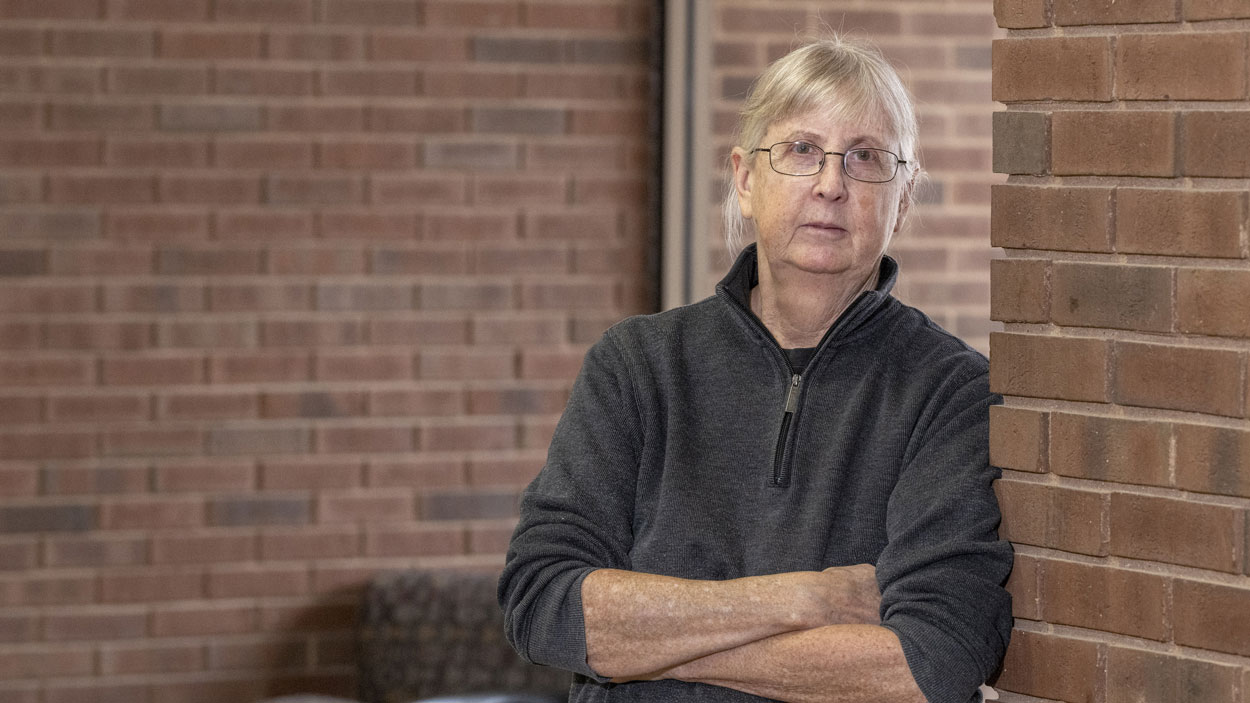
Sarah Boslaugh enrolled at UMSL more than two decades after earning her PhD so she could pursue a second bachelor’s in economics. She’s now working toward a master’s in philosophy after graduating last semester. (Photo by Derik Holtmann)
Throughout her life, Sarah Boslaugh has been driven by a deep desire to better understand the world around her.
She took her talent for numbers and statistics and earned a PhD in measurement and evaluation, then put those same skills to work exploring issues in medicine, public health and education as an analyst, writer and editor over the past three decades.
She’s authored or edited 13 books, including “Statistics in a Nutshell,” “Healthcare Systems Around the World: A Comparative Guide,” “Drug Resistance” and “The Encyclopedia of Epidemiology.”
In her free time, Boslaugh started reviewing films – especially documentaries and international films because she’s found they provide her a window into different cultures and traditions. She currently serves as the film editor at The Arts STL, a blog that covers music, film, comic books, books and live theater.
More recently, Boslaugh’s curiosity has taken her back to school at the University of Missouri–St. Louis. Last semester, nearly 30 years since she completed her doctorate, Boslaugh earned a second bachelor’s degree in economics, and she is now working toward a master’s degree in philosophy.
“I had come to a point in my career where I really didn’t need to keep on doing the same thing,” Boslaugh said. “Everything’s paid off. Nobody’s depending on me for anything. And so, I thought I’d pursue things that interested me.”
Boslaugh first graduated college with a bachelor’s degree in music. She also earned a Master of Public Health to help her in her career. But she had never studied economics and thought it could help broaden her perspective.
“I think economics, if you understand it, it tells you a lot about why things in the world happen the way they do,” she said. “It also tells you about a lot of assumptions that are made by people who are making the decisions. They assume that the world works in certain ways.”
Boslaugh said financial considerations helped lead her to UMSL. She was already living in St. Louis when she first enrolled as a part-time student seven or eight years ago, and because she already held a bachelor’s degree, her opportunities for financial aid were limited. UMSL’s affordable tuition made pursuing a new degree attainable.
She started slowly, taking one or two courses each semester.
“I was still working,” she said. “I was not a full-time student, but because I was not in a hurry to complete the degree, that was fine. It worked out fine for me.”
Her background in mathematics and statistics helped her as she began to grapple with the new material. She said she went into each class trying to learn as much as she could to maximize the experience.
Boslaugh also joined the Pierre Laclede Honors College, which enhanced her learning.
“Knowing that I’m a different cohort from the students here, I thought it would be a good way to get more acquainted with how college is taught these days and how the students are, because they’re different,” Boslaugh said. “They have different lives than I did at their age.
“It’s turned out great. I’ve had a lot of interesting courses. I like the fact that they’re smaller classes based more on discussion. I think everybody should have the opportunity to take those classes.”
During her time at UMSL, she has contributed to research, first with a GIS project led by former faculty member Elaina Johns-Wolfe that involved mapping crime locations in St. Louis and later lending her statistical expertise to UMSL’s Addiction Science, Practice, Implementation, Research and Education Lab, led by Associate Professor Rachel Winograd.
Boslaugh didn’t set out to pursue another master’s degree, but the more she studied economics, the more questions she had about the underlying thought behind it and what it says about the world people are trying to create.
“She explained to me that she came to philosophy because, in her other studies, she always wanted to ask practitioners why they do things a certain way or why they make certain assumptions – and that they never gave her a satisfactory answer,” said Professor Eric Wiland, who is serving as Boslaugh’s thesis advisor in the Department of Philosophy. “Philosophy is the place where ‘Why?’ questions are not only tolerated but welcomed.”
She is particularly interested in issues of inequality and what it means for the health of a society.
In the aftermath of World War II and throughout the 1950s, 60s and 70s, the United States made strides at reducing disparities in income and wealth as measured by the Gini coefficient, which plots cumulative income against the percentage of the population. But the gains in economic growth that have occurred since 1980 have not been evenly distributed, leading to increases in inequality.
“I think when inequality reaches a certain point, you have a different society than you started with,” she said.
Boslaugh is planning to use her thesis to explore the different conceptions of inequality used by people attempting to measure societal health and well-being.
“Sarah is a very confident student who was not intimated by beginning a graduate program in a field she was largely unfamiliar with,” Wiland said. “She pursues education not to fill her days, but to understand the world better and to argue for better ways to do things. She is also a wonderful writer, so as a professor, I enjoy reading her work on just about anything.”