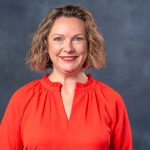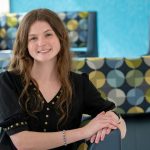
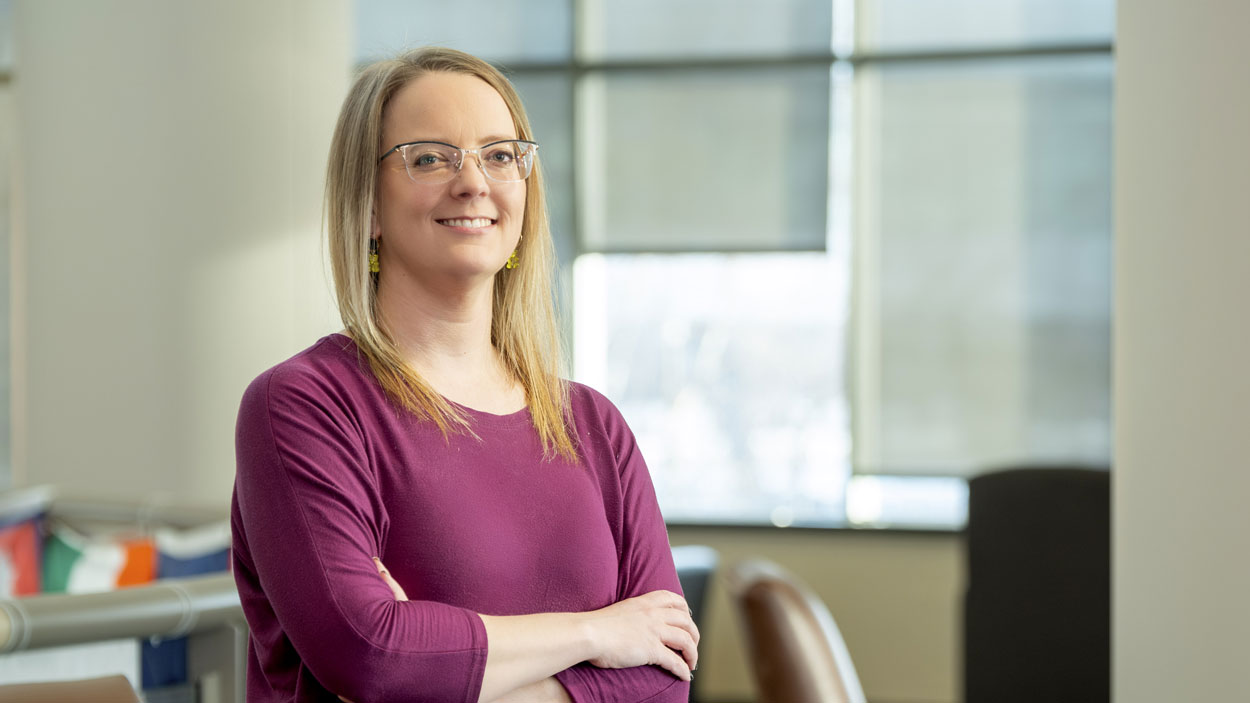
Elaina Rohlfing graduated with her master’s degree in computer science in December but is staying at UMSL after transitioning into the doctoral program. She’s researching solar flares using time series data in the lab of Assistant Professor Azim Ahmadzadeh. (Photo by Derik Holtmann)
Elaina Rohlfing can still picture the meeting early last fall with her fellow graduate students in the Department of Computer Science at the University of Missouri–St. Louis.
They were talking with some of the faculty members, and Rohlfing, who was on track to finish her master’s degree in December, off-handedly remarked that she was in her last semester at UMSL.
She remembers Professor and Chair Cezary Janikow hearing her and responding simply, “We’ll see.”
“I don’t know if he really did,” Rohlfing said, “but I swear that’s what I heard.”
It turns out Rohlfing did have more time remaining at a university and in a department that has become like home for her over the past five years. After earning her bachelor’s degree in computer science from UMSL in May 2024 and as she was finishing work on her master’s last fall, she made the decision she would stick around to begin working toward a PhD this semester.
Rohlfing received encouragement from several faculty members, including Assistant Professor Azim Ahmadzadeh, who offered her the opportunity to continue working as a graduate research assistant, using machine learning to study solar flares and contribute to his lab’s efforts to improve space weather forecasting, as she pursues her doctoral studies.
“One of the greatest challenges in running a research lab – second only to securing funding – is recruiting committed and talented students,” Ahmadzadeh said. “Elaina had already demonstrated exceptional ability as a master’s student in my lab, developing a strong foundation in the interdisciplinary research I lead. Given her growth and dedication, offering her a PhD position was an easy decision, and I was quite happy when she accepted.”
An indirect path
The idea of signing up for at least three more years of schooling would have been something Rohlfing found difficult to believe in 2021 when she started working toward her bachelor’s in computer science.
Her first foray into higher education actually came 14 years earlier after graduating from Collinsville High School in Illinois. She enrolled at Southwestern Illinois College, unsure what she wanted her academic path to be.
“Even throughout going to SWIC, everything, every class, that I took was the most interesting thing, and that’s what I wanted to do,” Rohlfing said.
At the same time, she found it difficult to stick with school for very long.
“It was really hard to go consistently for more than four semesters,” she said.
She took about five years to finish her associate degree. She then enrolled at UMSL with plans to pursue a bachelor’s in accounting before deciding it didn’t fit with her interests.
Unsure what to do instead, Rohlfing took another break from school, working a series of retail jobs over several years and didn’t give much thought to returning to the classroom. That changed sometime in 2020 amid the COVID-19 pandemic.
“I was kind of spinning my wheels in retail at that point,” Rohlfing said. “It was very fun but very monotonous and repetitive and boring.”
She started thinking about other academic avenues and landed on computer science.
“I played around with coding a little bit in high school and things like that, and then at some point, when I was trying to figure out what to do if I went back to school, I knew I couldn’t just go back for anything,” she said. “It had to be something I could make money in and something that was going to hold my interest. Computer science seemed very exciting because of the lifelong learning aspect. It’s a dynamic field. You have to keep up with technology.”
Rohlfing said she also read the statistics showing women were underrepresented in the field and took them as a personal challenge.
Making connections
After joining the Department of Computer Science in 2021, Rohlfing quickly found a group of other female students with similar ambitions, and they became a source of friendship and support as she pursued her studies.
She made it a point to hang around the department offices and computer lab before and after classes, which not only helped her form relationships with her peers but build connections with faculty members. That made it easier for her to seek out help when she needed it.
“I lived in the computer lab, so the faculty would see me all the time,” said Rohlfing, who formed a particularly strong bond with Associate Professor Sharlee Climer.
One of the things that drew Rohlfing to computer science was that it could be used in other disciplines, and Climer provided an example of how. Her research focuses on developing combinatorial methods for biological applications. She looks for patterns in genetic data because the patterns can be associated with complex traits of interest, including diseases such as Alzheimer’s.
Rohlfing remembers reaching out and meeting with Climer before she ever took one of her courses.
“I wanted to talk to her and ask, ‘How does research work? What can you tell me?’” Rohlfing said.
At the time, Rohlfing wasn’t even certain she wanted to pursue research. It seemed more likely she would finish her bachelor’s degree as quickly as possible and hit the job market. But from that first conversation, Climer planted the seed for pursuing a master’s degree.
Rohlfing would go on to take two of Climer’s courses: “CS 4280: Program Translation Project” and “CS 5130: Advanced Data Structures and Algorithms.” Climer said the former requires the students to complete a semester-long coding project in which they build an entire compiler.
“Elaina expertly mastered both courses and was at the top of the class,” Climer said. “She went on to be an exceptional Supplemental Instructor for 4280 the following year – definitely the best that I’ve ever had – with organized study sessions in which she expertly guided students and clearly articulated the complexities of the course materials.”
Rohlfing remains grateful for the chance to work in that role and other opportunities that Climer helped facilitate.
“She was constantly recommending me for things,” Rohlfing said. “I thought, ‘Oh my god, why does she think I can do this?’ She just had so much belief in me. She was the main motivator that got me into the master’s, and it just snowballed. It just keeps snowballing.”
Deeper learning
Rohlfing joined Climer’s lab as a graduate research assistant when she started the accelerated master’s program in the fall of 2024.
Climer noted that individuals participating in studies of human diseases are commonly classified by race. But that approach can be too simplistic because a single human genome is comprised of a multitude of genetic patterns with varying frequencies across global populations. Rohlfing was tasked with systematically mapping genetic patterns that appear in one or more global human populations. She worked with large amounts of data, cleaning and analyzing it using network modeling methods developed by Climer.
“A major challenge was removing duplicate patterns as memory was quickly exhausted,” Climer said. “But she persisted through the struggle and produced a high-quality library of these patterns, along with a draft manuscript describing her work.”
Rohlfing enjoyed the challenge, but she did not fall in love with genetics.
Climer encouraged her to stay open to other opportunities that might present themselves. Then, last year, she attended a colloquium Ahmadzadeh organized where he discussed his research into solar flares, including using computer vision to extract data about when they occur.
Rohlfing was intrigued learning about the work. She’d enjoyed the astronomy classes she took while pursuing her associate degree and thought it would be more closely aligned with her personal interests in ecology or earth sciences. So, she accepted an invitation to join Ahmadzadeh’s lab.
Over the past year, she’s been examining time series data related to solar flares and published two peer-reviewed workshop papers at the 2025 IEEE International Conference on Data Mining – one as the lead author and the other as a co-author – and presented her findings in November at a conference in Washington, D.C.
Rohlfing will be building on that work as a doctoral student, using recent advances in machine learning for time series analysis that has the potential to aid in space weather preparedness.
It’s a place Rohlfing never expected to be, but it also feels like where she belongs.
“I just really like learning,” she said. “I like taking the classes. I like doing the projects, and I guess that’s why I ended up where I am right now. I enjoy the process.”