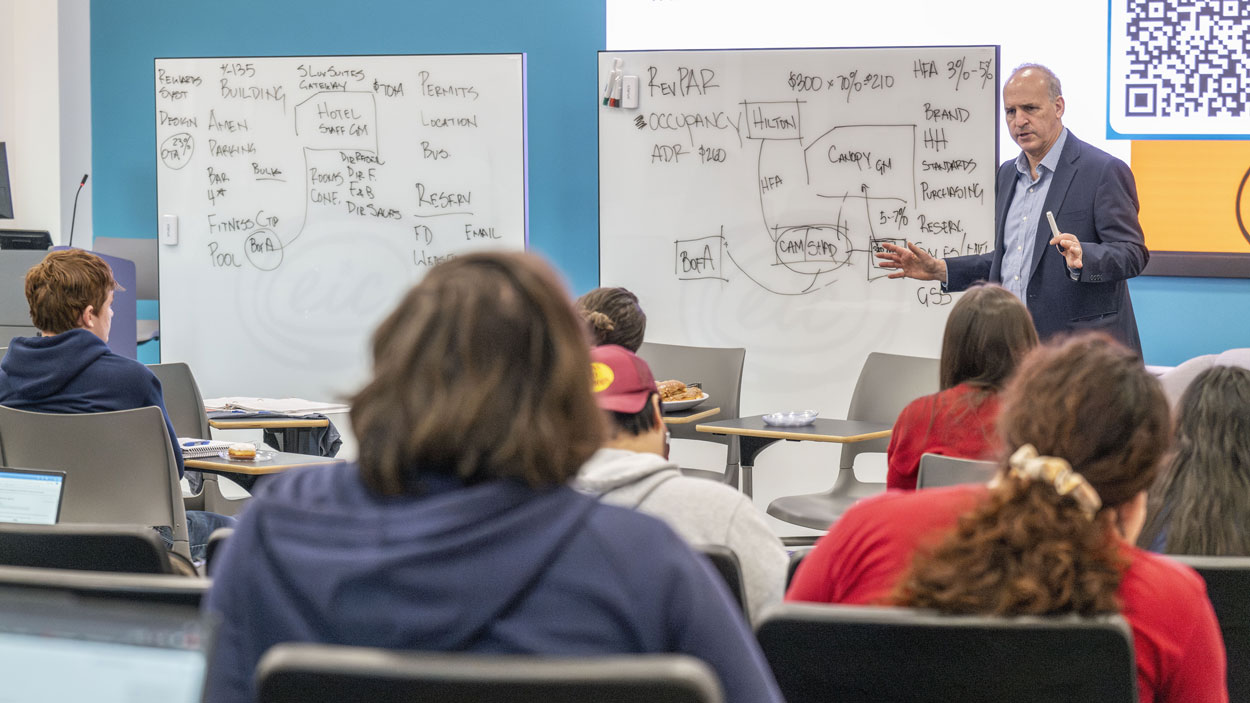
American University faculty member Steven Shapiro leads UMSL entrepreneurship students through an exercise designed to help them explore the hotel industry last Tuesday in the UMSL Innovation Center. Shapiro serves as the director of the Hospitality and Tourism Law Program at American University Washington College of Law. (Photos by Derik Holtmann)
When Assistant Teaching Professor Scott Morris’ students walked into the University of Missouri–St. Louis Innovation Center on Tuesday morning, they found a spread of food befitting any hotel breakfast bar, with trays of donuts and pastries along with coffee and hot tea laid out on the counter near the entrance to the auditorium.
Whether intentional or not, it helped set the mood for the morning’s class in “Entrepreneurship 3100” – a required course for all students in the Ed G. Smith College of Business that covers applications of entrepreneurship.
Visiting that day from Washington, D.C., was Steven Shapiro, an adjunct professor and director of the Hospitality and Tourism Law Program at American University Washington College of Law. Over the course of more than an hour, he led the UMSL students through a look at the hospitality industry, and more specifically some of the decisions required when owning or operating a hotel.
“Fundamentally, most of us don’t understand nor should we know the economic structure of a hotel,” Shapiro said. “Most of them today are franchising, but we walk into the Marriott thinking, ‘Marriott owns this.’ The core of the exercise is to show students the different possibilities for owning a hotel.”
Shapiro was joined by his former law student and St. Louis-based marketing professional Cameron Smith as he took students through some of the questions that every owner must consider, beginning with where they want their property to be. For the purposes of Tuesday’s discussion, they decided to convert an apartment building in downtown St. Louis.
Students then had to give it a name, design a brand and decide if it was going to be a luxury hotel, cater to business clients or offer extended stay. They discussed how they would advertise, what they would need to take reservations and whether they would offer a loyalty program, and Shapiro taught them about industry terms such as RevRAR – revenue per available room – and ADR – average daily rate.
Shapiro later walked them through different ownership structures – independent, owner-operated franchises and franchises operated by third-party managers – and some of the pros and cons for each, as well as the different types of legal agreements underlying them.
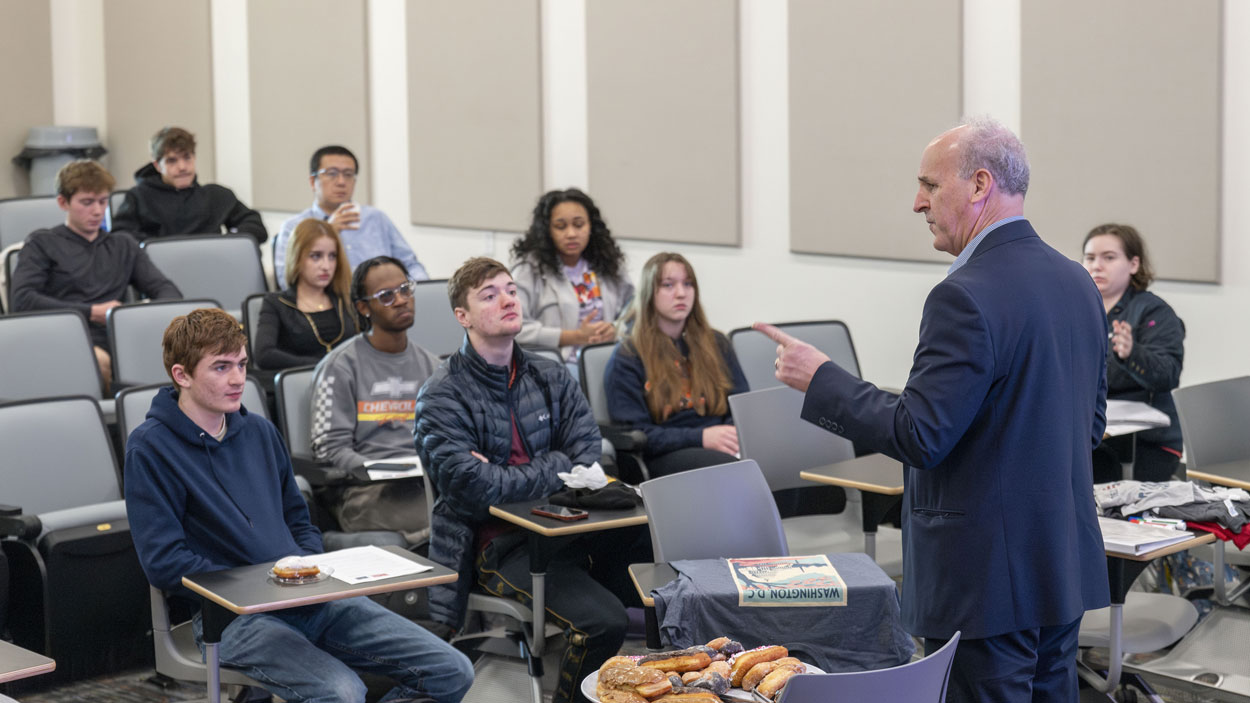
Steven Shapiro talks to students about some of the career opportunities that exist in the hotel industry, whether they want to own or operate a hotel franchise or work in the corporate office at one of the world’s leading hotel chains.
“It’s a great way to start thinking about the industry, and then to highlight where the careers are,” said Shapiro, who has led similar exercises for law students at American University and hospitality management students he’s taught as an instructor in Paris.
Career opportunities in hotels don’t end at the front desk. There are numerous jobs to be filled, whether a student is interested in operating a franchise or working in accounting, finance, marketing, supply chain management or some other area at the corporate office of one of the world’s leading hotel chains.
“My suspicion is that hospitality is not an area that UMSL students are necessarily thinking of, but it’s a great industry,” said Morris, who also serves as the director of UMSL’s Entrepreneurship and Innovation Center. “It’s a phenomenal industry. There are always jobs available. So, this is exposing them to something that they wouldn’t otherwise get exposed to. It just broadens their mind and enriches their experience.”
Makayla Morones, a junior studying finance, counted herself among the students who hadn’t previously given much thought to the hotel industry. But she appreciated the chance to view it in comparison to what her father went through to open and operate his Mexican restaurant.
“It was interesting to learn about the process of becoming a franchise versus my understanding of just owning a business in general,” she said.
Madelyn Pecka, a junior majoring in entrepreneurship, found herself looking at the industry differently because of Shapiro’s presentation.
“I’ve always worked in the hospitality industry, but this was a really cool opportunity to see it from a different side, instead of from customer to staff,” Pecka said. “It was interesting. There were things that I wouldn’t have thought, that I wouldn’t have even considered, just because it’s not my area of expertise. Now it’s something that has sparked my interest, so I might look into it further.”
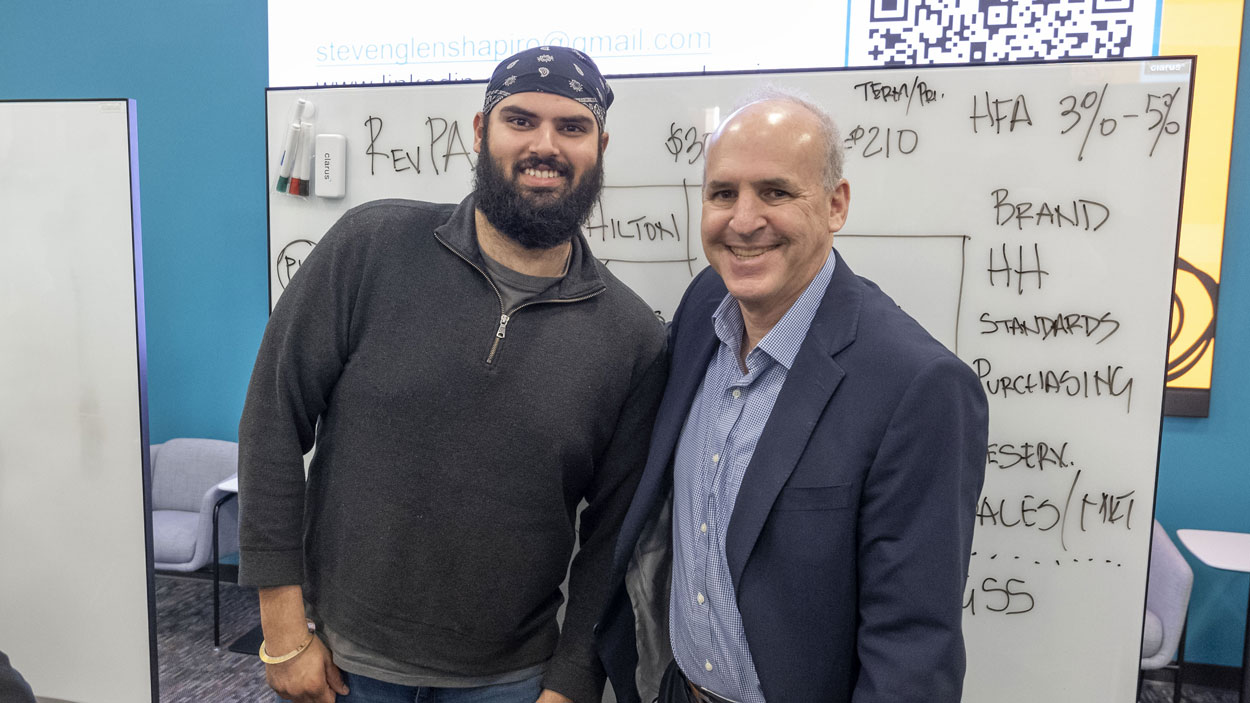
American University faculty member Steven Shapiro helped open UMSL junior finance major D.J. Pujjji’s eyes to opportunities in the hotel industry he hadn’t considered before, and Pujji took advantage of the opportunity to network with Shapiro after Tuesday’s class.
Junior finance major D.J. Pujji was engaged throughout the class discussion and stuck around to continue the conversation with Shapiro afterward.
“Things like this are actually what make me value my education here at UMSL,” he said. “We have speakers that come in from Washington, D.C. and open our eyes up to industries that students like me might be closed off to initially, and I think that’s very valuable.”
Tuesday’s exercise also served to demonstrate the importance of making connections – a valuable lesson for students studying entrepreneurship or any other emphasis area.
Shapiro found his way to campus because of his connection to Cameron Smith and his father, Ed G. Smith, an UMSL alum and founder of American Direct Marketing Resources for whom the College of Business is named. Shapiro had reached out to Ed because he was going to be in St. Louis, and Ed in turn connected him with Dean Shu Schiller. She then asked faculty members in the College of Business if any of them had a club event or class in which Shapiro could speak.
For Morris, it was an easy choice, particularly given how neatly Shapiro’s area of expertise connects to entrepreneurship.
“We’re always networking,” Morris said. “We’re always looking for new connections, new opportunities. You just never know how it might cross your path later.”