

Ecologist Kirk Winemiller, who recently retired as a University Distinguished Professor at Texas A&M University, delivers the annual Margalef Seminar in Ecology last Wednesday afternoon at Benton Hall. (Photos by Derik Holtmann)
Longtime University of Missouri–St. Louis Professor Robert Ricklefs and his wife, Susanne Renner, created the Department of Biology’s annual Margalef Endowed Seminar in Ecology to honor the legacy of Ramon Margalef, considered one of the founding fathers of modern ecology.
They established the endowment in 2015, the same year Ricklefs, now retired, was named the recipient of the prestigious Ramon Margalef Prize in Ecology from the Generalitat of Catalonia in Spain for his own outstanding contributions to the field.
The annual lecture has brought leading researchers from across the country to UMSL over the past decade to engage with students and the wider scientific community and share their ideas about some of the biggest questions being explored in ecological research.
This year’s seminar featured Kirk Winemiller, who recently retired as a University Distinguished Professor and Regents Professor at Texas A&M University. He has received international recognition for his research on fisheries and aquatic ecology, which emphasizes life history theory, community ecology and food web ecology.
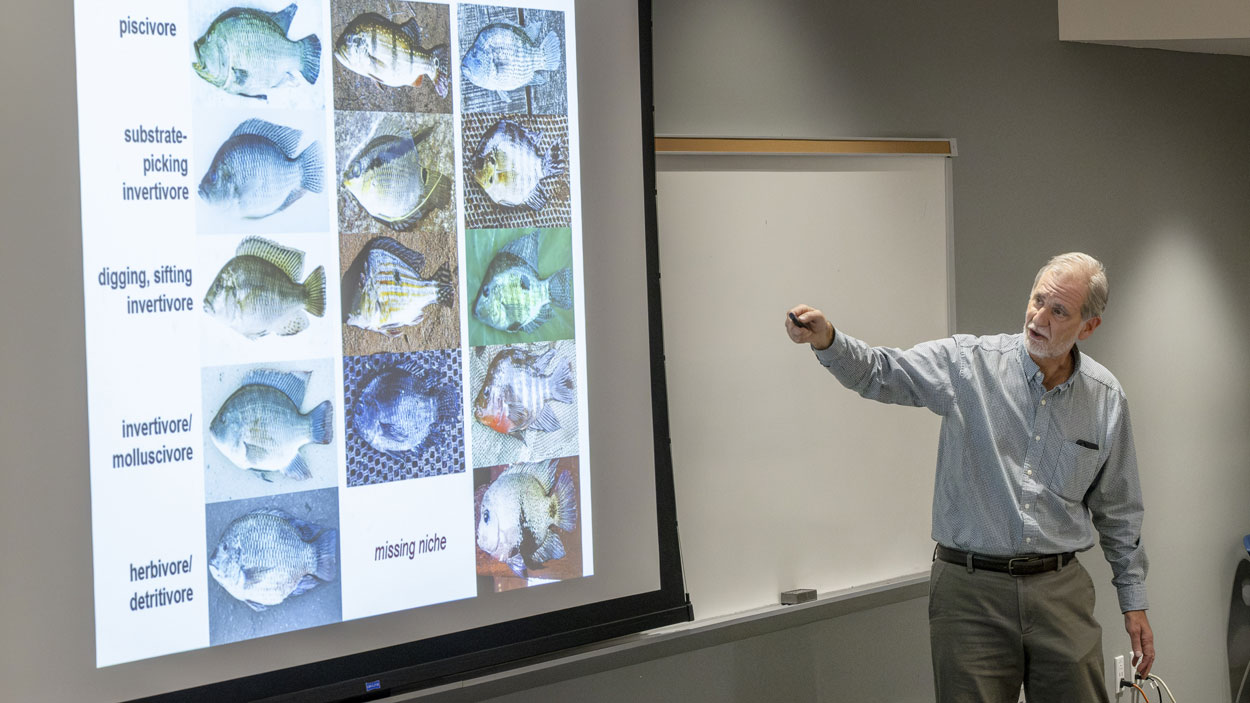
Ecologist Kirk Winemiller discusses fish with different lineages that have developed similar traits and come to occupy similar niches in their home environments.
“Kirk Winemiller is a world-class ecologist whose work has had a major impact on our understanding of ecological patterns and processes, particularly in freshwater ecosystems,” said Michi Tobler, the E. Desmond Lee Endowed Professor in Zoological Studies at UMSL. “Over the course of his career, he has developed influential ideas about life-history strategies, food webs and community structure that resonate across many areas of ecology. He was an especially fitting choice for the Margalef Lecture because his research addresses fundamental questions that cut across disciplinary boundaries. Our department brings together a wide range of ecological perspectives, and Dr. Winemiller’s work speaks to many of these themes.”
Tobler is one of the legions of scientists who trained under Winemiller. He spent two years as a postdoctoral research fellow in the Department of Wildlife and Fisheries Sciences and the Department of Biology at Texas A&M University, and he thought UMSL students would benefit from Winemiller’s expertise.
More than three dozen students turned out along with current and retired faculty members and scientists at other institutions in the St. Louis region to listen to Winemiller’s lecture last Wednesday afternoon inside Benton Hall.
Over the course of an hour-long talk, Winemiller discussed the development of a “Periodic Table of Niches,” highlighting research he published in 2015 in Ecology Letters and co-authored by late evolutionary ecologist Eric Pianka, building on an idea that originated with Canadian-born ecologist Robert MacArthur.
The idea of a periodic table of niches would organize species based on their functional traits and environmental adaptations. It would act as a framework and multidimensional map, similar to the periodic table of elements created by Russian chemist Dmitri Mendeleev in the 19th century.
Underlying a periodic table of niches is the concept of convergent evolution, in which organisms develop similar features in species of different lineages, suggesting they emerge from similar environmental pressures rather than shared ancestry.
“I would argue convergence is all around us, everywhere, if you just look for it,” said Winemiller, who shared several side-by-side examples of unrelated snakes or fish displaying similar traits. “Here’s an example of the emerald tree boa on your right, the green tree python from the neotropics on your left. Unrelated lineages, green constrictors, both arboreal, both have relatively more cryptic juvenile coloration phases.”

An audience of UMSL students, current and former faculty members and other scientists from around the St. Louis region listen as Kirk Winemiller delivers the 2026 Margalef Seminar in Ecology in Benton Hall.
Winemiller noted that niches are more complicated to try to quantify than atomic weights as in the period table of elements. He suggested classifying niches based on five dimensions: habitat, life history, trophic, defense and metabolic.
One goal in creating such a table would be to organize species in a way that could predict different ecological responses, such as the success of an invasive species or how well a population might persist within different environments.
“We’re talking about selection that yields the same solution over and over again,” Winemiller said. “In nature, it doesn’t matter if you’re talking about plant, insect or fish. These theories are predicting general patterns.”
It’s an ambitious idea. To ever assemble a true periodic table of niches would require gathering and analyzing massive amounts of data on each of the dimensions, but Winemiller had brains churning in the audience as attendees thought through the possibilities.
“I hope students were inspired by the scope and ambition of Dr. Winemiller’s work,” Tobler said. “His career illustrates how much can be accomplished through sustained curiosity, careful observation and long-term engagement with ecological questions.”
Tobler believes Winemiller’s work also testifies to the importance of going out into the field and observing organisms in their natural environments.
“Field research can be slow and painstaking, but it remains essential for understanding how species interact with each other and with their ecosystems,” he said. “That perspective, valuing careful natural history alongside modern analytical tools, is something I hope resonated with many of the students in attendance.”