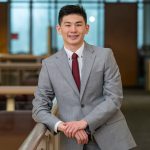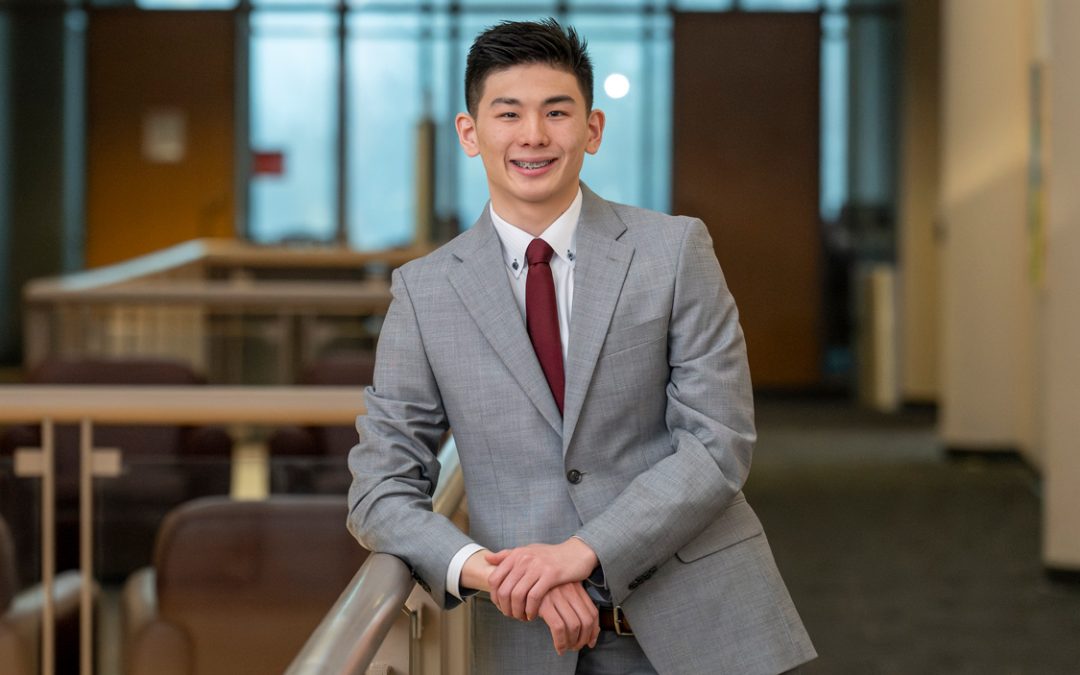
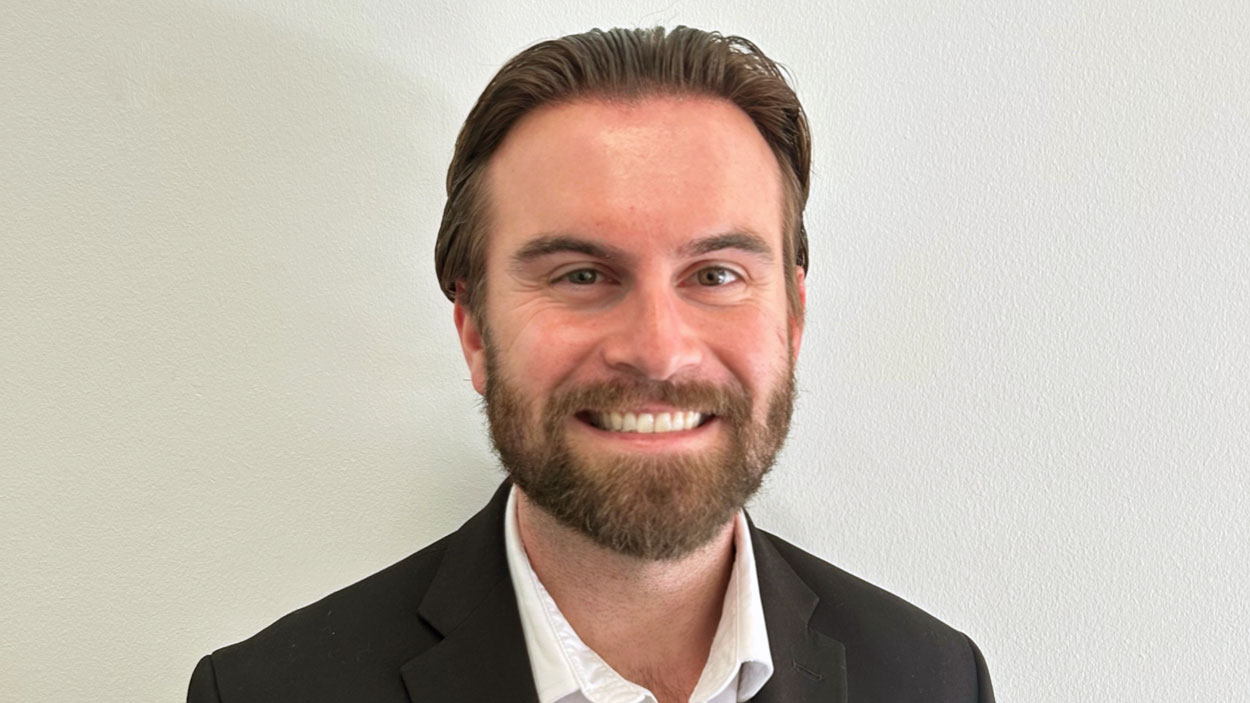
John Luder, a fourth-year student in UMSL’s College of Optometry, was recently named the latest recipient of the Dr. Frank D. Fontana Memorial Scholarship from VSP Global and the Heart of America Eye Care Congress. (Photo courtesy of John Luder)
When Dr. Frank Fontana passed away in 2018, the renowned St. Louis-based optometrist and pioneer in contact lens fitting left behind an enduring legacy in patient care, advocacy and innovation. And Fontana, who was recently inducted into the new Missouri Optometry Hall of Fame, continues to inspire new generations of optometrists.
John Luder, a fourth-year student in the College of Optometry at the University of Missouri–St. Louis, was recently named the latest recipient of the Dr. Frank D. Fontana Memorial Scholarship from VSP Global and the Heart of America Eye Care Congress. In his winning essay, Luder reflected on how Fontana’s legacy guides his own approach to patient care, from clinical decision-making to innovation and technology to sharing knowledge with future optometrists and developing the profession as a whole.
“Dr. Fontana inspires me to continue to research and learn new clinical methods to not only improve the vision and quality of life of my future patients but also pave the way for the next generation,” Luder wrote. “I plan to build my career, incorporating the values and clinical expertise optometrists like Dr. Fontana have displayed for decades, and I plan to give back through community outreach and advocacy for this profession.”
Luder was selected for exemplifying excellence in four qualities Fontana embodied: outstanding clinical performance, empathetic patient care, embracing modern technologies and active involvement in the optometric community. He received a $4,250 scholarship and a $750 travel grant to attend the Heart of America Eye Care Congress’ annual conference in Kansas City.
Luder originally started studying engineering in college but pivoted to the medical field after realizing he didn’t excel at math. He started shadowing his friends’ parents, who own their own optometry practice, and hasn’t looked back. As a Kansas City native, UMSL’s College of Optometry was an easy decision for Luder, who hoped to stay close to home. In the college, he’s found a supportive environment designed to help students thrive.
“Everybody’s very nice and helpful,” he said. “The beauty of this profession and the school is that everybody is trying to build each other up. It’s not a competitive school; it’s not like law school or medical school. Everybody wants everybody to succeed, and we’re all at the same end goal of becoming a great doctor and practitioner. The teachers are great. The facilities are great. They’re always trying to give back to us as much as they can. I’ve really enjoyed my time here.”
Luder is currently completing his final rotation at the Kansas City VA Medical Center. It has been his favorite so far as it’s both educational and challenging. He’s in lecture with his preceptors and other staff doctors eight hours a week and is always learning something new.
“It’s not that I didn’t learn anything in my other rotations, but we’re really getting into research studies and how to incorporate research-based medicine into practice,” Luder said. “I’ve gotten to see a lot of diseases with the eyes. It’s a little bit different than learning in classes or from a book. When you actually dive deeper and learn how to read these research trials – not just read the abstract – you can see why we treat the way we do. Glaucoma, for instance, is such a difficult disease to understand. Reading those research studies to try to understand why we do what we do is very helpful and very important to how we practice.”
After he graduates this spring, Luder plans to join his mentors at Leawood Family Eye Care, a private practice in Leawood, Kansas. After initially shadowing at the practice, he started working as a tech after his freshman year of college and continued to work there every summer. He’s excited to continue to learn under his longtime mentors and to figure out a possible specialty. For now, though, he’s just happy to get to work as an optometrist.
“It’s great work because you’re helping people,” Luder said. “Most people don’t hate going to the eye doctor. People generally want to be there. We get some of the most time of patient interactions as any other medical profession. I enjoy helping people getting the best vision that they can achieve, and I enjoy talking with people. There’s never a boring moment in the day. It’s always something different, so I really enjoy the challenge of it, too.”