
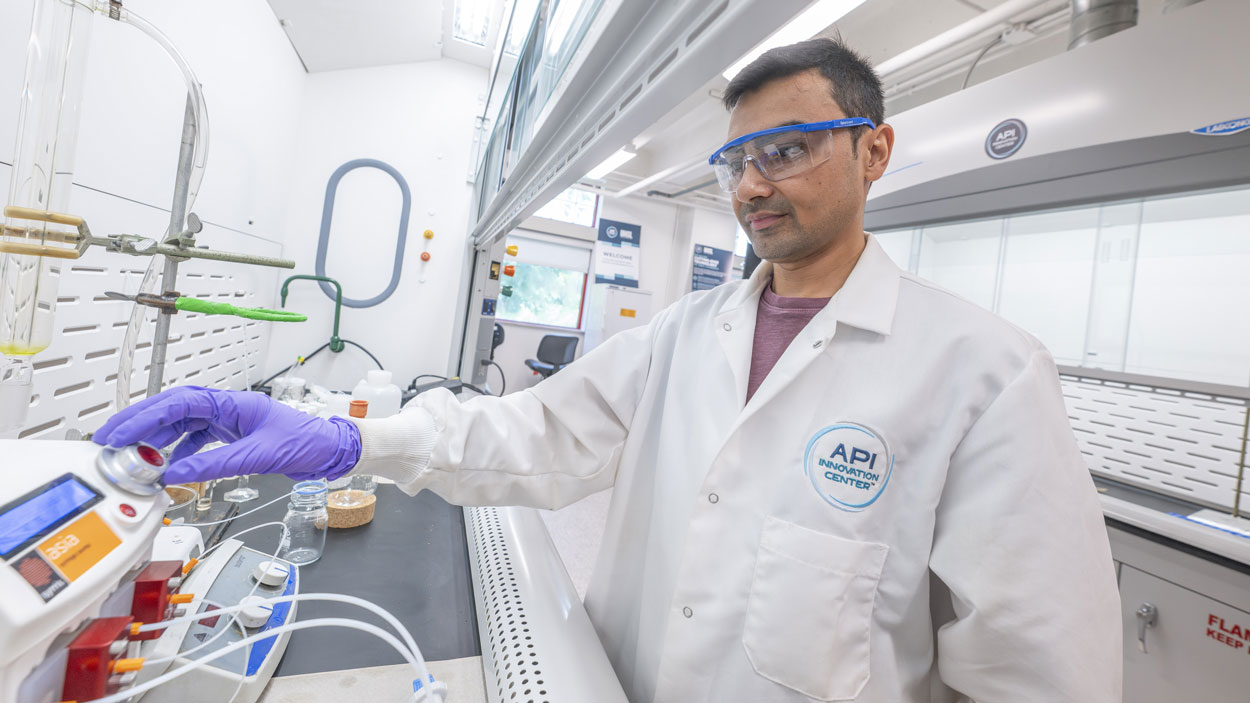
Chemist Saroj Kafle works in the API Innovation Center’s research and development lab in the UMSL Science Complex. (Photo by Derik Holtmann)
The University of Missouri–St. Louis, in partnership with the API Innovation Center, has received more than $1 million in federal funding to support the launch and advancement of the API Advanced Manufacturing Innovation Hub on UMSL’s campus.
The initiative is designed to strengthen domestic production of active pharmaceutical ingredients – APIs – and finished drug products – FDPs – through cutting-edge continuous flow and other innovative advanced manufacturing technologies.
Congressman Wesley Bell led the effort in Washington, D.C., to secure the funding through the FY26 Commerce, Justice, Science Appropriations Act under the National Institute of Standards and Technology Scientific and Technical Research and Services account within the U.S. Department of Commerce.
“I’m proud to have secured federal funding for the University of Missouri–St. Louis for the launch of the API Advanced Manufacturing Innovation Hub,” Rep. Wesley Bell said. “These funds will promote safe pharmaceutical practices and advancements in public health, and I will continue to fight in Congress to uplift future generations of leaders through investments in higher education.”
The initiative will improve public health while also strengthening workforce development.
“We are deeply grateful to Congressman Wesley Bell for championing this critical investment in the University of Missouri–St. Louis, APIIC and the wider region,” UMSL Chancellor Kristin Sobolik said. “His leadership and commitment to strengthening domestic pharmaceutical manufacturing will help ensure that essential medicines are produced safely and reliably here in the United States. This funding empowers UMSL and our partners to advance innovative manufacturing technologies, protect public health and build a highly skilled workforce for the future.”
Strengthening the nation’s pharmaceutical supply chain
The COVID-19 pandemic highlighted serious vulnerabilities in the supply chain for pharmaceuticals in the United States. There has been a heavy reliance on overseas manufacturing to produce essential medicines with the majority of APIs currently produced in China and India due to lower manufacturing costs, government subsidies and fewer regulatory constraints. That creates risk around national security and public health because supply chain disruptions can lead to shortages of essential medications.
The API Advanced Manufacturing Innovation Hub will help address these risks by advancing innovative, scalable manufacturing methods that reduce costs, increase efficiency and enhance supply chain resilience. The continuous flow manufacturing technologies supported by this funding can reduce production costs by an estimated 30–50% compared to traditional batch methods, and they can improve quality control and regulatory compliance.
UMSL and APIIC are specifically working to reshore production of five essential generic APIs:
- Propofol (sedation and anesthesia)
- Bupivacaine (local anesthetic)
- Albuterol (asthma and COPD treatment)
- Metoprolol (cardiovascular treatment)
- Lorazepam (anxiety and seizure disorders)
These widely used medications are critical in acute and chronic care settings and have experienced supply chain pressures in recent years. Industry collaborators, including Missouri-based Sentio BioSciences and Par Health, are partnering to strengthen domestic production capacity and ensure reliable access to the treatments.
Investment in research and infrastructure
The $1,031,000 in federal funding will help support upgrades to advanced analytical instrumentation essential for API research and process validation. It will also aid in acquisition and integration of continuous flow reactors and associated synthesis equipment, and it will enhance research and development activities focused on efficient and scalable manufacturing processes.
These investments align with NIST’s mission to enhance U.S. leadership in scientific and technical research while adhering to the highest standards of quality, safety and regulatory compliance.
UMSL and APIIC are uniquely positioned to lead this initiative. APIIC was established in 2021 with a mission to drive national health security and economic growth through U.S.-based production of medicines so that every patient, health care system and pharmacy retailer has access to critical medicines. The nonprofit sought to partner with UMSL, drawing on the university’s expertise in chemical synthesis and continuous flow chemistry. In 2025, it opened a state-of-the-art research and development lab inside UMSL’s Science Complex.
Chris Spilling, UMSL’s vice chancellor for research and economic and community development as well as a professor of chemistry, is helping lead the creation of the API Advanced Manufacturing Innovation Hub, which will further position Missouri as a leader in pharmaceutical manufacturing and innovation. It will provide a scalable model for reshoring U.S. pharmaceutical production, strengthening public health preparedness while driving economic growth in the St. Louis region. By integrating university research, industry collaboration and advanced manufacturing technologies, the initiative will help secure a safer, more resilient domestic drug supply.
“We are grateful to Congressman Bell for his leadership and support of this important investment,” said Tony Sardella, founder and chair of APIIC. “Through our collaboration with UMSL we are strengthening innovative and advanced API manufacturing in Missouri. Partnerships like this demonstrate how public and private partnerships can work together to build a more resilient and secure U.S. generic drug supply chain.”