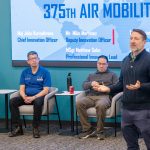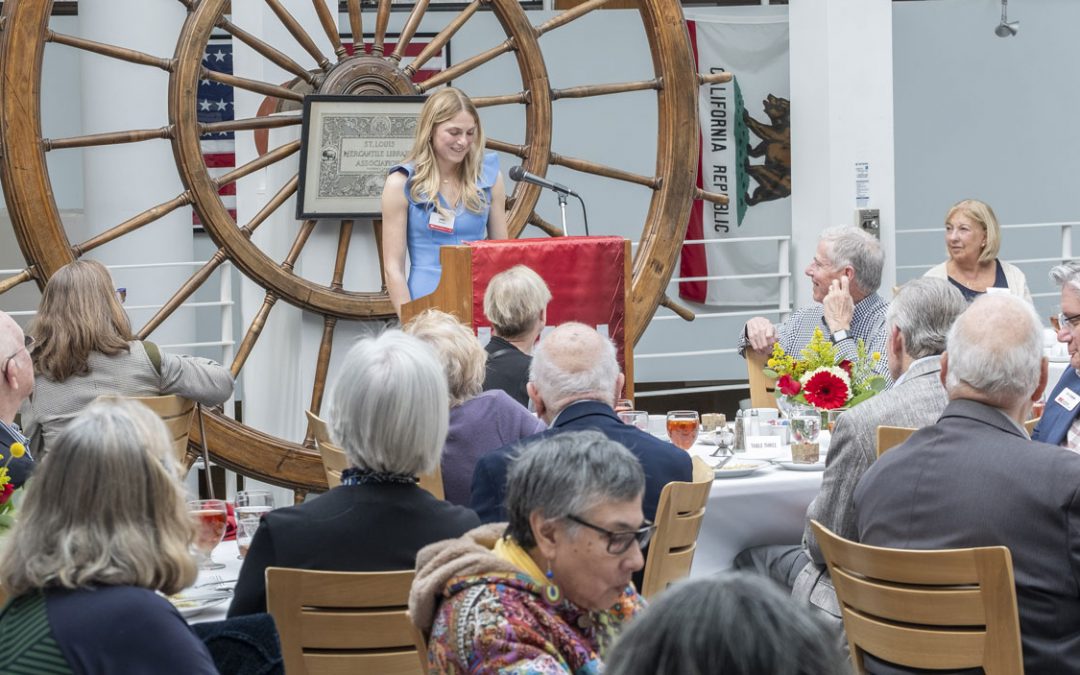
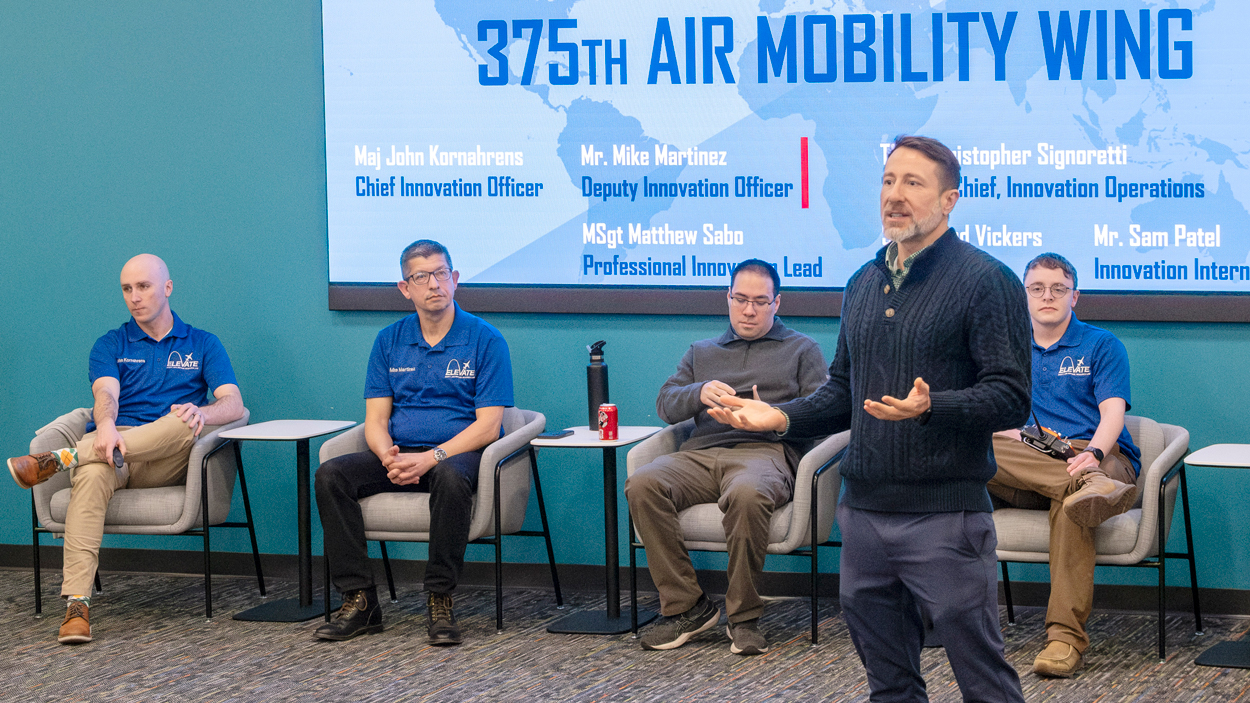
Mike Seper, UMSL’s director of Intellectual Property Commercialization and Innovation, introduces members of Elevate, the 375th Air Mobility Wing innovation team from Scott Air Force Base, during a lunch-and-learn event at the Innovation Center on March 17. (Photo by Derik Holtmann)
Members of Elevate, the 375th Air Mobility Wing’s Innovation Office at Scott Air Force Base, came to the University of Missouri–St. Louis full of curiosity as they participated in a lunch-and-learn event showcasing robotics on March 17 at the UMSL Innovation Center.
This was the second campus-wide UMSL Innovation event, organized by Mike Seper, UMSL’s director of Innovation and Intellectual Property Commercialization, which provided one of the first opportunities for collaboration with Scott AFB’s innovation hub.
“I was looking for pathways that we could engage with the Elevate team, and this seemed like a great fit to get engineering students and people across the campus engaged,” Seper said. “It’s a really cool opportunity to have more of a hands-on experience to see innovation in action and to be able to see some cutting-edge technology we have here on campus.”
The team of Major John Kornahrens, Elevate’s chief of innovation, along with Deputy Innovation Officer Mike Martinez, Technical Sergeant Christopher Signoretti and Staff Sergeant Brad Vickers arrived eager to display some of what they’ve been working on while also learning about UMSL’s new School of Engineering, which welcomed its first class in the fall semester.
“This is the kind of collaboration we’re always looking for,” Kornahrens said, “not only to bolster whatever innovations we’re already doing, but to look to industry or academia to see, ‘Hey, what are they doing, and how can we either better facilitate our projects or tackle something new?’”
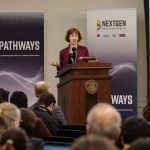
With an audience of UMSL students and other interested observers looking on, Professor Xin Wang, UMSL’s program coordinator for electrical engineering, showed off UMSL’s robotic dog while discussing the engineering school’s goal of becoming a national leader in the education and research of AI and robotics.
“It really brought me some joy to hear him talk about that,” Kornahrens said. “That’s why we’re here, is to understand, ‘What is academia doing? What are the professors doing? Are we behind on certain aspects?’ We’re always looking to other people. And so, what he talked about with UGVs (unmanned ground vehicles), UAVs (unmanned aerial vehicles), the robot dog – there’s almost endless possibilities as far as use cases, examples, different problem sets we can tackle.”
UMSL faculty members are just as excited to work with the team from Elevate.
“It’s a great match, and there are definitely a lot of collaboration opportunities,” Wang said. “It’s very exciting to think about the potential projects that we can work on together involving a lot of new technologies, such as AI and robotics.”
George Nnanna, founding director of UMSL’s School of Engineering, stressed what this partnership will mean for the students with events such as Tuesday’s, which provide them with concrete examples of how they can apply the concepts they are learning at UMSL.
“I do see the team from Air Mobility Command supporting our key goal of experiential learning and providing projects to our students that not only give them the opportunity to connect math and science and engineering, but also, you’re creating a product and you’re testing it to see that it functions,” said Nnanna, who is hopeful that Elevate will be able to participate in UMSL’s engineering summer camps in June. “Even though this may not be an internship per se, working on a real-world project is really another form of internship opportunity, and having the guidance from industry as well as from a faculty member, it’s an exciting opportunity for us, and we hope that it will dovetail into several other areas.”
The partnership comes at a formative time for the School of Engineering as well as Elevate, so there is eagerness on both sides to explore different ideas.
“I think the fact that we, as an innovation shop, aren’t set in our ways, and we’re able to have the flexibility, having a partner that has the same flexibility basically doubles those efforts,” Kornahrens said. “We’re not going to have to fit our model into whatever anyone else was doing because we don’t have a predetermined charter for what we’re doing with innovation. And the engineering school being so new doesn’t have a predetermined path, so that adds infinitely more possibilities.”