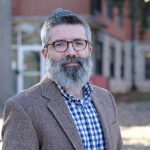
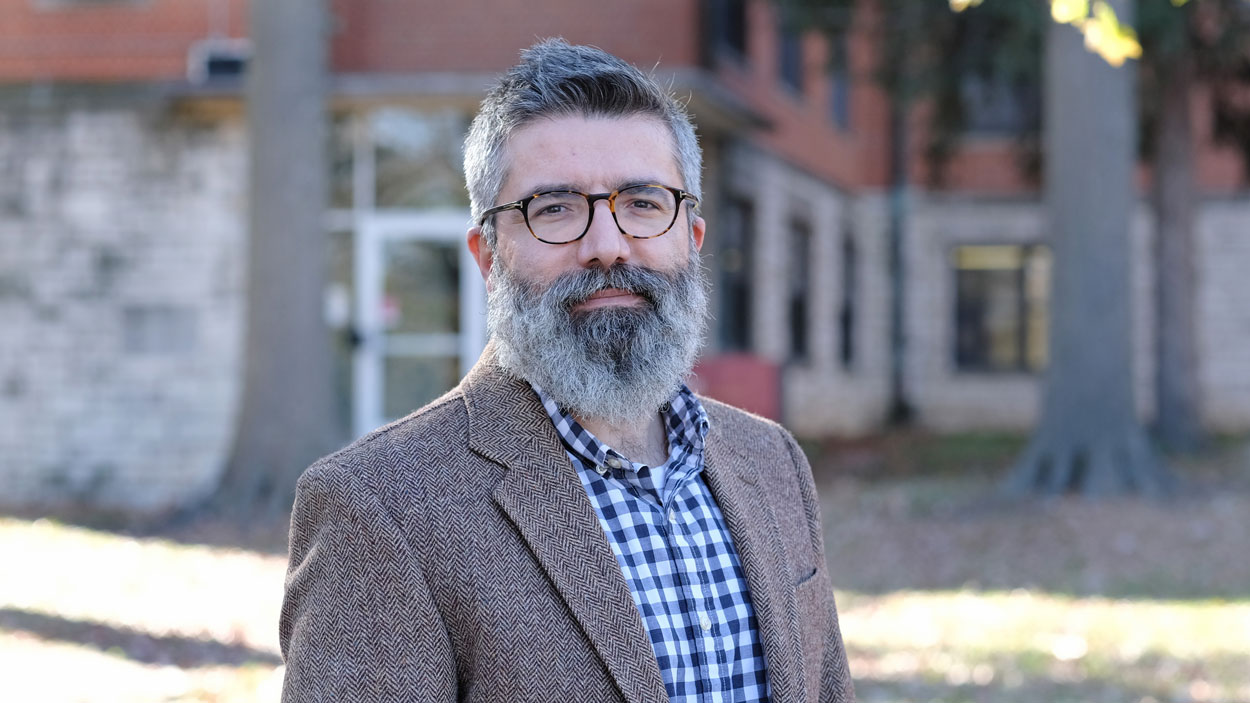
Umit Tokac is an associate professor of data science in UMSL’s College of Nursing. He was recently appointed to a third term as a DATA scholar with the National Institutes of Health Office of Data Science Strategy. (Photo by August Jennewein)
Umit Tokac will often tell his graduate students to think about his biostatistics and data science courses like a murder mystery.
As an associate professor of data science in the University of Missouri–St. Louis College of Nursing, Tokac is well aware that many of his students don’t enjoy statistics. That’s why he encourages them to think of themselves as investigators, using the data at hand to crack the case.
“Especially in today’s world, everything’s based on data,” Tokac said. “That’s happening in the nursing field as well, and it’s really important to use this data to get some answers. When we talk about data, it sounds really small, but it’s not. It explains and fills every little gap we are not able to see in the first side, but then we go deeper and deeper. We get more information with that data.”
Tokac, who is originally from Turkey, initially wanted to be a doctor when he was growing up. But his brother said one doctor in the family was enough, so he decided to become a math teacher instead. Over the years, he’s found a way to bridge his background in management and statistics with his interest in health outcomes to drive his passion for data science in the medical field.
After earning his bachelor’s and master’s degrees in Turkey, Tokac moved to the United States to get another master’s in research methodology and statistics and a PhD in measurement and statistics from Florida State University. For the past six years, he’s worked at UMSL’s College of Nursing, where his research explores how machine learning, geospatial modeling and AI-driven methods can address public health challenges.
Tokac also leverages his expertise in data science as a DATA scholar with the National Institutes of Health Office of Data Science Strategy. The program brings together experienced data and computer scientists and engineers across the country to tackle challenging biomedical data problems with the potential for substantial public health impact. While DATA scholar positions are typically appointed for one or two years, Tokac was recently asked to stay on for a third year due to his effective work.
As a DATA scholar, Tokac integrates health and environmental data to improve patient and community health. In this role, he leads collaboration between the National Heart, Lung, and Blood Institute and the National Institute of Environmental Health Science, linking health data with environmental data to study how those factors affect people’s health outcomes. Every data set tells a different story, which keeps the work interesting.
Beyond this role, he also joined a multidisciplinary team to establish a research funding initiative at NIH that leverages AI approaches to address complex interdisciplinary challenges in heart, lung, blood and sleep disorders. This initiative provided valuable experience in developing novel grant mechanisms within the NIH framework.
“I’m always using different data sets, and they all tell me a different kind of story,” Tokac said. “Every project, I apply a different kind of data analysis to create a new brand of research methodology. I feel like I’m not really working on one project, but many different projects.”
Tokac is currently researching the impact of wildfire smoke exposure on asthma and Chronic Obstructive Pulmonary Disease – or COPD – patients in Oregon. The project utilizes lung and heart health outcome data from 2019 to 2021 to examine the impact of Oregon’s 2020 wildfire season, the most destructive on record, on asthma and COPD patients. Tokac’s research also investigates how geographic factors influence these health outcomes, particularly how the Cascade Range traps wildfire smoke on the western side of the state, potentially exacerbating respiratory conditions compared to eastern Oregon.
Since 2020, Tokac has collaborated with Jennifer-Anne Chipps from the University of the Western Cape and Petra Brysiewicz from the University of KwaZulu-Natal in South Africa on several research projects, including social media sentiment analysis, artificial intelligence models for preventing avoidable hospital readmissions, and machine learning applications in telehealth. The hospital readmission project also involves collaboration with Dr. Damian Clarke and Dr. John Bruce from Grey’s Hospital in Pietermaritzburg, South Africa.
Whether he’s researching the impact of wildfires in Oregon or hospital readmission rates in South Africa, Tokac is in his element when he’s using data to address public health challenges.
“That kind of stuff is my happiness in life,” he said. “I really enjoy dealing with numbers and then creating new methods, especially health outcomes. I’m also coming from a really health-related family – my brother’s a doctor, and I grew up in the medical environment – so that’s what I like to do. I like numbers, so applying numbers in health outcomes is the perfect job for me.”