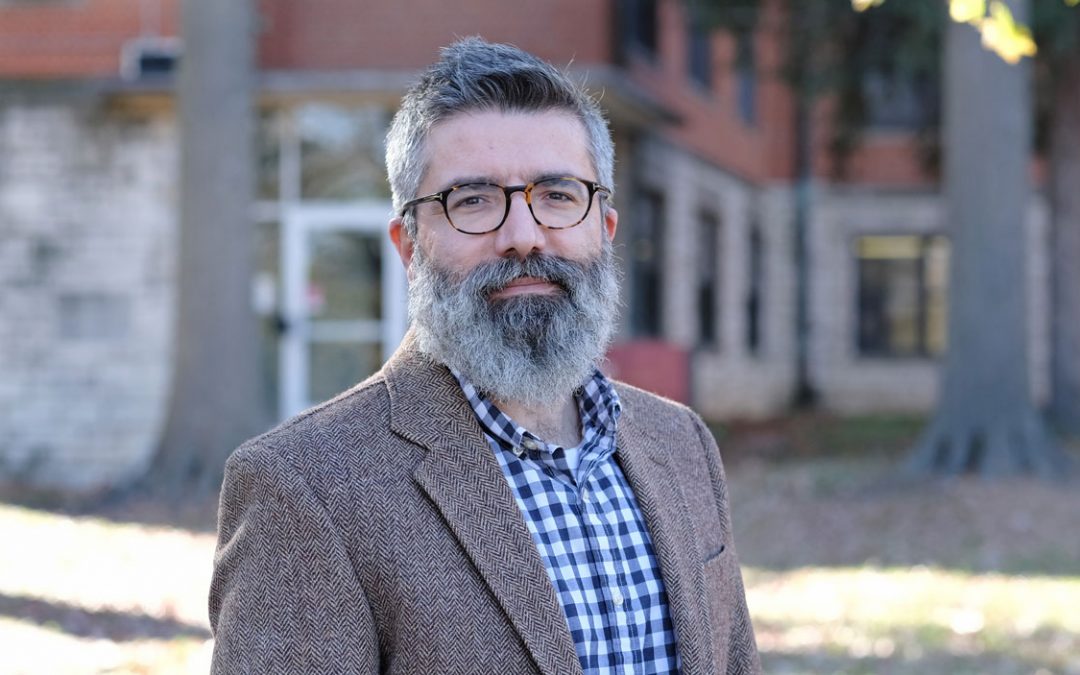
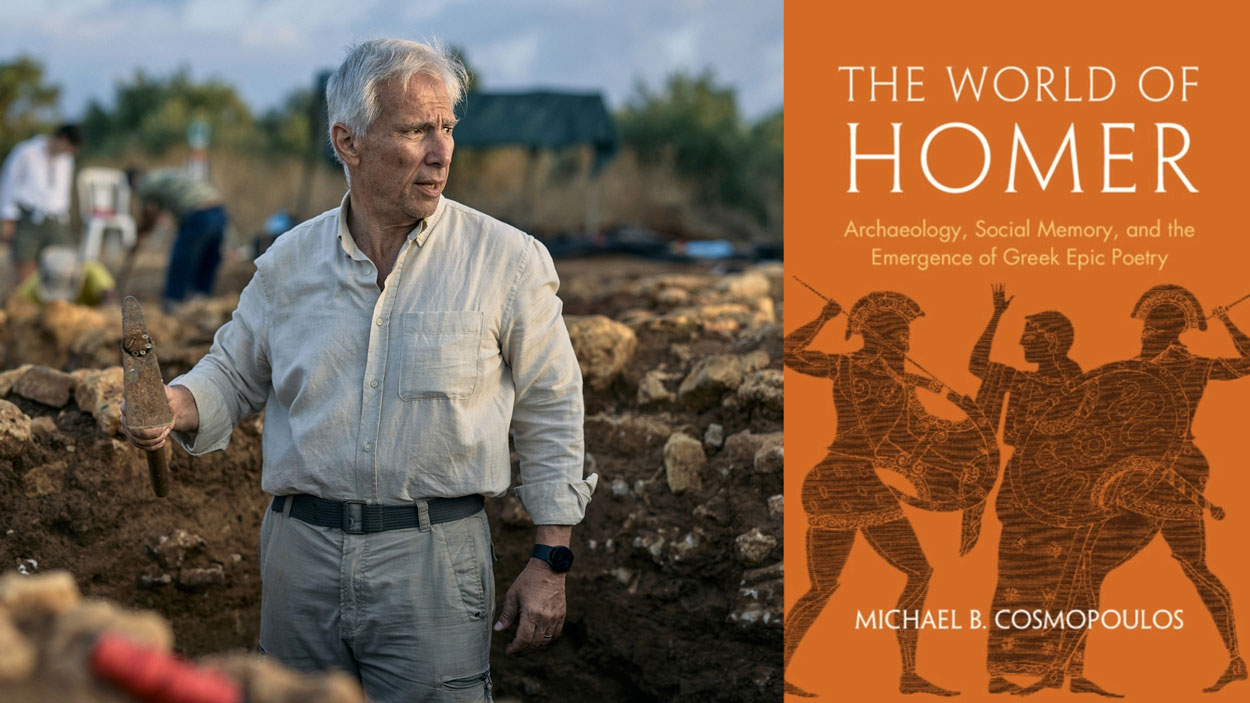
Michael Cosmopoulos, the Hellenic Government-Karakas Foundation Professor of Greek Studies, received a 2026 PROSE Award for his book “The World of Homer,” which explores forces that gave rise to the epic poems “The Iliad” and “The Odyssey.” (Photo courtesy of Michael Cosmopoulos)
Michael Cosmopoulos’ book “The World of Homer,” released last summer, explores the epic poems “The Iliad” and “The Odyssey” and wrestles with long-standing debate over their origins.
More specifically, the book examines the question of whether they can be traced to a single era and author – i.e. Homer – or rather were developed over centuries by multiple poets and shared through oral tradition.
Cosmopoulos, the Hellenic Government-Karakas Foundation Professor of Greek Studies and professor of archaeology at the University of Missouri–St. Louis, has received positive reviews since “The World of Homer” was published by Cambridge University Press. This month, the Association of American Publishers named him the 2026 recipient of a Professional and Scholarly Excellence – or PROSE – Award in the classics category.
The awards have been presented since 1976 and are intended to recognize the very best in professional and scholarly publishing by celebrating the authors, editors and publishers whose landmark works have made significant advancements in their respective fields of study each year.
“This recognition is particularly meaningful to me because ‘The World of Homer’ was the result of many years of sustained work, both in the field and in the library,” Cosmopoulos said. “The book represents an effort to bring together archaeological evidence and the Homeric epics in a way that speaks not only to specialists but also to a broader audience. To see that work acknowledged is deeply gratifying.”
Cosmopoulos is a member of the American Academy of Arts and Sciences and was also inducted into the Academy of Athens as Chair of Bronze Age Archaeology in 2024. In “The World of Homer,” he uses his expertise in archaeology and anthropology as well as philology to help readers understand the world in which the poems were formed and the factors that shaped them into works that continue to be celebrated today.
He hopes the recognition will bring attention to three wider issues he views as central to society’s current understanding of the ancient world.
“First, the need to overcome artificial barriers between disciplines – in this case, literary analysis and archaeological evidence – and to approach the ancient world in a more integrated and holistic way,” Cosmopoulos said. “Second, the realization that the opposition between ‘myth’ and ‘history,’ which still shapes public perception, is itself artificial, since the two are deeply interconnected. And third, the urgency of preserving the fragile archaeological record, on which all such interpretations ultimately depend.”