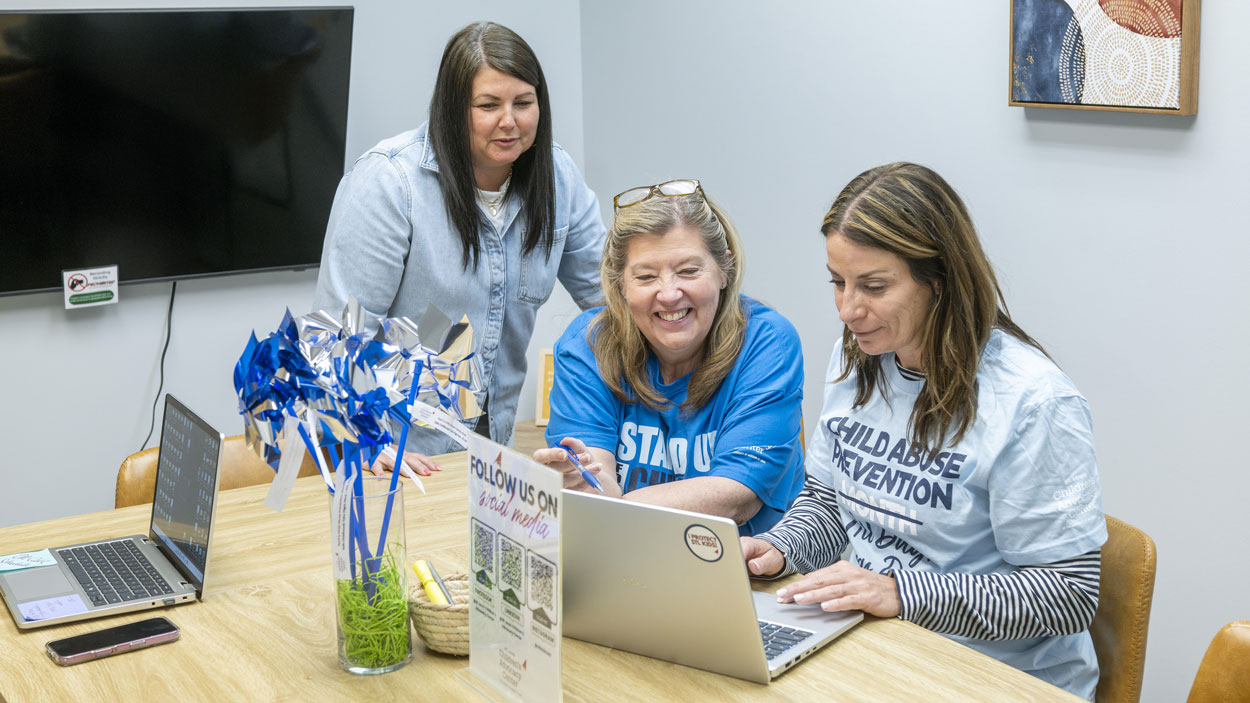
(From left) St. Louis Children’s Advocacy Center Director of Forensic Services and Community Engagement Amy Robins, Executive Director Jerry Dunn and Deputy Director Megan Marietta have been working to raise awareness of the prevalence of child abuse and neglect as well as the services available at the center during National Child Abuse and Prevention Month. (Photo by Derik Holtmann)
Staff members at the St. Louis Children’s Advocacy Center conducted more than 900 forensic interviews last year with children who were victims of abuse or neglect.
That number almost certainly represents only a fraction of the cases of abuse that occur each year in St. Louis City and County because so many instances go unreported, said Megan Marietta, the deputy director of the center, housed at the University of Missouri–St. Louis.
“We know that with child abuse often there are delays in disclosure,” Marietta said. “But even when children disclose, we, the first responders, are intimately aware of what’s happening, but I would say the general community doesn’t know about it.
“When we give tours to different groups that make donations – the Knights of Columbus, Rotary Clubs – we share with them how many children we see a year, and they are absolutely floored that child abuse is happening at the rates that it does.”
April has been designated National Child Abuse Prevention Month, and the center is working throughout the month to increase awareness of the prevalence of child abuse and neglect as well as steps that can be taken to prevent it and the services available to victims.
Last week, Marietta and her colleagues, along with partner organizations throughout the St. Louis region, launched a social media campaign that outlines forms of abuse, how frequently they occur, myths that might get in the way of believing victims and the testimonies of staff working to prevent it.
The campaign is also calling attention to events planned throughout the month, beginning with the Flight for Hope Tour at the St. Louis CAC at 9 a.m. Tuesday at the Kathy J. Weinman Children’s Advocacy Centre on UMSL’s South Campus.
On Friday, St. Louis CAC staff will take part in a Pinwheels for Prevention Ceremony, placing blue pinwheels in the memorial courtyard outside St. Louis County Police Headquarters at 1 p.m. in downtown Clayton. The pinwheel is the national symbol of Child Abuse Prevention Month and is meant to represent the joyful, healthy childhood each child deserves.
Staff members will also take part in the St. Louis City Circuit Attorney’s Resource Fair from 1-4 p.m. on April 23 at City Hall in downtown St. Louis.
The St. Louis Children’s Advocacy Center operates as part of a multidisciplinary team along with the St. Louis County Police Department, St. Louis Metropolitan Police Department, St. Louis County Prosecuting Attorney, St. Louis Circuit Attorney’s Office, Missouri Department of Social Services, SSM Health Cardinal Glennon Children’s Hospital and St. Louis Children’s Hospital.
They work together to gather information about potential instances of abuse so that children aren’t forced to go through a series of interviews that could lead them to endure greater psychological and emotional pain while they relive their experiences.
“The whole mission of the CAC is to provide a coordinated, systemic response, a trauma-informed response to allegations or concerns of child maltreatment so that we’re reducing retraumatization,” Marietta said.
The St. Louis CAC offers a child-friendly and non-threatening environment for those forensic interviews to occur. The center also provides mental health therapy and promotes educational and advocacy programming for children and families while simultaneously conducting research and helping to train students to work in children’s advocacy. Forensic and clinical services are offered at no cost to children and families thanks to the generous support of donors and funders.
“Most folks don’t know who we are and what we do,” Marietta said. “When I talk about the services that we provide, everybody typically understands therapy, but when I talk about forensic interviewing and forensic services, that is such a nebulous concept to pretty much everybody. Creating that awareness is really important for us, and it’s about educating families.
“I’m a parent. Even though I know what to look for, I know warning signs, I know how to talk with my kiddos, that doesn’t mean that I can keep my kids safe from the evil of the world happening to them. So, it is about teaching caregivers, ‘What are those warning signs? How do you talk with your kids about body safety? How do you foster a relationship with your child where they feel safe coming to talk with you?’”