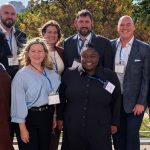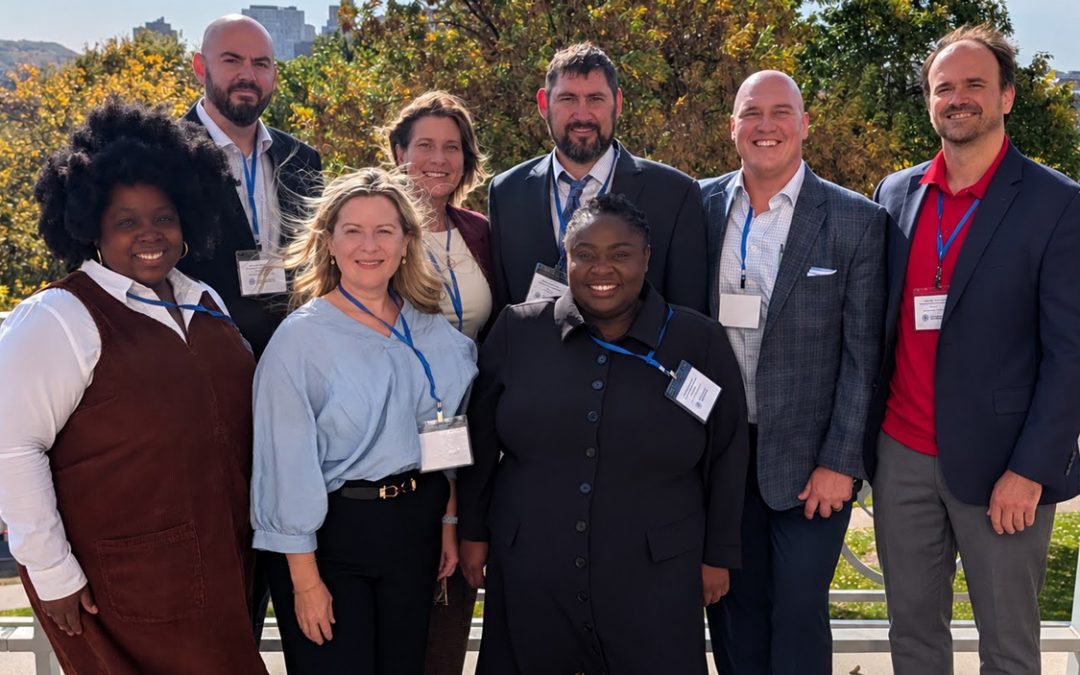
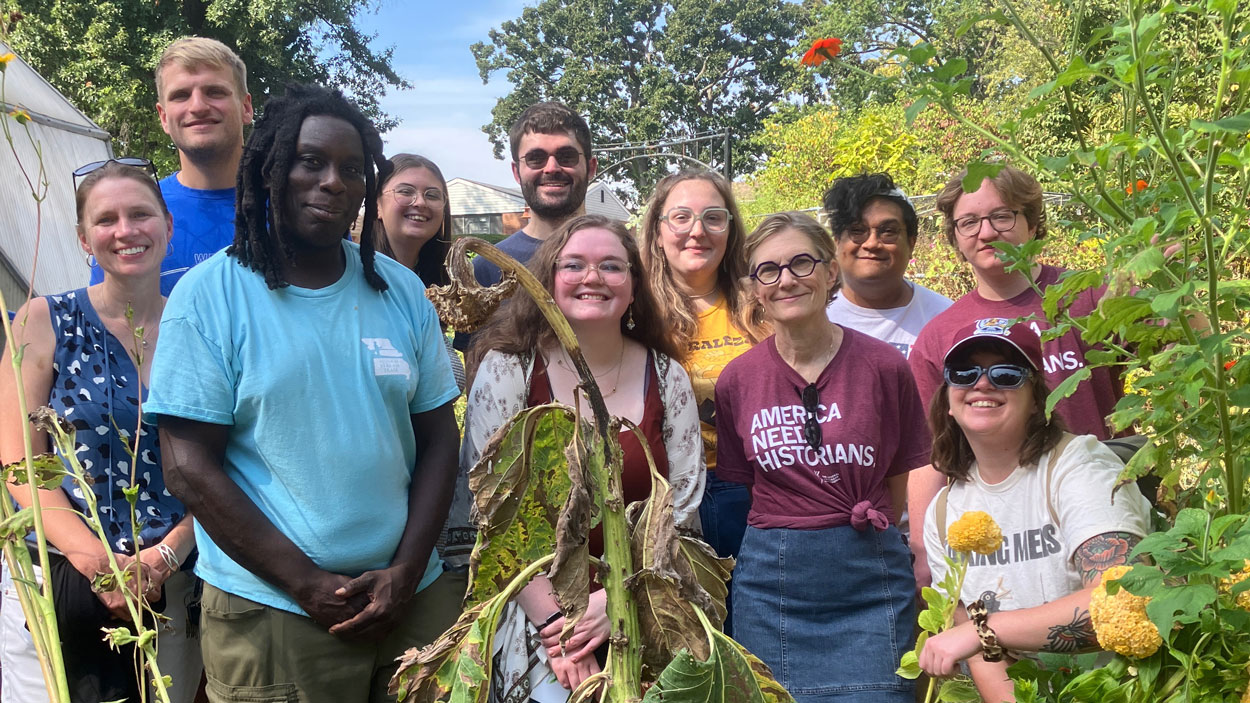
Professor Laura Westhoff (front row, second from right) and her students looked for evidence of hope while visiting neighborhoods and cultural sites, including The Green Center, around St. Louis last semester as part of the course “St. Louis: Hope in Action.” Westhoff designed the course as part of a fellowship at Notre Dame’s Institute for Ethics and the Common Good. (Photo courtesy of Laura Westhoff)
A group of 10 students from the University of Missouri–St. Louis spent part of their fall semester visiting neighborhoods and community spaces around St. Louis.
They strolled past the vibrant shops, galleries and restaurants along Cherokee Street in south St. Louis, walked around Forest Park, visited the Missouri Historical Society and The Green Center and toured the Historic Ville Neighborhood around Sumner High School, studying the past and also interacting with individuals shaping their communities in the present.
The students were enrolled in a course titled “St. Louis: Hope in Action,” designed and taught by Laura Westhoff, a professor in UMSL’s Department of History.
Westhoff developed the course last summer during a one-month summer fellowship at the University of Notre Dame while serving as a signature course fellow at the university’s Institute for Ethics and the Common Good.
The fellowship program, supported by a grant from the John Templeton Foundation, brought together 18 scholars from across disciplines and higher education institutions and assisted them in building and launching their own “signature course.” The courses are often interdisciplinary and intended to provide engaging learning experiences that stir rich discussions and help students develop critical thinking skills.
“These are really meant to be transformative courses for students,” Westhoff said. “We want them to ask big questions and offer opportunities to think not just about content but also about the direction of their lives and who they are becoming.”
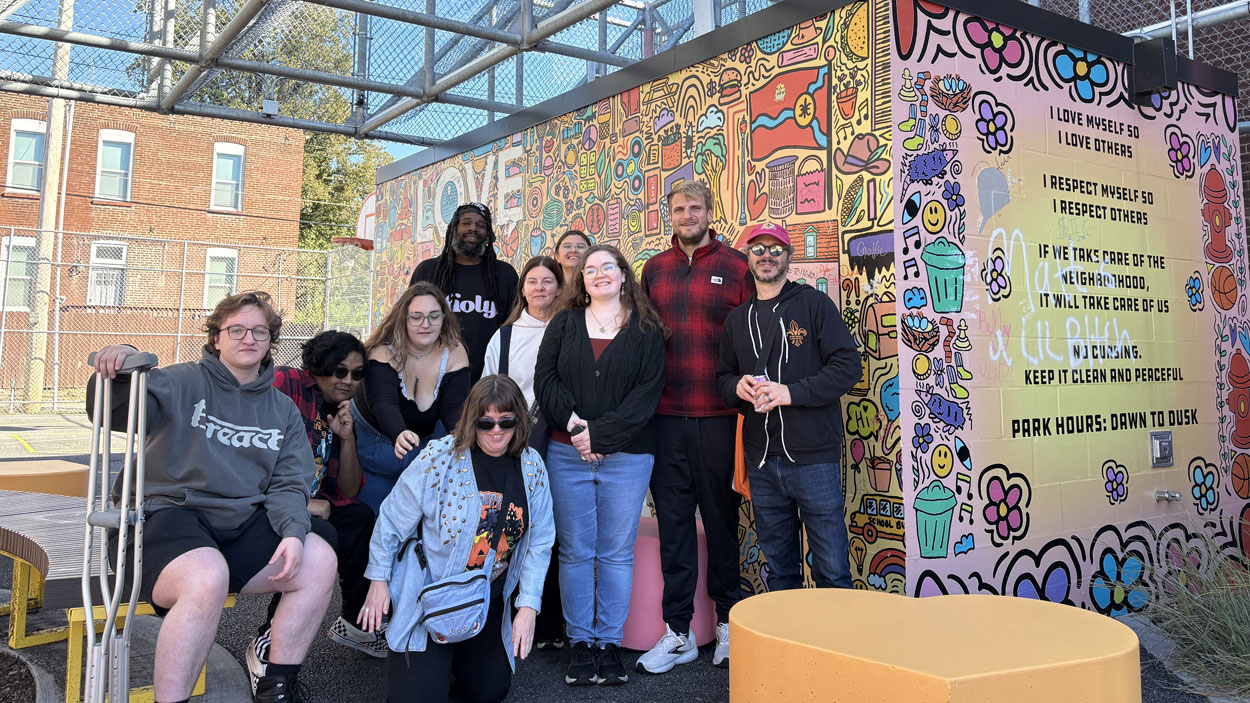
Students in Laura Westhoff’s “St. Louis: Hope in Action” course visited a park built by community members on a formerly vacant lot along Cherokee Street. (Photo courtesy of Laura Westhoff)
Each was to focus on an important question related to human flourishing.
Westhoff always knew she wanted to ground the course in St. Louis, and after hearing from students during department coffee hours and other informal discussions, she decided to center it on the theme of hope, something they told her they needed amid a period of change and uncertainty.
As part of the fellowship, Westhoff was able to hire a student intern, Tyler Winter, a history major and student in the Pierre Laclede Honors College. He also traveled to Notre Dame over the summer and assisted Westhoff as she developed the course, helping talk through different ideas and pacing for the course and creating some of the course materials.
“I got to work with a bunch of other really fantastic student interns who were all working on their own classes,” Winter said. “We lived together, we ate together, we worked together, and we all got super close over the month, and it was really cool to be able to share in a new version of an academic community where we were all doing this really intensive work for classes that we were really passionate about.”
Winter continued to assist Westhoff throughout the fall semester while receiving internship credit through the Honors College.
The first third of the course they designed featured a selection of readings about hope from philosophy, psychology, theology, environmental sciences, politics and history.
“We started with some deep dives into philosophy, which made clear that humans are intrinsically hopeful or we would never get out of bed in the morning,” Westhoff said.
As a historian, she knows that many of the most seminal moments of the past were when things appeared bleakest. But those were also times where people took action to change their circumstances, even with no assurance of what the future might bring.
“One of the best examples that I read from history is looking at the 1850s,” Westhoff said. “The Dred Scott decision, the Fugitive Slave Act and violence in Congress seemed to be retrenching slavery. It would be hard to imagine, if you put yourself back in time there, that 10 years later enslaved people would be free. That doesn’t mean that the Civil War solved all racial problems, but that was a pretty big positive step forward in a decade that seemed bleak.”
It’s hard to imagine that change was possible without hope. Westhoff said a recurring theme for the course was the way “hope hides.”
“It hides in the archive,” she said. “It also hides in plain sight in our neighborhoods.”
That’s why Westhoff thought it so important for the students to get out of the classroom and look for evidence of hope in the communities around them.
The field trips left an impression on the students.
“I was really excited to get out of the classroom and get into the community and do observation and study local activism and things like that,” said history major Larry Bowman, an aspiring history teacher. “It’s been really fun.”
Bowman was moved by walking around the Ville and seeing how the neighborhood was being preserved and enriched through the actions of people living there, including those associated with 4theVille, a cultural heritage development organization.
“On Cherokee Street, we got to talk to community members that either ran businesses there or created a literal grassroots basketball court that they built from scratch,” said Kathleen Jochman, who graduated with her degree in history last month. “It was just from the local business owners coming together and working together.”
Jochman said the course gave her new perspective on the region.
“St. Louis is so complex,” she said. “We learn about the Delmar Divide and things like that, but we don’t go into those community places and try to look at it from that point of view. I thought that was so cool.”
Westhoff’s students were not just observers throughout the semester. They also had to come up with a way to collectively try to put hope into action.
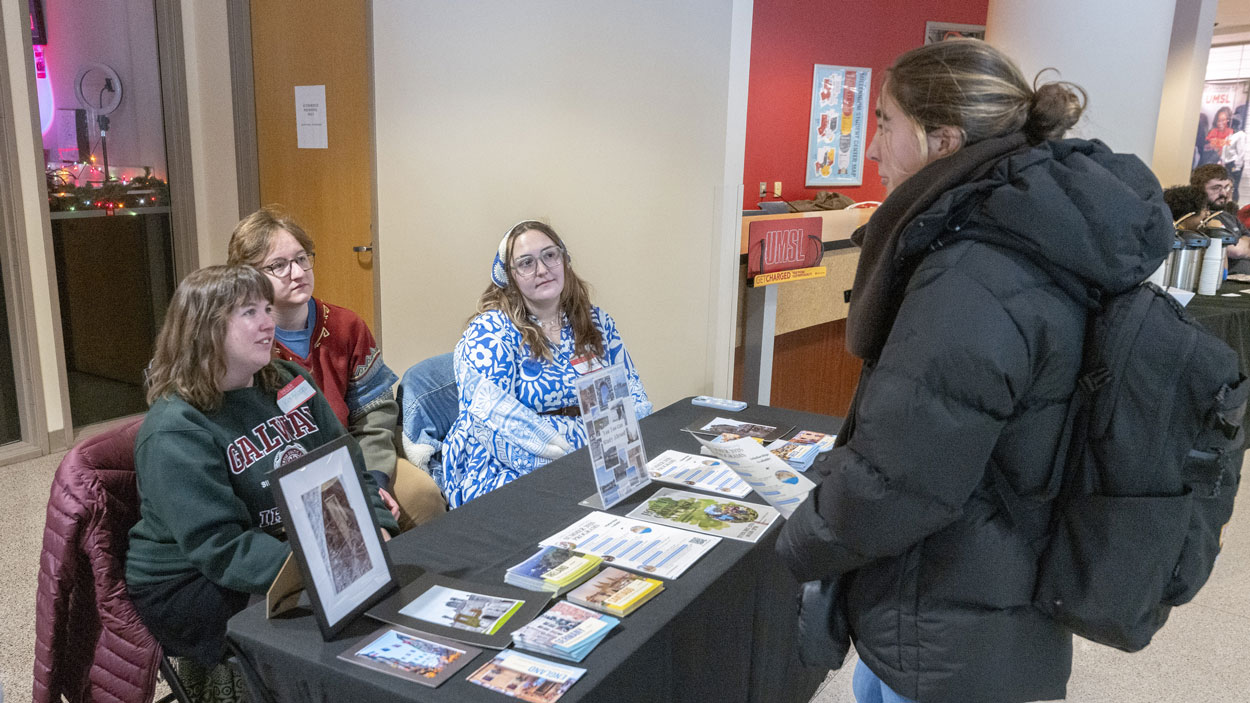
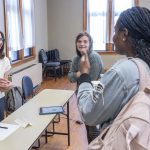
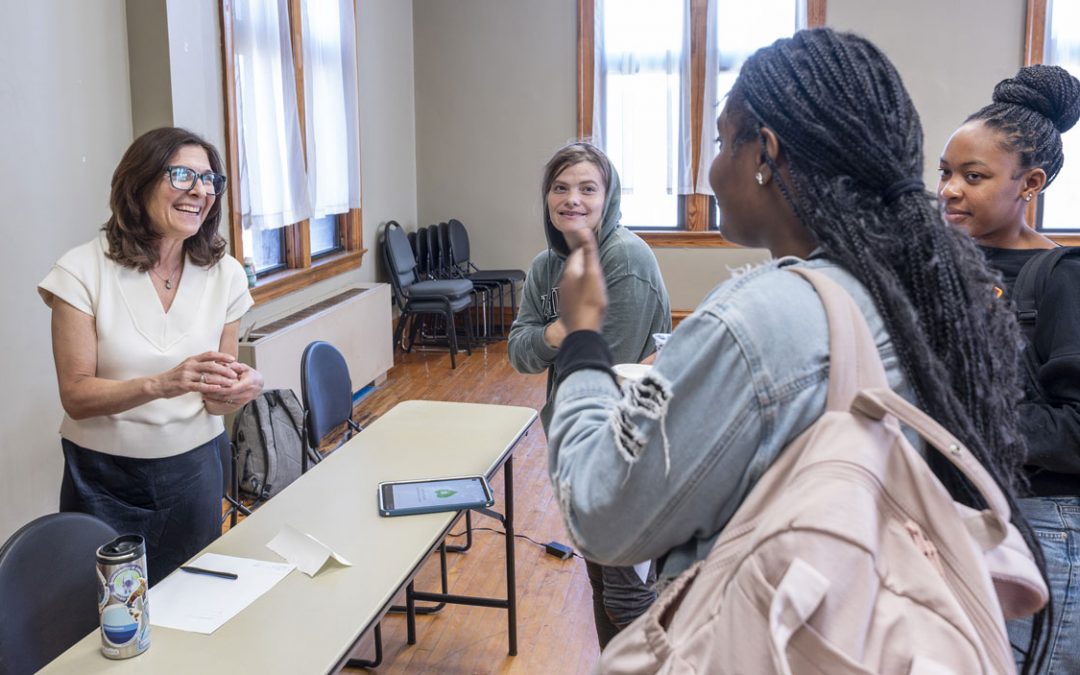
History students Kathleen Jochman, Tyler Winter and Eliza Stengle speak with freshman economics major Josefin Hansson about study abroad opportunities through UMSL while sitting at a table in the 2nd floor rotunda of the Millennium Student Center in early December.
Nearly all the students in the course came from nontraditional backgrounds and had had the experience of being new and trying to navigate the university environment, from setting their academic path to getting involved on campus. As a group project, they decided they would share some of the lessons they had acquired with some of their fellow students, so one day in early December they set up tables on the second floor rotunda of the Millennium Student Center, invited students to stop by and chat and provided some informal advice.
“It took most of us at least a year or two to really get into the hang of things, and most of us only have a year or two until we graduate,” said Eliza Stengle, who also graduated in December. “We wanted to kind of help people speed that process up so that they could get the most out of their time here.”
They talked about the value of reaching out to meet with their professors, get involved in student organizations and, in the case of Jochman and Stengle, study abroad. Jochman took part in a summer trip to Galway in Ireland while Stengle participated in the study abroad trip to Greece, where she gained experience working on the archaeological excavation at Iklaina under the direction of Michael Cosmopoulos, the Hellenic Government-Karakas Foundation Professor of Greek Studies.
Westhoff expects last semester’s course to serve as a prototype of other St. Louis-based signature courses in other disciplines across campus. She is using some of her fellowship funds to support other faculty on campus to develop their own place-based courses that will become part of a St. Louis Signature Course Series in the future.