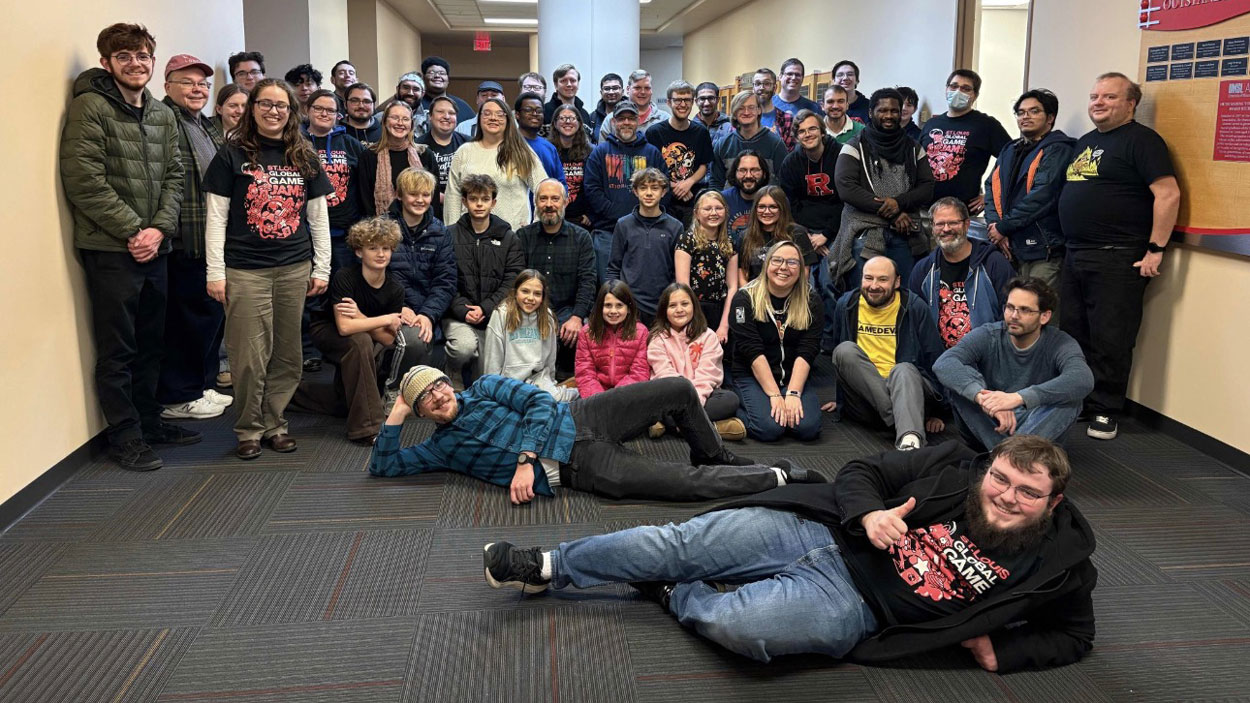
Nearly 100 participants participated in this year’s Global Game Jam, in which they designed, built and showcased 29 original, playable video games in a 48-hour period. (Photos courtesy of Brian Simcoke)
By Michael Moore
Months of careful planning by University of Missouri–St. Louis student Brian Simcoke paid off last weekend when UMSL hosted more than 95 participants for the 2026 Global Game Jam.
They joined tens of thousands of other creators at more than 800 sites across dozens of countries in the world’s largest game creation event.
Attendees at UMSL gathered in the Millennium Student Center to design, build and showcase 29 original, playable video games in a 48-hour period. The strong turnout helped the UMSL site rank 11th in the United States in attendance.
The enthusiastic “jammers” arrived in Century Room A Friday evening to get their marching orders. Just after 6 p.m., they learned the close-kept secret theme – “Mask.” In that moment, laptops sprang open, jammers dispersed into adjacent rooms, whiteboards filled and the available spaces quickly became a collaborative hub of programmers, artists, writers and designers working side by side.
By Sunday afternoon, family members and friends joined the developers in Century Room A, crowding together as teams presented what they had built and drew cheers, laughter and applause.
Student leadership at the center
Simcoke, a sophomore majoring in information systems and technology and president of UMSL’s Information Technology and Cybersecurity Club, served as the primary organizer for the event. A St. Louis native and U.S. Navy veteran, he coordinated logistics with STLGameDev, secured funding, coordinated catering, did a site inspection, assisted with setup and collaborated closely with UMSL Event Services and Club Officers to ensure the event ran smoothly.
Although the planning process was largely virtual and compressed into a few months, Simcoke said the experience helped him grow as a leader.
“It was a little hectic and definitely challenging,” Simcoke said. “A lot of it was over the phone or online, but we figured out everything we had to do and got it done.”
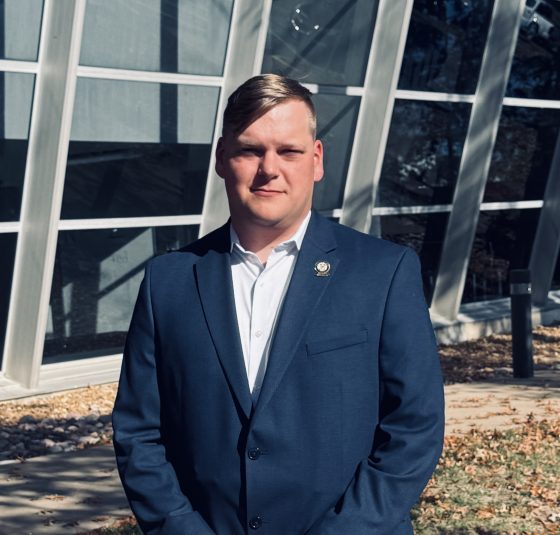
Brian Simcoke, a sophomore majoring in information systems and technology and president of UMSL’s Information Technology and Cybersecurity Club, organized this year’s Global Game Jam.
Simcoke said his background, including prior leadership experience, helped him step outside his comfort zone.
“It really pushed me to get out of my shell,” he said. “I had to talk to people, coordinate everything and make sure we stayed on track.”
Simcoke emphasized that the Global Game Jam is designed to be accessible, even for first-time participants.
“It’s a video game development workshop,” he said. “No matter where you are skill-wise, you can show up with a laptop and start creating.”
The Global Game Jam event is unique in that it focuses on collaboration and experimentation rather than strict deadlines. Games do not need to be fully finished by the end of the weekend and can continue to be developed afterward.
“There wasn’t a lot of pressure,” Simcoke said. “It’s not about perfection. It’s about showing what works, learning from others and enjoying the process.”
That relaxed and engaging atmosphere was reflected in the wide range of participants. The event welcomed UMSL students and alumni, professionals from the St. Louis game development community and first-time creators. Jammers ranged from teenagers to experienced developers, including families who formed teams together. One of the youngest participants was an 11-year-old coder and artist, who worked alongside her older sister and father.
The jammers were allowed to bring their own interpretation of the mask theme into their games. One included a cartoon-like wrestling match featuring old WWE-style competitors wearing masks. In another game, players were dropped into a field of play and tasked with finding the person with the mask on. The ambiguity was by design and allowed participants to draw on their own creativity.
Learning beyond the classroom
Simcoke said events like the Global Game Jam complement UMSL’s academic programs by offering students real-world experience.
“UMSL already has degree paths in computer science, cybersecurity, software development and information systems,” he said. “This gives students the opportunity to collaborate across disciplines, build a product and demo it.”
Participants leave with portfolio-ready work, experience working under time constraints and exposure to industry professionals. Organizers noted that past Global Game Jam projects have gone on to become larger commercial titles.
“Who knows,” Simcoke said. “The next big game could have been invented this weekend.”
UMSL’s long-standing support
This year marked the 15th Global Game Jam held in St. Louis, with UMSL serving as host for most of those years. Simcoke credited his fellow Information Technology and Cybersecurity Club officers and the university’s continued support for making the event possible.
“UMSL is unparalleled in its support for community events like this,” Simcoke said. “They really do care and make sure there’s space and resources for things like the Global Game Jam to happen.”
Professor Dinesh Mirchandani, who chairs the Department of Information Systems and Technology in the Ed G. Smith College of Business, echoed that sentiment.
“I could not be more proud of the leadership and perseverance Brian showed in organizing the very successful UMSL Global Game Jam,” Mirchandani said. “UMSL and the IT and Cybersecurity Club played a big role in making this possible.”
Looking ahead
While organizers were pleased with the turnout and overall experience, Simcoke said there are opportunities to expand awareness on campus and encourage participation from even more disciplines, including art, music and writing.
Still, as the final demonstrations wrapped up Sunday afternoon, there was a palpable sense of pride and accomplishment in the room. Groups buzzing with excitement lingered to talk about their games, exchange ideas and make plans to continue developing their projects. As a testament to the success of the event and Simcoke’s resolve, a room once full of strangers with fragmented concepts was transformed into a community bound by shared late nights and creative breakthroughs.