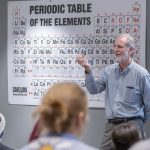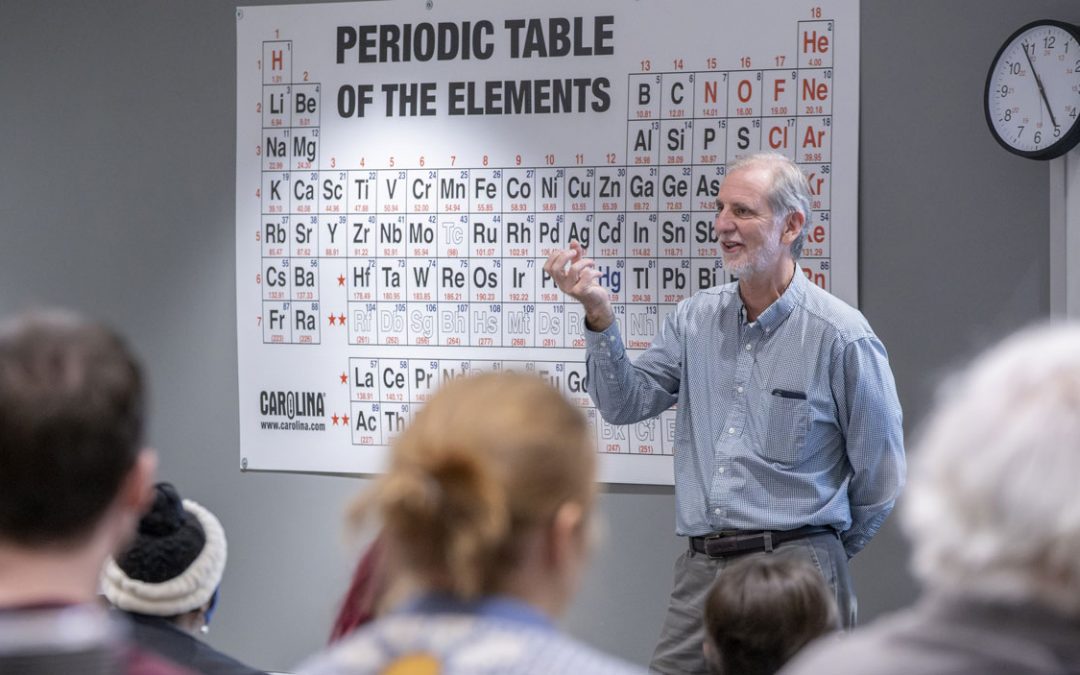
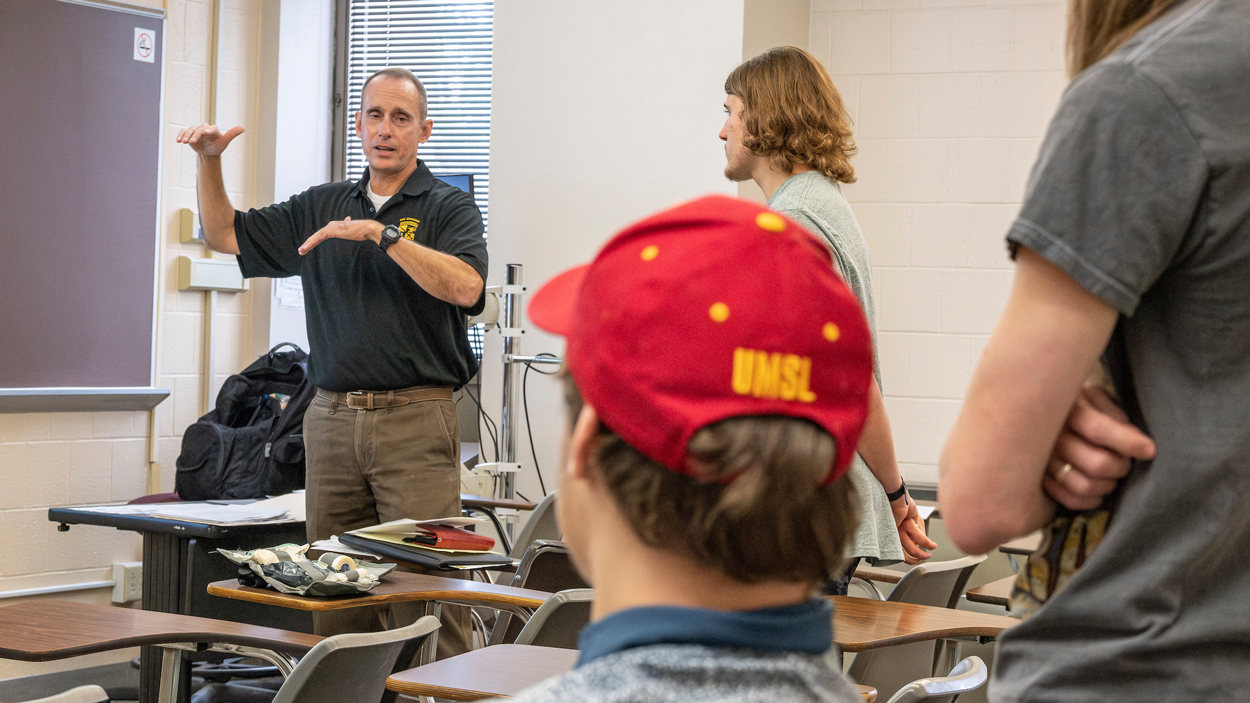
Senior Military Science Instructor Chad A. Callis leads a class discussion on basic first aid. UMSL student cadets taking “Introduction to Leadership I” learn about the practices that breed good leadership as well as practical military skills. (Photo by Derik Holtmann)
After a several-year hiatus, Army ROTC classes returned to the University of Missouri–St. Louis campus this semester.
The effort to revive the program was driven by a collaboration between stakeholders at UMSL and Gateway Battalion, which oversees Army ROTC programming at eight St. Louis area universities. This summer, the two institutions struck an agreement that offers a variety of financial benefits to UMSL students who join ROTC, making it possible to recruit the first new cohort of cadets in five years.
“This agreement with UMSL, it’s game changing,” said Lee Rodriguez, Gateway Battalion Recruitment Operations Officer. “It shows that we’re open for business, and we’re going to do what we have to do to entice and attract quality students.”
It’s been a goal of UMSL Vice Chancellor for Strategic Enrollment Reggie Hill since he arrived at the university in 2021.
“One of my initial wins that I wanted here as an enrollment manager was to revitalize the ROTC program,” Hill said. “Not only can ROTC bring another pathway for students to enroll on campus, but also it changes the fabric of the campus by infusing young future leaders to the campus who are serious and who are career ready on day one.”
Rodriguez stressed that there’s initially no military service obligation to join the program. However, once students do contract with Army ROTC on an officer track, typically after they complete 24 credit hours, UMSL will provide $1,200 for textbooks and a $6,000 housing grant for Oak Hall per academic year. Simultaneously, Army ROTC will provide a monthly allowance of $420, and the National Guard will offer monthly drill pay.
“We’re making this experience not only affordable for the Gateway Battalion to send us more students, but we’re also making it affordable for the cadet who leaves here and becomes a second lieutenant,” Hill said.
A new start
Army ROTC, or Reserve Officers’ Training Corps, trains college students to eventually become commissioned officers in the United States Army, the Army Reserves or the Army National Guard. Previously, the training program had a strong presence at UMSL.
However, like so many other organizations across the country, Gateway Battalion had to adapt the best it could during the onset of the COVID-19 pandemic in 2020. In the wake of such a major disruption, it ultimately pulled back programming at some universities including UMSL. That left a void on campus for several years.
About a year ago, Rodriguez began brainstorming. Higher education enrollment numbers were recovering, and Rodriguez was eager to find a way to improve Gateway Battalion’s reach in the region. He wanted people to understand Army ROTC was still “open for business.” After looking at the local landscape, it made sense to start with UMSL.
“We did an analysis of all the colleges out there, and it was driven by growth potential and by cost,” he explained. “UMSL is a great school. It’s a state school. How do we work with them, specifically, to see if we can entice more students to come into Army ROTC.”
This past spring, Rodriguez reached out to Olivia Mendez-Alm, the director of Enrollment Services, Adult Education, and they began discussing how to make the idea a reality. They quickly brought Hill; Jim Craig, associate dean of the College of Arts and Sciences and teaching professor of sociology and veterans studies; and Lt. Col. Sean Hill at Gateway Battalion into the fold. Within two months, the two organizations hammered out the details of the agreement.
Reggie Hill was thrilled to see one of his long-time goals fulfilled.
“I’ve learned strategic patience,” he said. “If you believe in something, you know sometimes it won’t happen immediately, but you just continue to work toward those initiatives and something will come to fruition.”
Servant leadership
UMSL’s newest freshmen ROTC class includes 10 students, who have been taking the military science course, “Introduction to Leadership I,” during the fall semester. The course is less about specific technical military training and more about cultivating values and practices that breed good leadership.
“We want them to learn interpersonal skills,” Rodriguez said. “We want to teach them time management skills. We want to teach them ethics and public speaking. They’ll gain some social skills and team-building skills. Then we throw in some military stuff – how to read a map, how to identify terrain features on a map, Army values and the ethics of being a soldier.”
In addition to the classroom, the student cadets have also had the opportunity to take part in weekly physical training, though it’s only required for those that are contracted on an officer path, and field exercises that mimic boot camp.
Martina Meng, manager of the UMSL Veterans Center, and Robert Chisenhall, a recruiter for the National Guard based on UMSL’s campus, are often the first points of contact for students interested in ROTC. Meng and Chisenhall answer questions and offer guidance for those considering the program. They also echo Rodriguez’s sentiments about the value of military science courses.
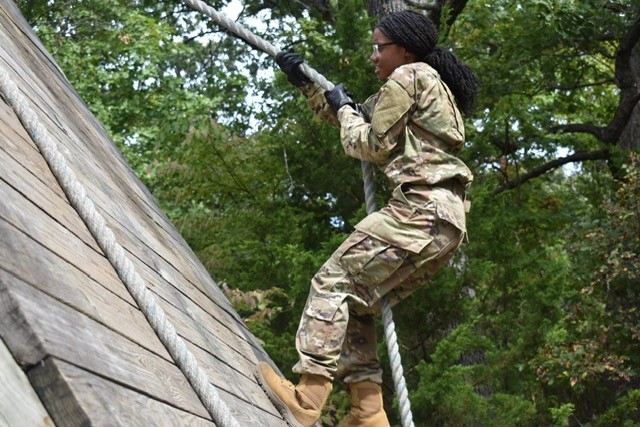
Student cadets have the opportunity to participate in field exercises in addition to their coursework. (Photo courtesy of UMSL ROTC)
In addition to interpersonal skills, Chisenhall noted that the courses demonstrate the value of service and help student cadets build resilience.
“The hope is that they see that’s just the tip of the iceberg, and they become addicted to the idea of how service, service to others and service to your country can grow you as a person and build you up as a leader,” Chisenhall said. “Those leadership skills carry over across your life.”
Ideally, if student cadets complete four years of ROTC, they will be commissioned as second lieutenants in the Army. Meng noted that it’s an efficient way to gain rank. However, she stressed that rank comes with duty to others.
“Moving up in rank does not necessarily mean that you are the boss,” Meng said. “It means that you are responsible for those who work underneath you.”
Community impact
Stakeholders agree that ROTC’s return to UMSL will not only be a boon for the university but also for the St. Louis region. Meng views the program as a bridge between UMSL’s military-connected students and the rest of campus, while Chisenhall anticipates that the return will continue to raise awareness of ROTC in general and aid recruitment efforts in the future.
Meanwhile, Hill is excited that UMSL will now be producing even more leaders who will go on to shape the future of the region and beyond.
“ROTC is the right fit for UMSL,” Hill said. “It fits within our mission to transform lives. What we know is that these cadets go from high school student to college student, and their dream is to become a commissioned officer in the United States military. If we can facilitate that process, that’s a win for UMSL, a win for the student and a win for the United States military.”