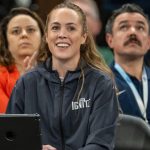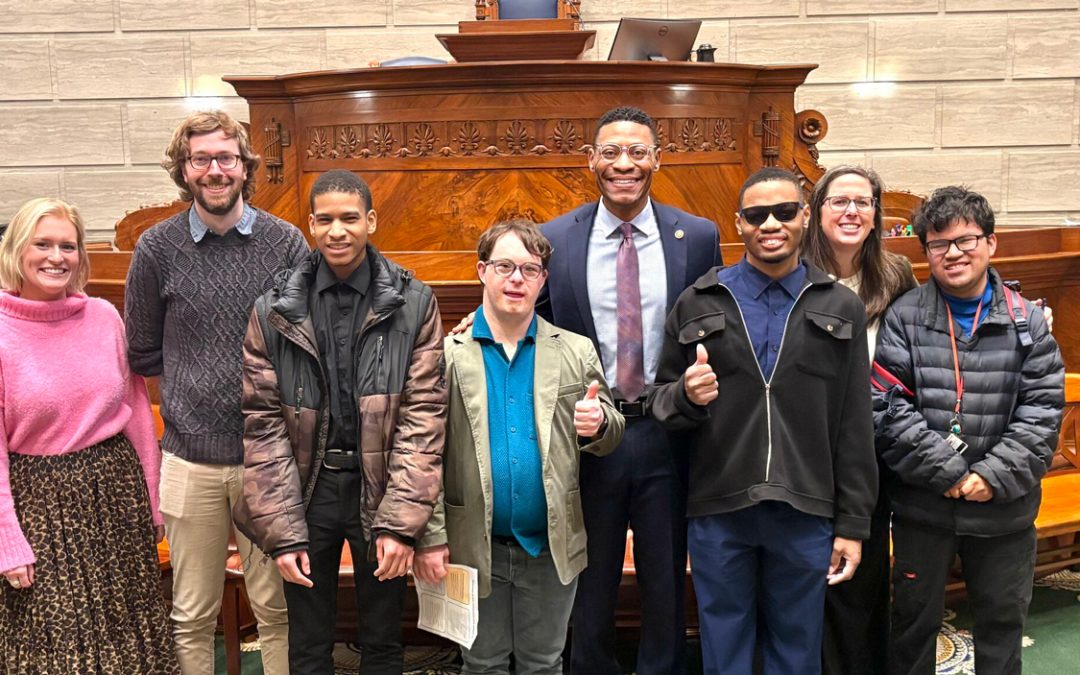
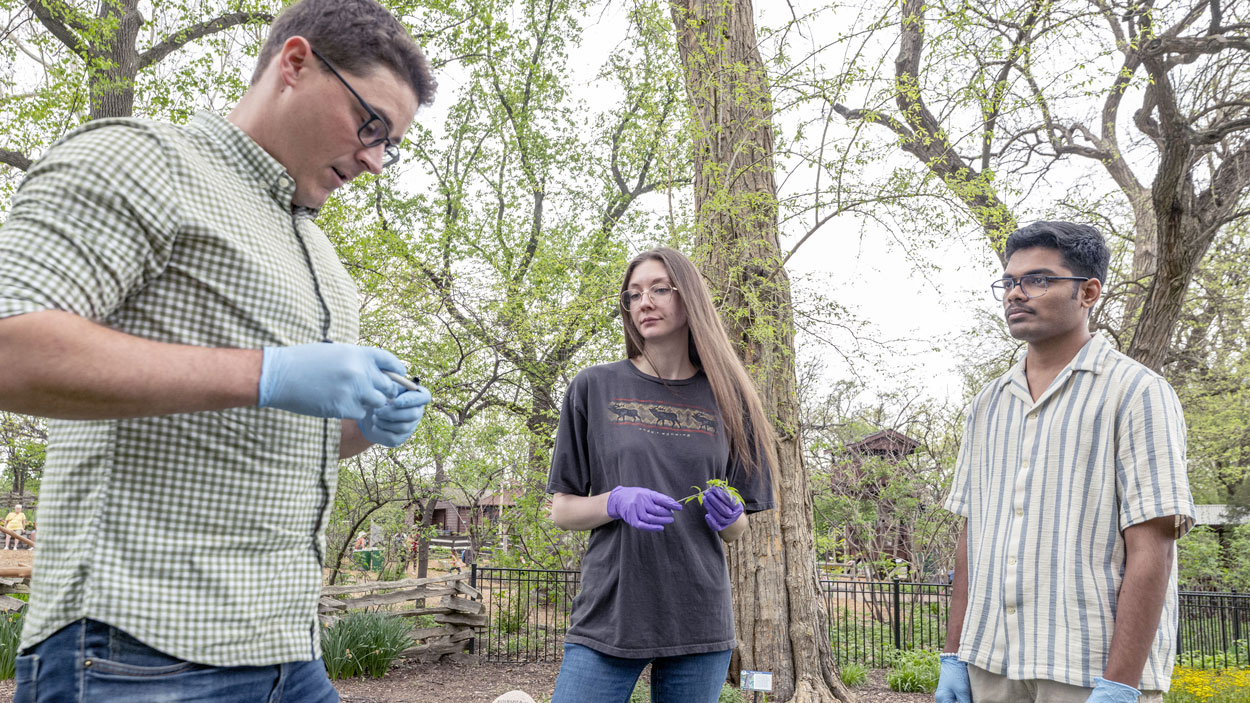
Biology Assistant Professor Blaine Marchant and graduate research assistants Jessi Kreder and Sujith Sudagani collect tissue samples from an Osage Orange tree last April at the Missouri Botanical Garden. Marchant has been teaching a course on bioinformatics this semester and leading students through a project to assemble part of the genome for the tree as part of the American Campus Tree Genomes project. (Photos by Derik Holtmann)
A person might take notice of an Osage Orange tree while out for an autumn hike. Its leaves turn bright yellow in the early fall while its distinctive, bumpy, brain-like fruit hangs heavy on the branches or drops to the ground below.
The tree – whose scientific name is Maclura pomifera – is actually a relative of the mulberry or fig tree, rather than part of the citrus family. Its fruit might compare in size to an orange – it’s probably closer to a softball – but that’s about where the similarities end. It’s yellow-green in color and, rather than sweet and juicy on the inside, is bitter and possesses a sticky, latex-like texture.
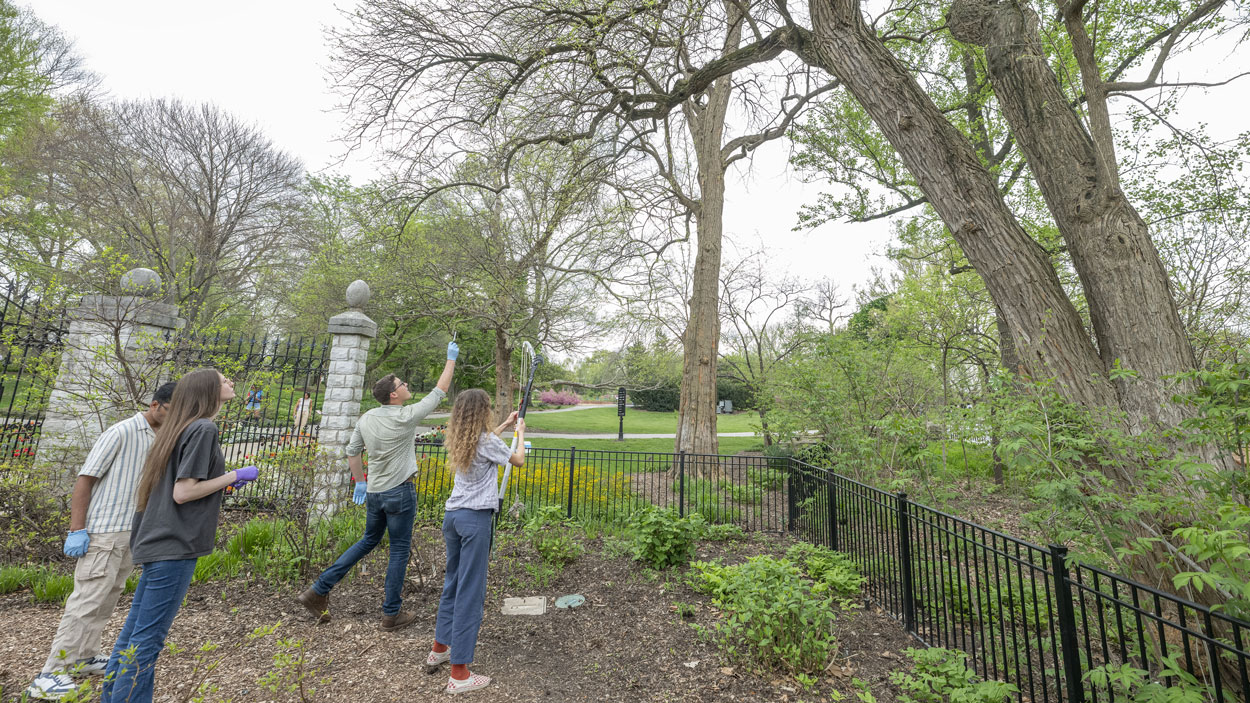
Meghan Forde (at right), the living collections data specialist at the Missouri Botanical Garden, helps Assistant Professor Blaine Marchant and graduate research assistants Jessi Kreder and Sujith Sudagani gather Osage Orange samples from a tree near the Children’s Garden. The samples were used to obtain DNA for the tree.
Nothing today eats it, but it’s believed to have once been a favorite food of woolly mammoths, mastodons and ground sloths, who relied on it for nutrition during the last Ice Age. They, in turn, helped disperse its seeds.
The tree, noted for its hard, dense wood, is native to a small area of what now is the central southern United States, but it has spread widely, especially in the middle part of the country and into Canada. Before the invention of barbed wire in the mid-1800s, Osage Orange trees were often planted close together in rows to form natural fencing – “bull-strong and hog-tight” – to keep livestock contained.
Despite this ancient history and much more recent practical significance, not much is known about the Osage Orange’s genetics or its evolution. But University of Missouri–St. Louis students have been hard at work this semester trying to change that while enrolled in a bioinformatics course taught by Blaine Marchant, an assistant professor in the Department of Biology.
The students, a mix of both undergraduates and graduate students, have been tasked with assembling and analyzing part of the genome – a complete set of an organism’s DNA – for the tree. They’ve made use of Hellbender, a high-performance computing data ecosystem available to researchers in the University of Missouri System, to process short-read and long-read genomic data.
The data was generated by the HudsonAlpha Institute for Biotechnology at its Genome Sequencing Center in Huntsville, Alabama, and provided to UMSL as part of its participation in the American Campus Tree Genomes initiative.
“I’ve always thought the best way to learn bioinformatics is hands-on assignments and data,” Marchant said. “There’s nothing more hands-on than real data and trying to crank through it. We’ve been learning a lot of the bioinformatics skill sets through this project – dealing with big data, dealing with the different file types, command line.”
Real-life learning
ATCG was conceived with the idea of using iconic trees as a gateway to help students engage with modern genome sequencing technologies. The goal has been to have them work together in cohorts to assemble, analyze and ultimately publish genomes in leading journals with all the participants serving as co-authors.
Alex Harkess, a faculty investigator at HudsonAlpha who previously completed a postdoctoral fellowship at the Donald Danforth Plant Science Center in St. Louis, founded the initiative with Leslie Goertzen, the director of the John D. Freeman Herbarium at Auburn University. It is funded through a CAREER Award Harkess received from the National Science Foundation.
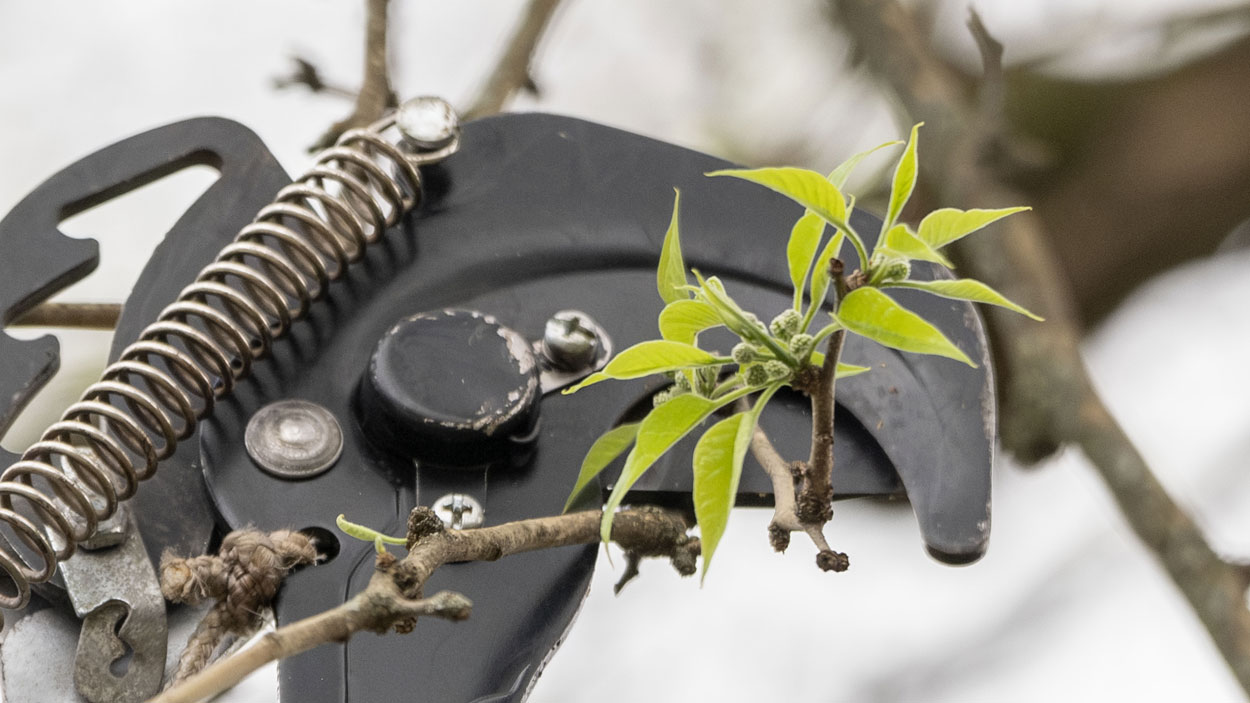
A set of clippers cuts a new bud from an Osage Orange tree at the Missouri Botanical Garden.
They taught the class that worked on the first project at Auburn in 2021, when students sequenced the genome of a clone of one of the famed oak trees that once stood at Toomer’s Corner next to campus.
“Over the course of the semester, we taught them basically how to sequence using cutting-edge, long-read genome sequencing,” Harkess said. “I used an online teaching platform and students had access to a supercomputer. These undergrads learned what it was like to effectively be a postdoc in my lab.”
The goal throughout had been to publish their findings.
“It soon became less of a class and more of this authentic living scientific collaboration,” Harkess said, “where students had skin in the game because they knew that they were going to get a paper.”
He and Goertzen replicated the course at Auburn using the d’Anjou Pear tree a year later. Subsequent projects at other universities have included sequencing the genome of the famed hedges that line the football field at the University of Georgia’s Sanford Stadium and sequencing and analyzing the genomes of several tree species in McCarty Woods on the University of Florida campus in Gainesville, Florida.
That happens to be where Marchant earned his PhD in evolutionary genomics, and two of his mentors, botanists Doug and Pam Soltis, led the project.
In 2022, students at Washington State University sequenced the genome of the ‘WA 38’ or Cosmic Crisp apple tree developed there as part of another ACTG project. Assistant Research Professor Huiting Zhang’s online syllabus provided a guide for Marchant as he was developing his course ahead of this semester at UMSL.
A historic subject
Marchant first spoke with Harkess about participating in ACTG when they ran into each other at a biology conference in the summer of 2024. The two have known each other from research circles dating to their time as doctoral students, and Marchant was already familiar with the initiative.
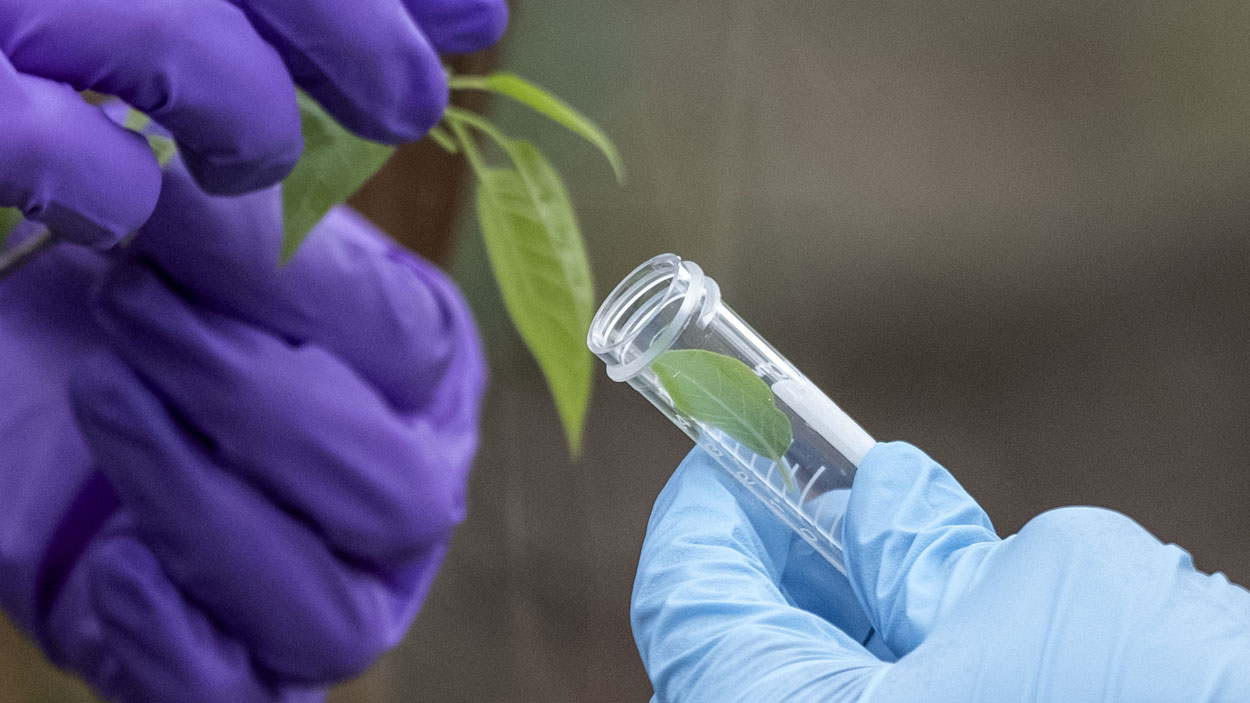
Doctoral student Jessi Kreder places a leaf collected from an Osage Orange tree at the Missouri Botanical Garden inside a glass tube. The tube was sent to the HudsonAlpha Institute of Biotechnology so that it could process the sample and extract the DNA that students have been using to assemble the genome.
“I threw out this idea of the Osage Orange, and he loved it,” Marchant said of Harkess. “His background is sex chromosomes, and Osage Orange is dioecious, so it has separate male and female plants and definitely has sex chromosomes. But there’s not a lot of information on the mechanism there, so biologically, it was perfect.”
Marchant had to collect tissue samples that could provide the genetic data, so he reached out to the Missouri Botanical Garden and received permission to do so from male and female trees on the property near the Children’s Garden. Garden founder Henry Shaw planted Osage Orange trees in the 1860s to line the carriage trail leading to his then-country home.
Marchant and graduate research assistants Jessi Kreder and Sujith Sudagani visited the garden last April and collected newly growing leaves, buds, and other material from the two trees, placing the tissues in tubes that were then shipped to HudsonAlpha for processing.
Marchant had the data back in plenty of time for fall.
Lessons for the future
Kreder is one of the students enrolled in the bioinformatics class this semester. Over the summer, Marchant tipped her and fellow labmates Michael Hayes and Pratikshya Chalise off to the semester-long project they’d be working on the course. But most of the other students only learned about it when they arrived for the first class meeting in August.
“I was surprised,” said Balaji Balamurugan, a doctoral student currently working as a graduate research assistant at Danforth. “When I signed up for the course, I thought it would be like doing BLAST” – Basic Local Alignment Search Tool – “or using major tools, but I had no clue we’d be using all the tools to assemble a huge plant genome.”
It’s a big undertaking, and one that could be intimidating to some students, especially if they came in with only minimal experience with coding.
“He’s broken it down step by step,” Chalise said of Marchant, who first guided them through assembling the genome for the chloroplast, which controls photosynthesis. “First, we went through how we input the data, how to do the initial steps, and then the chloroplast assembly.”
More recently, they worked on nuclear assembly and have also been focusing on trying to analyze and understand the Osage Orange’s sex chromosomes.
The exercise has given them a lens to explore how the plant has evolved by comparing the genetic blueprint they’ve assembled with other related species to recognize conserved genes as well as distinctive mutations.
Marchant believes their work will have produced several results that will push scientific understanding forward.
“The chloroplast genome alone is a publishable result,” he said. “The full genome assembly, making that public, looking at all these different genes, that would be very publishable. You can do some comparative genomics with other plants with sex chromosomes to figure out how that all works.”
Perhaps more importantly, the skills the students have been developing are transferrable to other projects.
“Even if you have a harder time grasping the code, you still know the bioinformatic tools that are available,” Kreder said. “In the future, if we don’t want to do genome assembly, we still are able to go back to our notes and see, ‘Well, we used this,’ and ‘I can use that in my research.’ I think that’s really helpful.”
Their experience could also give them a leg up when they hit the job market.
“Being able to say, ‘I’ve worked on stuff like this,’ that immediately gets your foot in the door,” Hayes said. “Being able to tell people, ‘I’ve worked in Unix and Python, and I’ve used Hellbender, I’ve done genome annotation, all that sort of stuff,’ even if it’s just barely anything, that’s better than someone who has nothing. With coding being such a big thing for bio people recently, the expectation is that you’re a biologist but you’re also a statistician and coder. You have to be able to do both.”