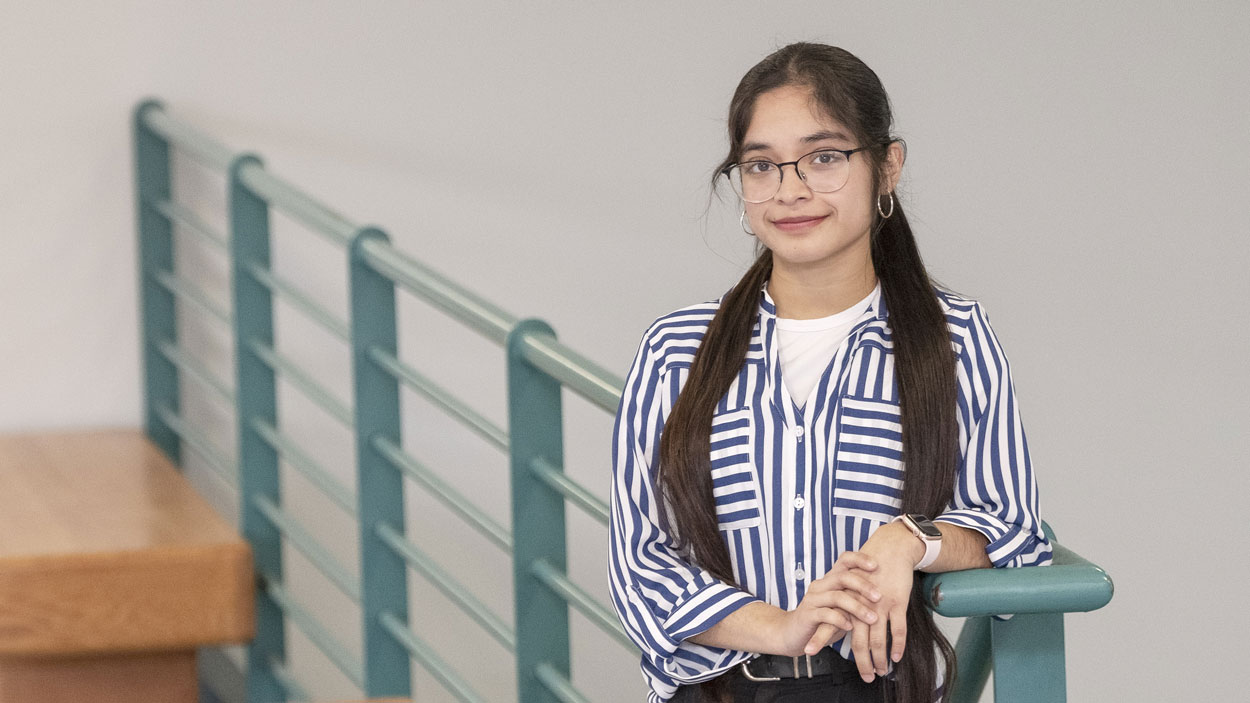
Alondra Mendez will be the first member of her family to graduate from college when she receives her Bachelor of Science in mathematics. She’s planning to pursue a master’s degree in data analytics and applications. (Photo by Derik Holtmann)
Alondra Mendez’s family has been planning her graduation party for weeks. Her grandparents will be visiting from Mexico, and she has aunts, uncles and cousins in Columbia, Missouri, making the two-hour drive on Saturday to witness her walk across the commencement stage at the University of Missouri–St. Louis and celebrate with her afterward.
The ceremony at the Mark Twain Athletic Center will be a proud moment for Mendez, who is earning her Bachelor of Science in mathematics.
“I’m the only person in my family to ever go this far in education,” Mendez said. “I wanted to show everyone that, ‘Oh, I can do this. It’s not impossible.’ I wanted to prove to myself and everyone else that I was determined to get it done.”
Mendez has been focused throughout her time at UMSL in a way that she said she never was as a student at Pattonville High School. She’s become a regular on the dean’s list in the College of Arts and Sciences and has been taking 18 credit hours in her final semester so that she can complete her degree in 3½ years.
But she isn’t finished with school. She’s expecting to continue her education by pursuing a master’s degree in data analytics and applications at Washington University in St. Louis.
Mendez has not followed the original plan she had for herself when she enrolled at UMSL in the fall of 2022.
She chose the university because it provided a high-quality and affordable education and allowed her to stay close to her family on the heels of the COVID-19 pandemic and with a new brother at home.
Mendez started out as a math education major and expected to make her way to a high school classroom teaching math after graduation. But sometime during that first year, she realized that wasn’t her calling.
Her fondness for math remained, however, and the more she learned about it, the more passionate about it she became.
“I always liked math and it always came easy to me, but I never really understood the why part,” she said. “Understanding all the proof-based classes was really interesting to me because now I can see all these theorems and all these formulas and recognize why and how they work. They’re not just slapped in front of me without an explanation.
“Learning how to do proofs and how to read a proof was definitely a whole other animal on its own. But I really appreciated the challenge.”
Mendez has felt supported in her studies by faculty members in the Department of Mathematics, Physics, Astronomy and Statistics, and she’s never hesitated to reach out when she has questions. She said Associate Teaching Professor David Covert, the undergraduate mathematics director, and Associate Professor Ravindra Girivaru have been particularly approachable and supportive.
“They’re really helpful and really friendly,” she said. “It was important for me to know that I could talk to a professor or a faculty advisor and I could get all my questions answered.”
Covert also helped her with planning out her semesters after she changed majors, allowing her to remain on track to graduate early.
She’s been active in the department along the way, serving as treasurer of the Math Club and also working as a Supplemental Instruction leader in a calculus course after being recruited for the position by Adrian Clingher, an associate professor and the director of graduate studies.
That latter role has helped the one-time education major share her knowledge with fellow students. SI leaders are undergraduate students who have taken the course and done well previously. They attend lectures, participate in class activities and serve as models for their peers as well as hold regular study sessions outside of class to help students improve their study skills and mastery of the course material.
“It’s really shown me how I can manage my time and that I can still help people, even though I’m not studying to be a teacher anymore,” Mendez said. “I really do enjoy that. Ultimately, in the latter half of my career, I do want to become a professor and teach at a community college at night or something.”
Mendez isn’t exactly sure what industry she would like to work in for her primary job, but she believes studying data analysis can open a variety of possibilities because the demand for data analysts has been increasing across multiple fields. She plans to work full-time while pursuing her master’s degree fully online, and her work experience could help her determine a long-range career path.
As a first-generation college graduate, she recognizes how important her education has been for opening professional avenues.
“I wanted to do something meaningful with my life and not just work at a low-paying job,” Mendez said. “My goal is to work a corporate job and work a 9 to 5, even though that’s not always the typical dream. It just unlocks a lot of opportunities that you wouldn’t have otherwise.”