
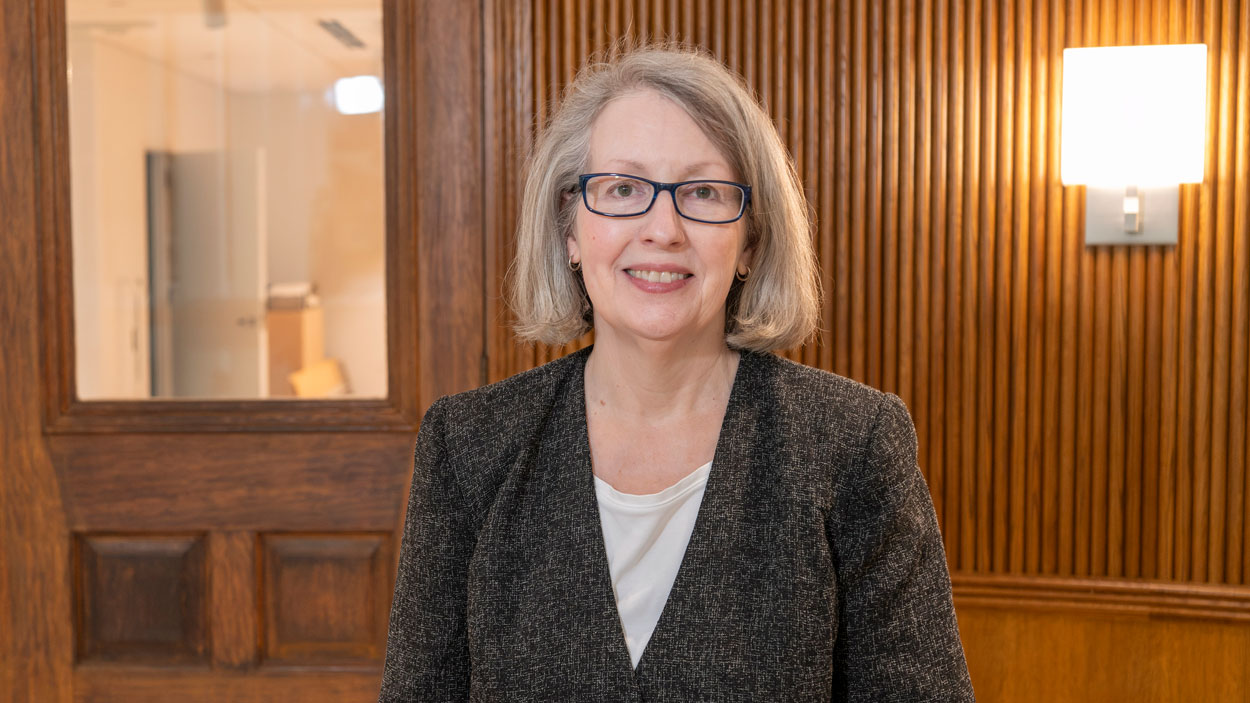
Julie Dunn-Morton started as the first full-time art curator for the St. Louis Mercantile Library in 2002 and will be retiring from UMSL. Recently, she helped bring the new Wallace H. Smith Gallery of Art to life. (Photos by Derik Holtmann)
Walking through the new Wallace H. Smith Gallery of Art at the St. Louis Mercantile Library last fall felt a little surreal for Julie Dunn-Morton.
“You think about it and you plan for it, with all the different levels of publication and the wall text and the events,” Dunn-Morton said. “There was a big team of people making that happen, and we all worked really hard on it. Then, the thing that we really hoped for happened, we had our opening reception and people enjoyed it and asked questions, and it was extremely exciting and gratifying. It was a real career highlight.”
The nearly 7,000-square-foot gallery was created during a $12.1 million, 65,000-square-foot renovation of University Libraries, which is a central component of the $110 million Transform UMSL initiative. But the vision for the new art gallery, brought to life by Dunn-Morton and her colleagues, stretches back much longer.
Dunn-Morton, the library’s endowed curator of fine art and an endowed research professor at the University of Missouri–St. Louis, first started talking about a gallery space with John Neal Hoover, the executive director of the St. Louis Mercantile Library, not long after she joined the Mercantile staff as its first full-time art curator in 2002. At the time, there was a space on the first floor of the library that could be used for rotating special exhibitions, but it wasn’t the most effective way to display those pieces. Eventually, a space was carved out to host a small gallery, but plans got put on hold when the COVID-19 pandemic hit.
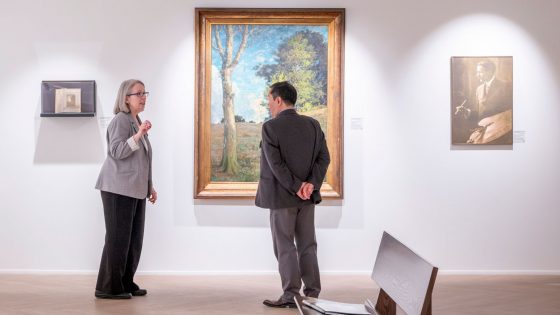
Dunn-Morton speaks with University of Missouri System President Mun Y. Choi during a tour of the new gallery in November.
When plans for a major transformation of University Libraries, which included moving all the staff offices to another floor, started taking shape, the opportunity for a new gallery finally presented itself. And instead of the small, 2,000-square-foot space that was initially planned, the gallery would be getting close to 7,000 square feet.
Dunn-Morton immediately began working with Hoover on fundraising for the new gallery, and they are extremely grateful to the Bellwether Foundation, the Kemper Foundation, the Orthwein Foundation and the Kranzberg Arts Foundation, as well as the private donors who helped bring the gallery to life. During the planning stage, she played a pivotal role in the design of the space, making sure that elements such as storage, security and climate control were appropriately addressed and weighing in on design elements such as wall colors and light fixtures.
The gallery officially opened last fall, along with two other new galleries on the entrance level including the Medart Gallery dedicated to rare books and the Seifert Gallery for works of art. The Wallace H. Smith Gallery of Art will feature changing exhibitions, with its inaugural exhibit, which is on view through July 31, highlighting the work and influence of the esteemed Frederick Oakes Sylvester. Dunn-Morton said Sylvester is a very important artist both nationally and regionally, though she wasn’t initially familiar with his work before coming to the Mercantile.
Hoover, however, had been collecting his works for many years both because of his importance as an early tonalist and impressionist painter but also because of his river subjects, which were a good match for the Mercantile’s Herman T. Pott National Inland Waterways Library.
Dunn-Morton, who returned to work at UMSL after graduating with her degree in art history in 1987, has dedicated much of her research to Missouri artists, including a catalog raisonné of the works of Sylvester.
“In an American art history degree, you seldom get into regional art in any meaningful way,” Dunn-Morton said. “But I’ve learned a lot about Missouri art working at the Mercantile, and I’m just really fascinated and actually quite proud of Missouri’s role in our nation’s art history and how the Mercantile has taken that on as our collecting mission. It really gave me the opportunity to show all that I’ve learned and all the ways that John Hoover and I built this collection to tell that story of St. Louis’ cultural history and the role that Missouri has played in the nation’s art historical development.”
With that said, the Mercantile has greatly expanded its collection of works by Sylvester since Dunn-Morton joined the staff over 20 years ago. As she and Hoover began working on the new gallery and thinking about its inaugural exhibition, they wanted to focus on what would tell visitors as much as possible about the Mercantile’s mission and its collection. Focusing on the works of Sylvester – as well as his deep-rooted connections with other working artists in Missouri – was a natural fit.
“As I learned more about Missouri artists and St. Louis arts organizations, this whole web of connections revealed itself between Sylvester and other artists working in the city,” Dunn-Morton said. “You can begin to see through shared exhibitions, social groups, the way that they would meet, compare artwork, critique each other’s work, all of these shared influences became apparent. Sylvester’s works are very strong, and they’re also very popular in St. Louis, so we knew that would be part of the attraction. And focusing on him and his ‘circle’ also allowed us to bring in all these other artists that we’ve been collecting from the 1890s right into contemporary artists. It really allowed us to introduce our collection in a pretty exciting way.”
Dunn-Morton, who is retiring from UMSL in February, is proud to have played a role in bringing the Smith gallery to life and in introducing visitors to the work and influence of Sylvester and other Missouri artists. She hopes the new gallery’s prime location right off the lobby of the Mercantile Library will encourage passersby to stop in and not just view the art but learn more about Missouri history.
“The minute you walk into our lobby, you are seeing the contents of the gallery, and we love that quick glance,” Dunn-Morton said. “It gives us that visibility and that space to really explore in depth areas of the collection that just haven’t been displayed before or that couldn’t be displayed in a way that really tells that story. I think the gallery will give people the opportunity to learn on a lot of different levels, whether they’re casually walking through or reading all of the wall text and catalogs to get more in-depth information. I hope they can get better acquainted with the Mercantile Library and its collection and what we have available to people to learn more about their city, their state and the country.”