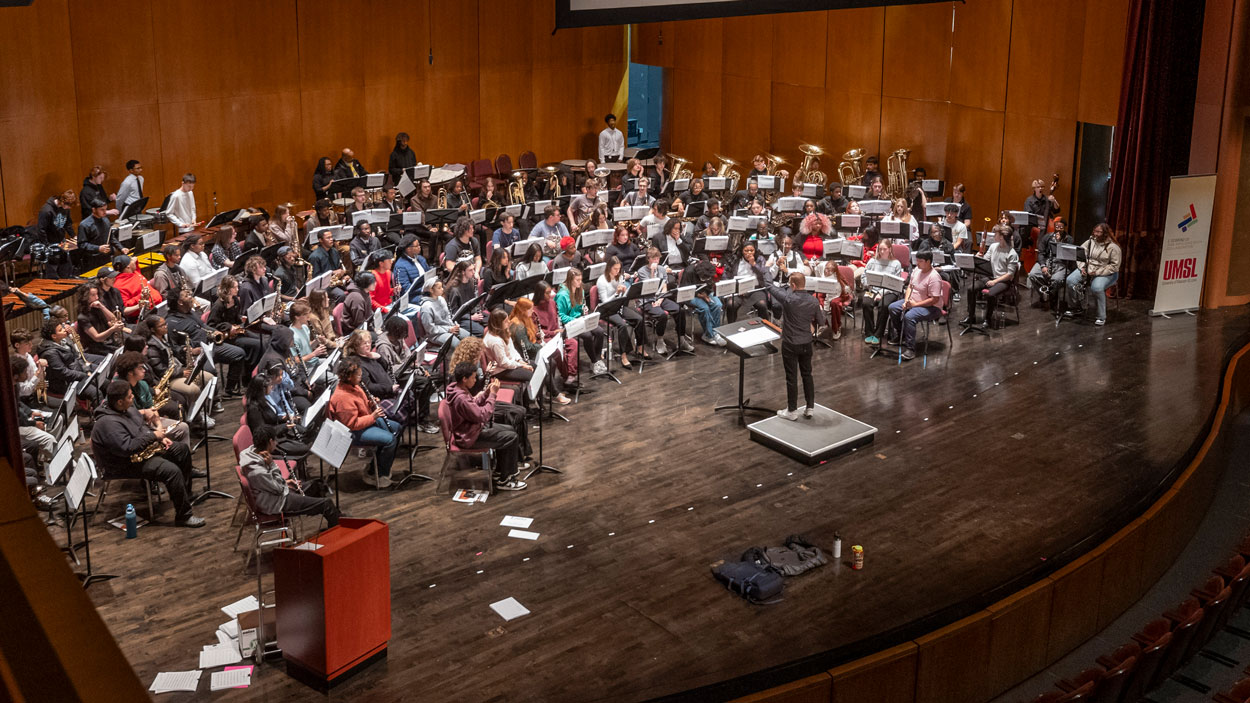
David Wacyk, director of instrumental ensembles and an assistant teaching professor of music at UMSL, conducts the high school concert band during the Des Lee Fine Arts Festival on Feb. 3. (Photos by Derik Holtmann)
Bayless High School band director Jeff Martini has been bringing his students to the Des Lee Fine Arts Festival for the past 11 years. He acknowledges that the festival is a lot of work, and his students are usually exhausted after a full day of rehearsing. But without fail, the next day they’ll ask, “When can we do that again?”
“That’s really the most exciting part, because they want to keep coming back,” Martini said. “It’s just a great opportunity for the kids to get out of our own classroom, our own environment, and to mix it up with other kids that they wouldn’t normally see or normally hang out with and make music.”
This year, Martini brought six of his students to the annual festival, held at the Blanche M. Touhill Performing Arts Center on the University of Missouri–St. Louis campus. His students were part of nearly 1,000 local high school and middle school students representing 15 school districts and more than 40 schools.
The festival, organized by the Des Lee Fine Arts Education Collaborative, provides an opportunity for students who have shown dedication to their school’s choir, band, orchestra and visual arts programs to practice and perform with fellow students from across the region and work with professional clinicians.
“The goal of our festival is simple: We want students to feel the joy of making art together, grow their skills and connect with peers from across the region,” said Michael V. Smith, the E. Desmond Lee Endowed Professor of Music Education at UMSL who serves as the director of the Des Lee Fine Arts Education Collaborative. “These are days where young musicians and visual artists – often from smaller programs – get to play in choirs, bands and orchestras far bigger than they normally would and see what they’re capable of when they collaborate and take risks. They learn from expert clinicians, make new friends and perform on a big stage with pride. We hope students leave feeling inspired, confident and reminded that their creativity matters – not just to their school, but to our whole community.”
Each year, Smith and his partners work to keep the festival fresh and responsive to what local educators and students want most. While the core of the festival – high-quality ensemble music rehearsals, concerts and visual arts showcases – stays the same from year to year, this year’s festival featured new partner artists, clinician collaborations and fresh activity formats designed to deepen learning, connection and creativity.
As one example, Denim Browder, a junior at Grand Center Arts Academy, helped guide portions of the festival from within the audience with some audience interview questions. “Denim represents exactly what this festival has always sought to cultivate: a young artist who has been encouraged, mentored and trusted, and who now steps forward to reflect the experience back to the community that helped form him,” Smith said. “His presence is not a departure from tradition, but a continuation of it.”
Sophia Fernandez, a junior at Pattonville High School, was drawn to the unique, immersive formats offered at the festival. She joined a group of students at tables outside the Lee Theater in painting T-shirts, taking inspiration from a microphone as her theme. Fernandez particularly enjoys painting and drawing portraits, so she made sure to incorporate a striking portrait of a woman singing into a rhinestone-bedazzled microphone. She plans to pursue a career in an art-related field, such as design or architecture, and appreciated the opportunity to build on her interest in visual arts and hone new skills at the Des Lee festival.
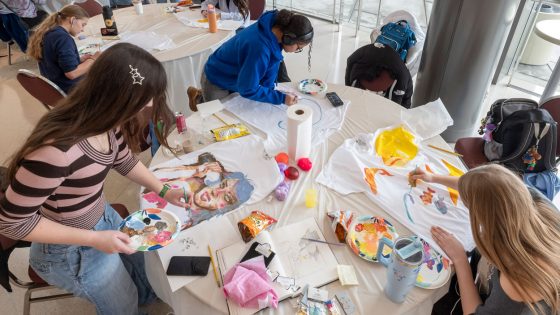
Sophia Fernandez, a junior at Pattonville High School (far left), paints a T-shirt during the festival.
“I’m in AP art right now, so I’ve been able to get a lot of experience on different projects through school,” Fernandez said. “Art is just really something I’m interested in. And I heard about this festival, and I heard we would be designing shirts, and that’s kind of something new that I haven’t done before.”
That’s exactly the kind of experience Smith hopes students take away from the festival, which builds on the mission of the Des Lee Fine Arts Education Collaborative to bring arts education out of the classroom and into a shared creative space.
“Whether they’re preparing music scores together, rehearsing in ensemble groups or installing their visual art in a public gallery space, the festival embodies the Collaborative’s belief that arts experiences should be inclusive, engaging and transformative,” Smith said. “It’s bigger than just one program or one school or one rehearsal room. I like to say that through the days of the festivals, students come together making music, making art and making new friends from across St. Louis.”
Nova Thompson, a sophomore at Orchard Farm High School, returned to the festival for a second year in a row after a great experience in 2025. She credits the festival with giving her the opportunity to meet new people, work with different band directors and improve her skills. Thompson, who has been playing the tuba since sixth grade and was especially excited to perform in a concert with her peers, said participating in the festival has made her a better musician.
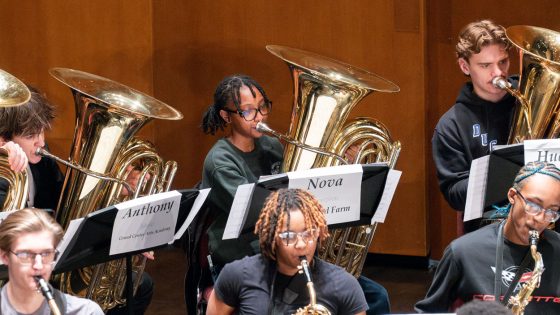
Nova Thompson, a sophomore at Orchard Farm High School, plays the tuba during the band’s rehearsal. She returned to the festival for a second year in a row
“It helps with sight reading and learning the rhythms,” she said. “It’s nice to be able to get answers quickly, because if you have a question, you can ask a conductor or someone next to you.”
This year’s festival was a bittersweet one for Smith, as it marks his final year serving as the director of the Des Lee Fine Arts Festival. While plans for who will take the reins next are still in the works, Smith hopes that the festival will continue to thrive and expand, noting that it’s become an important part of the regional arts ecosystem over its 20 years. In that time, he’s watched thousands of students grow, create and shine during the festival.
“For more than two decades, these festivals have nurtured young artists, affirmed creative identities, and built a community around the belief that the arts matter – deeply and lastingly,” Smith said. “What takes place on the stage and in rehearsals each year is inseparable from what has been unfolding in classrooms, rehearsal rooms and families across our region for generations.
“What is most striking about the festival today is not necessarily what is new, but what has endured. Sitting in the hall are parents – and increasingly, music and art teachers – who once sat on this same stage as students. Many of them first came to see themselves as artists and musicians through this very experience. They return now in new roles: as educators, as advocates, as families supporting the next generation. Their presence is living evidence that the festival does not simply present performances; it shapes lives and sustains artistic identity over time.”