
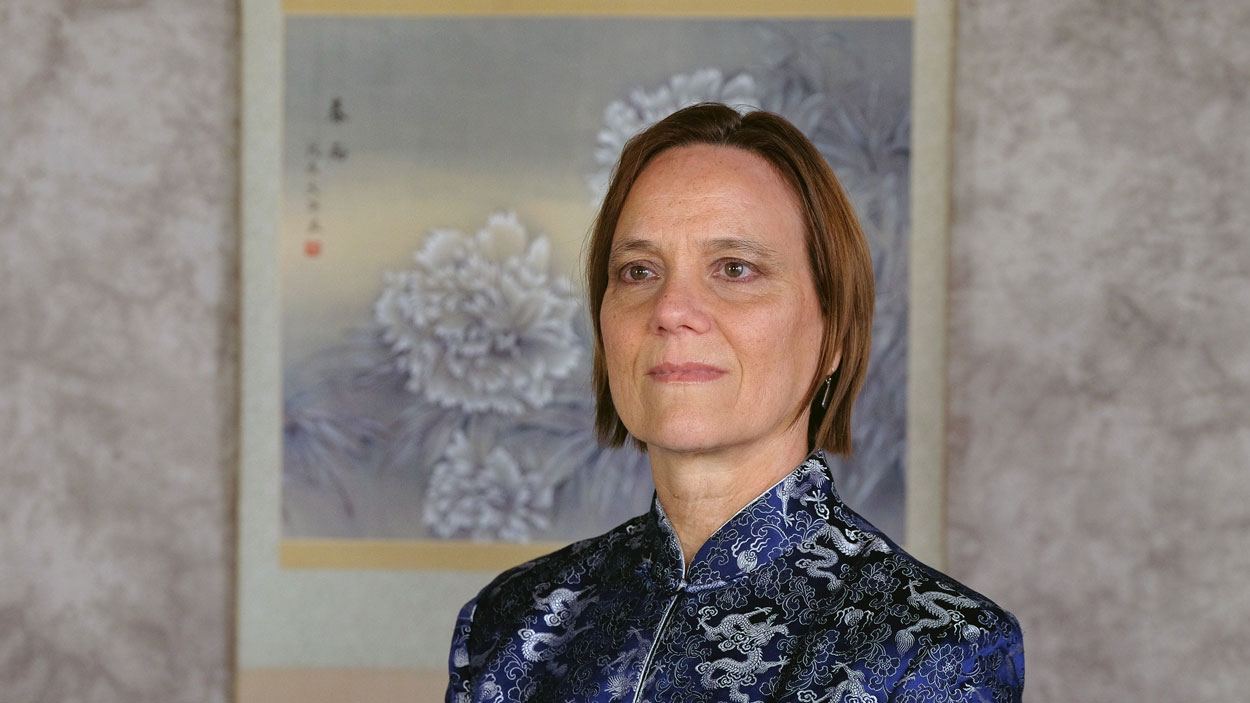
Susan Brownell, a Curators’ Distinguished Professor of anthropology in UMSL’s Department of History, is a noted expert on the Olympic Games and Chinese sports. (Photo by August Jennewein)
China’s first entry into the Winter Olympic Games came in 1980 at Lake Placid in New York. The Chinese waited 12 more years before claiming their first Winter Olympic medal, winning three silvers in speed skating at the 1992 Games in Albertville, France. It would be another decade before a Chinese athlete captured gold, with speed skater Yang Yang winning two at the 2002 Games in Salt Lake City.
But as Foreign Policy magazine highlighted in a series of infographics published on Feb. 13, China has enjoyed rising prominence in Olympic winter sports over the past quarter century. It finished fourth in the medal count and tied the United States for the third-most golds with nine at the 2022 Games it hosted in Beijing and is competing in a national record 116 events at this year’s Winter Olympics in Milan Cortina.
Foreign Policy spoke to University of Missouri–St. Louis faculty member and noted Olympic and Chinese sports expert Susan Brownell about China’s rise in a story that accompanied the infographics.
“The purpose of high-level sports in China is diplomacy,” Brownell told Foreign Policy.
That seems to have been clearly at play at the 2014 Winter Olympics in Sochi, Russia, when Chinese President Xi Jinping became the first Chinese head of state to attend a major international sporting event abroad. As Foreign Policy noted, he announced his intention to have 300 million Chinese people participating in winter sports – ones more commonly associated with the United States, Canada and European countries such as Norway, Sweden, Germany and the Netherlands.
Brownell, a Curators’ Distinguished Professor of anthropology in the Department of History, and a member of the National Committee on U.S.-China Relations, said that wasn’t the competition China was eyeing when it pushed to increase its place in Olympic winter sports.
“China doesn’t really care that much if it can beat Norway in the total medal count, especially in the Winter Games,” Brownell told Foreign Policy.
Rather, she suggested China was more conscious of neighbors Japan and South Korea, which hosted the 2018 Winter Games in Pyeongchang. So far this Olympics, China is trailing its East Asian rivals in the medal count with four medals – and no golds – compared to 17 for Japan and six for South Korea, but that could change with a week of competition remaining.