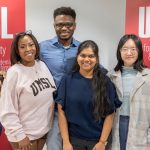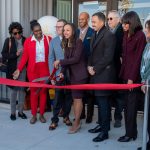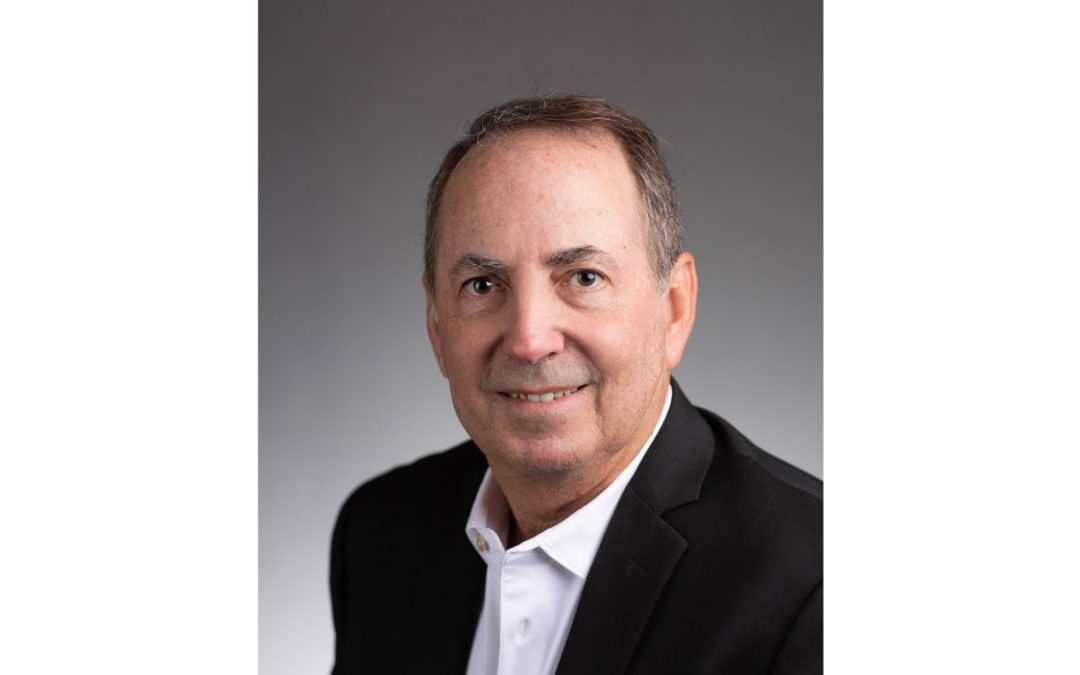
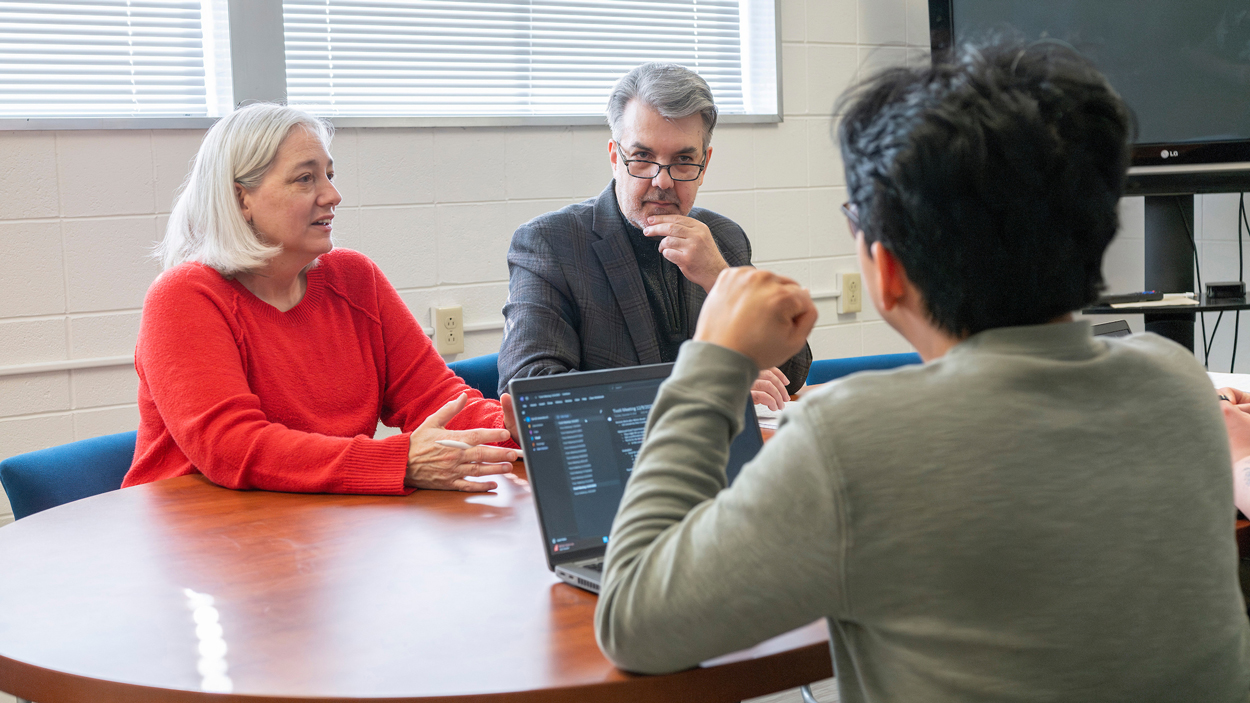
College of Education Dean Marius Boboc (center) developed the Community Learning Labs concept to reduce barriers and increase access to higher education by bringing the classroom to community members. Boboc envisions Community Learning Labs embedding wraparound educational and social services directly into trusted neighborhood spaces such as community and recreation centers, which will also serve as hubs of intergenerational learning and development. (Photo by Derik Holtmann)
Marius Boboc’s mind is immediately drawn to adult learners, particularly college noncompleters, when he considers opportunities for the University of Missouri–St. Louis to make a genuine impact in the community.
Boboc, dean of UMSL’s College of Education, notes that more than 40 million Americans have earned some college credit but have no credentials to show for it. However, going back to school can often be daunting and full of hurdles, such as childcare and transportation. Boboc believes the university can help ease those challenges by literally meeting adult learners where they are through a concept he’s developed called Community Learning Labs.
“One way to address the actual needs that they have is to find ways to take education back to the community,” Boboc said. “Instead of having them come here for a class – trying to juggle family life, work life and an academic career – being able to access academic resources in their neighborhood seems like an idea worthy of consideration. The second part of this conversation relates to older adults who may not seek a college degree, certificate or even a micro-credential, but they want to have access to services provided by a range of community agencies, one of which is a college or university.”
CoGenerate and the Stanford Center on Longevity recognized the transformative potential of the idea, and on March 10, the organizations announced UMSL as one of six winners of the Big Ideas Challenge to Reimagine Higher Education.
The national contest, launched in September 2025, encouraged higher education leaders to envision campuses as drivers of intergenerational collaboration and learning, while also fostering economic opportunity, lifelong learning and institutional sustainability. The Big Ideas Challenge is supported by the MetLife Foundation, and winners received a professionally produced video by Second Peninsula, a feature story and a place on a digital showcase to amplify their big ideas. The prize package will help winners create national visibility for their projects to help garner financial support.
“Even most college-connected programs for older adults operate in age silos – older adults in one place, younger adults in another,” CoGenerate Co-CEO Eunice Lin Nichols said. “Community Learning Labs at the University of Missouri–St. Louis are out to change that in a way that benefits people of all ages and the institutions where they gather. It’s our hope that this exciting model will spark the imagination of higher education administrators across the nation to try something similar in their campuses and communities.”
Boboc envisions Community Learning Labs embedding wraparound educational and social services – degree-granting programs, micro-credentialing, job training, counseling, tutoring and youth programs – directly into trusted neighborhood spaces such as community and recreation centers. This will shift the center of learning from campuses to neighborhoods, breaking down traditional barriers to education and creating environments where adult learners, older adults, displaced workers and youth learn, teach and train together.
Under the same roof, a high schooler might come to play basketball and stay to receive tutoring, while a working adult takes advantage of tax preparation services. Meanwhile, a retiree could obtain computer and digital literacy training to build skills that are not just beneficial but essential for living in the modern world. In turn, younger generations may benefit from older adults’ mentorship and wisdom.
“Community Learning Labs are spaces where diverse life stages intersect with shared purpose, whether you’re earning a credential, exploring a new career or gaining literacy skills,” Boboc said. “By creating a culture of learning that values everyone’s contribution, Community Learning Labs lay the groundwork for sustainable, community-rooted ecosystems of support where each generation uplifts the other.”
Boboc developed the concept with community collaboration and responsiveness in mind. The labs are not intended to duplicate existing services in a particular community. Rather, they would complement and promote established assets by bringing them together in a trusted neighborhood fixture, such as a community or recreation center.
Initially, Boboc plans to target areas in north St. Louis city and north St. Louis County that have historically faced disinvestment and been under-resourced. Depending on what each community needs, the wraparound services will differ from site to site. Identifying those needs will be achieved through a co-design process that involves community members and centers their feedback to ensure they have a say in the project. Through that process, Boboc said, the Community Learning Labs label might even change.
Ideally, the College of Education would be one stitch in the social fabric of the Community Learning Labs, with representatives providing an array of services including behavior analysis, counseling and tutoring. There’s also potential to build real-world internship experiences for students into the sites.
April Regester, chair of UMSL’s Department of Educator Preparation and Leadership and associate professor of inclusive education, stressed that the project is a two-way street. UMSL aims to undertake partnerships where the community’s lived experience informs its teaching, research and outreach. Thus, the university is not merely providing services but fulfilling its mission as a land-grant university and anchor institution in St. Louis.
“The Community Learning Labs are built on a foundation of true reciprocity,” Regester said. “While UMSL brings educational resources to our neighboring communities, we are there to learn just as much from the residents and local businesses. St. Louis neighborhoods have a deep well of institutional knowledge, cultural history and resilience that a traditional classroom can’t replicate. By listening to and learning from our community partners, UMSL becomes a more responsive, grounded and effective institution.”
The initiative is still taking shape, but Boboc has already engaged the mayor’s office, civic leaders and urban planners in St. Louis. At the suggestion of the latter, Boboc attended neighborhood meetings to gain an understanding of the pressing issues facing residents, and he has also secured partnerships with St. Louis nonprofits A Red Circle and Beyond Housing. The next step in the process is a feasibility study, after which he aims to establish the first Community Learning Labs in spring 2027.
Boboc is eager to get to work, particularly with the support of CoGenerate and Stanford Center on Longevity, but he knows that the College of Education now has a responsibility to bring the Community Learning Labs to fruition. In doing so, it will help lift up those who have historically been left behind so they too can succeed.
“There are lots of pockets of innovative ideas that thrive in various corners of the country,” Boboc said. “So, on that premise, I think to be selected speaks to the potential of this idea, but the selection also obligates us to deliver in terms of the vision for the concept of a Community Learning Lab. What we do here could represent a model that could be adapted elsewhere across the country.”