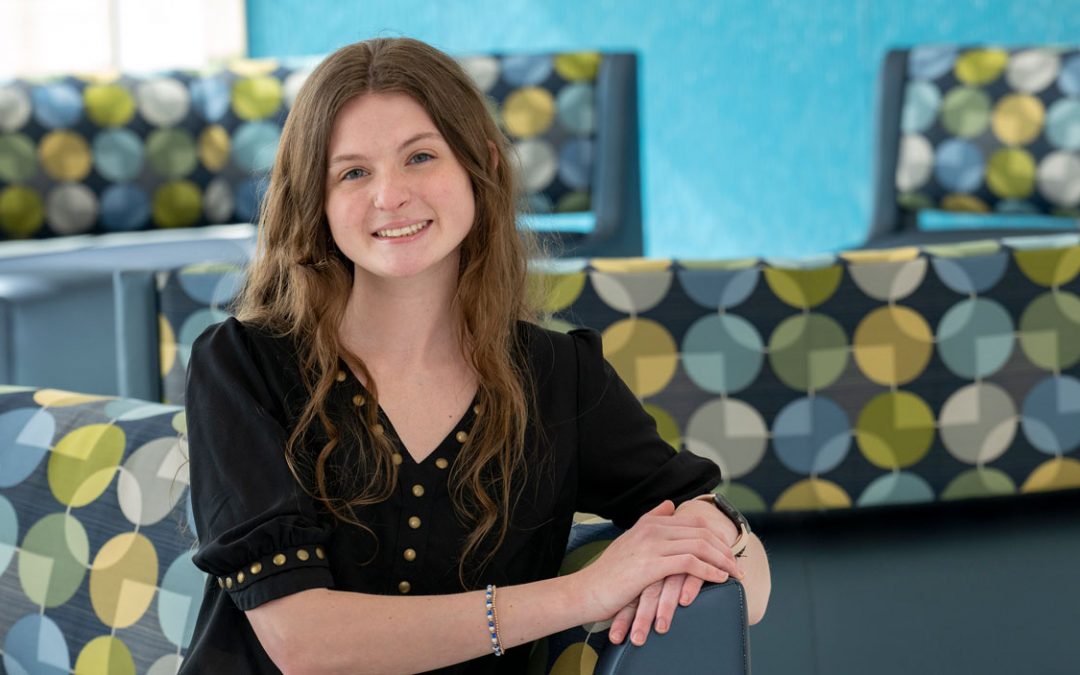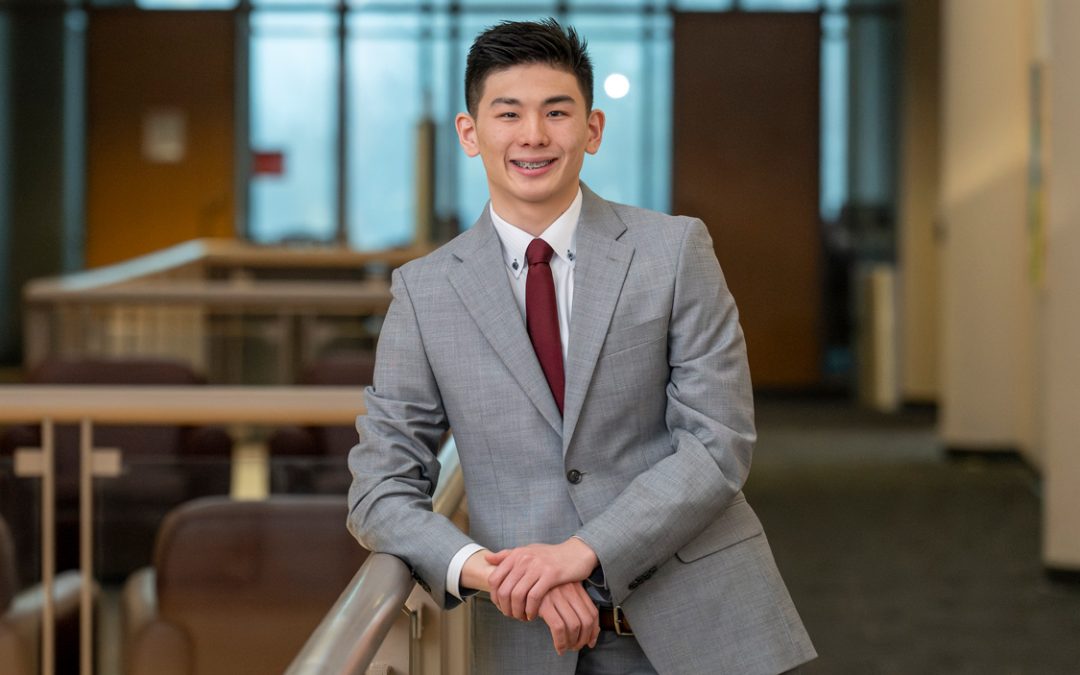
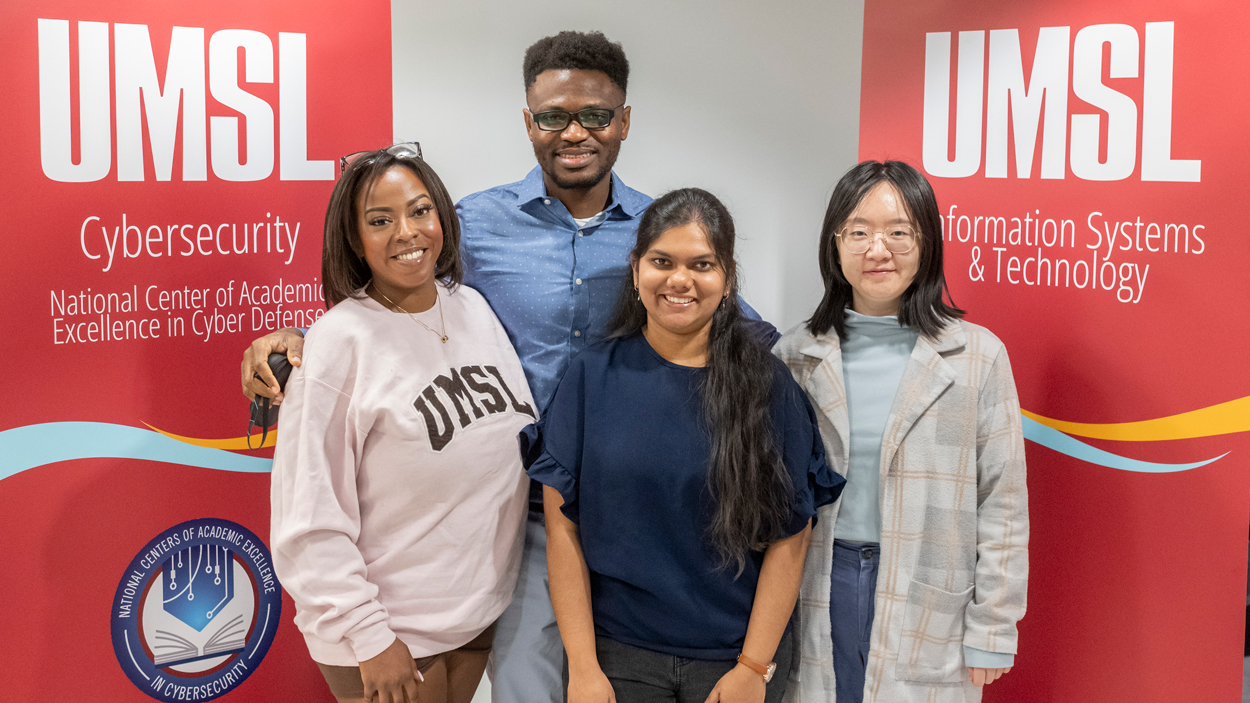
With Le Kuai (far right), an assistant professor in information systems and technology, serving as the faculty liaison, a team of five UMSL students recently placed third in a regional bracket for the NCAE Cyber Games, a competition forcing teams to defend a complex network of virtual machines against cyberattacks. Team members include (from left) Merilyn Gibson, Ernest Bobmanuel and Jahnavi Mannam. Not pictured are Maisa Salahaldin and Jordan Godwin. (Photo by Derik Holtmann)
For a team of students from the Ed G. Smith College of Business at the University of Missouri–St. Louis, March 14 was an exhausting day. In the best possible way.
The quintet of Merilyn Gibson, Jordan Godwin, Ernest Bobmanuel, Jahnavi Mannam and Maisa Salahaldin placed third out of 13 teams in a regional bracket of the NCAE Cyber Games. It was the first time a group representing UMSL had ever participated in the event, hosted by the National Centers of Academic Excellence in Cybersecurity, which provides students interested in cybersecurity the opportunity to build their skills and learn about the industry while competing against teams from colleges across the country.
“I’m really proud of them,” said Le (Carol) Kuai, an assistant professor in information systems and technology who was the faculty liaison.
Over a 7½-hour period, which included a 1-hour lunch break, teams worked together to defend a complex network of servers, routers and other virtual machines against a barrage of hackers attempting to exploit hidden vulnerabilities. They solved digital puzzles, analyzed suspicious activity and protected critical data from simulated cyberattacks, all while working to keep the system secure and running efficiently.
“It was just, like, go, go, go, nonstop,” said Bobmanuel, who is scheduled to graduate in May with a master’s in cybersecurity. “You’re basically being attacked, with all kinds of problems coming at you, fishy accounts being created that will target a particular system, creating backdoors and stuff like that. Your job is to go in there, kick them out, figure out what backdoor they’re using, try to block that. And all these things are happening in real time.”
Teams accumulated points while they were able to keep the system functioning. There were also a variety of “capture the flag” challenges that popped up throughout the day, presenting singular problems to solve for additional points. When the competition ended at 6 p.m., UMSL had 4,966 points, finishing behind only a pair of teams representing Eastern Washington University.
“It’s quite a feat for a new group to actually have come in third,” said Jarad Perry, a teaching assistant to Kuai last fall who graduated in December with a master’s degree in cybersecurity and served as an advisor to the team. “Having done similar competitions, it’s not easy when you’re there all day and you’re trying to keep stuff working and then trying to figure out why it’s not working. There’s a lot going on.”
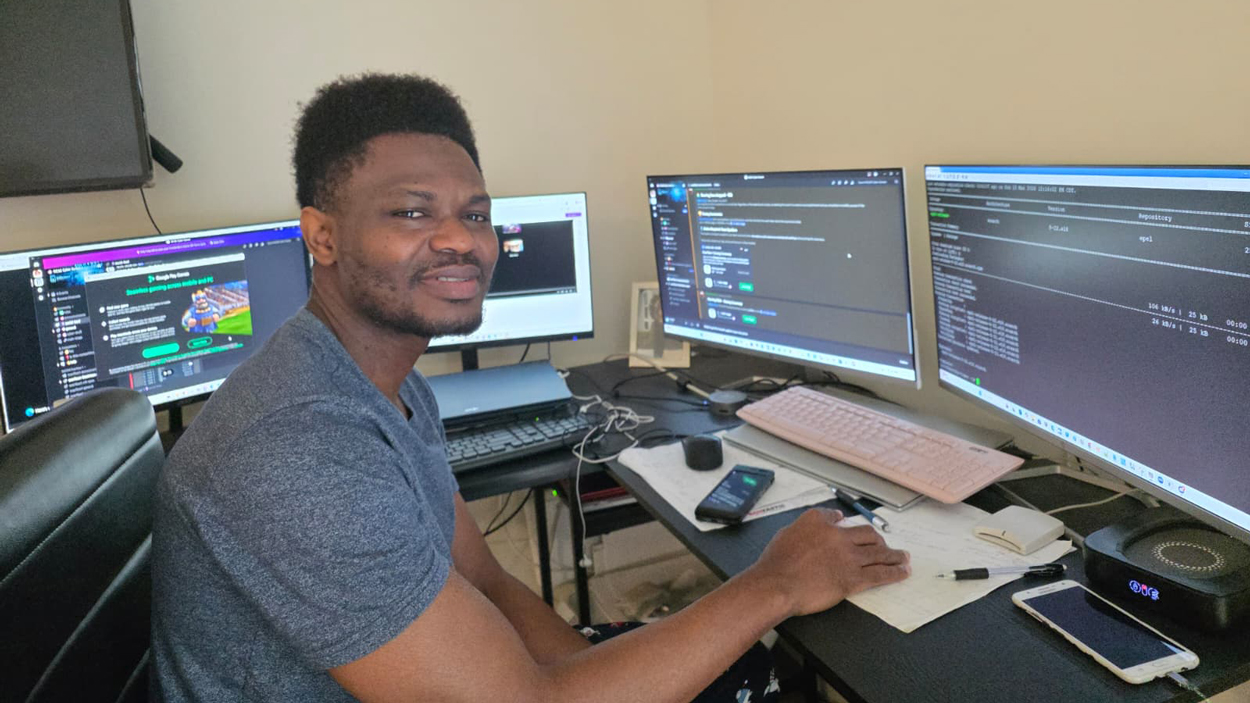
Graduate student Ernest Bobmanuel competes in the NCAE Cyber Games on March 14 as a member of a five-person team representing UMSL. (Photo submitted by Ernest Bobmanuel)
And it took a lot out of the team.
“Once six o’clock rolled around, I was like, ‘Man, I’ve got to go to bed for the next two days,’ because we worked for it, that’s for sure,” said Godwin, who is scheduled to graduate in May with a bachelor’s degree in information systems and technology and a minor in cybersecurity. “It was very fun, but it was very stressful.”
It also provided very valuable, real-world experience for the students hoping to build a career in the fast-growing, high-demand field of cybersecurity.
“The greatest value of these competitions is the hands-on aspect of it, being able to get in and see how to keep a web server up or a database server up, see what actual pen testers or hackers would do to a system in ways they get in there,” Perry said. “So, it allows you to take all the theory you’ve learned, and you actually get to see it in practice.”
Like Bobmanuel, Mannam and Salahaldin are both pursuing a master’s in cybersecurity. Salahaldin, who will graduate this May, earned her undergraduate degree in computer systems engineering, while Mannam received a bachelor’s degree in computer science. Mannam is in the second semester of her master’s studies, and she said she would strongly recommend all students who are considering a career in the industry participate in this type of competition at least once.
“In our courses, we will learn how to do things in a particular assignment or a particular project, but this helps with understanding what a real cybersecurity professional has to do,” she said. “If you’re going to do this job in a company, how is it going to be, and what are the real challenges that you’re going to deal with? I feel like this gave me a good experience, and I can mention it on my resume, which will be a boost for my job search in the future.”
Salahaldin agreed and welcomed the event as an opportunity to apply what she has learned in the classroom, stating that the ability to tackle live challenges alongside the team in a fast-paced, high-pressure cybersecurity competition provided meaningful real-life experience.
“Opportunities like this at UMSL have helped me build confidence in my technical and problem-solving skills and given me a clearer understanding of what to expect in my future career in cybersecurity,” she said.
For Gibson, who spearheaded the effort to form the team, the competition gave her the chance to try something new. A sophomore working toward a bachelor’s degree in information systems, Gibson said she was looking for something in the tech industry that would push her out of her “comfort spot,” and after the successful experience, Gibson is considering a minor in cybersecurity.
“I don’t know about anybody else, but sometimes I don’t feel as confident not having that hands-on experience,” she said. “But now that I’ve done this competition, I can say I have a little bit of hands-on experience. I can say that I’ve seen firsthand the things that can really happen within a business as far as cybersecurity, and I’m not going to freak out. I kind of know the different avenues that I can go to solve a problem.”
It’s a great example, Perry explained, of how UMSL goes above and beyond to provide the opportunities that really make a difference for its students.
“The faculty support and the department support from Dinesh (Mirchandani, Professor and Department Chair) and Carol is really important to give students the opportunity to do things like this, and I think that really sets UMSL apart from other universities, honestly,” Perry said. “Even though they were brand new to this competition, the fact they got the opportunity and they took it and they owned it – I think that speaks a lot about them and also about the department’s response to how the world is changing.”