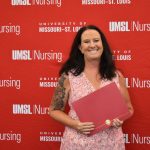
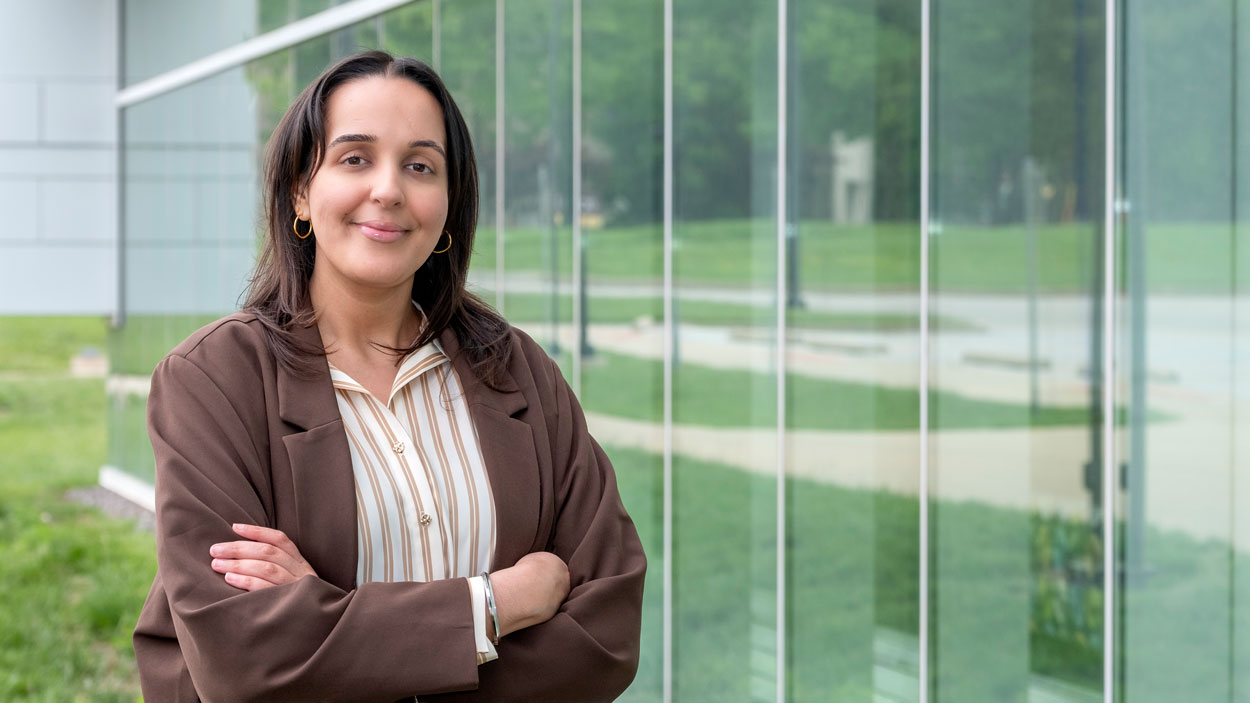
Airshpreet Kaur graduated from the College of Optometry in May. On July 1, she’ll be starting a year-long residency at The Eye Institute of the Pennsylvania College of Optometry at Drexel University in Elkins Park, Pennsylvania. (Photo by Derik Holtmann)
Airshpreet Kaur is a firm believer that many of us take our vision for granted. She knows firsthand how much the ability to see can change someone’s life – and that belief was cemented while earning her degree from the College of Optometry at the University of Missouri–St. Louis.
Earlier this spring, for instance, Kaur performed a comprehensive eye exam on a patient in her 50s who had only ever worn over-the-counter reading glasses. When Kaur showed her patient, who works as a school bus driver, the difference in what she would be able to see with her new pair of glasses, she got extremely emotional. She hadn’t realized how long she’d gone without being able to see properly.
“We forget how much we rely on our vision” Kaur said. “A lot of times I see patients that have not had an eye exam in years – maybe they’re in their 40s, their last eye exam was when they were children, and they’ve never worn glasses. There’s something special to me about being able to show someone, ‘This is how blurry your vision has been for however long. And this is what it looks like with a pair of glasses.’”
Kaur has known from an early age that she wanted to work in healthcare. Her mother is a nurse and would often bring her along with her during evening shifts at the nursing home where she worked. As a child, Kaur enjoyed interacting with the patients, and as she got older, she was drawn to the idea of becoming a doctor and taking care of her own patients as a provider. When she went for her annual eye exam during her first year as an undergraduate at Rutgers University in her native New Jersey, her mother mentioned Kaur’s interest in the medical field to her optometrist, Dr. Lourdes Lherisson, who invited her to shadow her at work. Immediately, Kaur knew optometry was a fit.
“I just loved it,” Kaur said. “I’ll never forget Dr. Lherisson telling me, ‘There is nothing better than giving someone the ability to see.’ That is something that resonated deeply with me and has stayed with me my entire career thus far.”
Kaur’s journey as an optometry student was a little unusual, however, as she came to UMSL’s College of Optometry as a second-year student. After earning her bachelor’s degree from Rutgers, she started optometry school in Michigan but decided to step away, taking a gap year for personal reasons before applying to a few different optometry schools across the country. When she came to UMSL for her in-person interview, she felt right at home.
Kaur enrolled in the College of Optometry in August 2023 and hasn’t looked back since.
“I do look back on my first day, and smile at how nervous I was to be the new student,” Kaur said. “I just wasn’t sure what to expect. I’m so grateful to be a part of the class of 2026, who welcomed me with open arms.”
During school, Kaur served as vice president of UMSL’s chapter of the American Optometric Student Association and enjoyed being able to get involved on campus and facilitate opportunities for her fellow students to network with various eyecare vendors. She also gained valuable hands-on clinical experience working as a teaching assistant in the third year Ophthalmic Optics and Clinical Optometry IV courses as well as volunteering through UMSL’s chapter of Student Volunteer Optometric Services to Humanity at a Native American reservation in South Dakota and a homeless shelter in Chicago in her fourth year, which helped her determine her future path in optometry.
Last fall, for instance, she completed a rotation at Chicago Lighthouse, a renowned nonprofit organization serving the blind, visually impaired, disabled and veteran communities. While there, she met a patient in her early 30s with an eye condition known as hemeralopia, or daytime blindness, that made her extremely light-sensitive. The patient had heard about specialized tinted contact lenses that had done wonders for other patients with daytime blindness and was curious if she’d be a candidate. Kaur was able to get the patient the contact lenses, which she said were an immediate gamechanger.
“Her personality came out,” Kaur said. “She had always carried around at least two to three different pairs of sunglasses to help with light comfortability. With the tinted contacts, she found she was able to sit comfortably indoors without needing to wear one of her many sunglasses. She even followed up during the holidays, sharing she was able to see snow for the first time without needing her sunglasses.”
Having earned her Doctor of Optometry from UMSL last month, Kaur knows that more of those moments are on the horizon. On July 1, she’ll be starting a year-long residency at The Eye Institute of the Pennsylvania College of Optometry at Drexel University in Elkins Park, Pennsylvania. She’s excited to be a little closer to home back on the East Coast, but even more so, she’s looking forward to learning and growing as a low-vision specialist specifically and as a provider more generally.
“I genuinely just love what I do,” Kaur said. “I pride myself in being a clinician who truly wants her patients to know what’s happening with their eyes and overall health. Even if it means spending a few extra minutes, I don’t mind, because for me, I feel like I cannot do my job well unless they’re actively part of the process and doing what they should be doing at home in taking care of themselves. If you have diabetes, for instance, you should be actively monitoring your sugar, and taking your medications as prescribed by your managing providers. In addition, you should be coming in for your annual eye exams to rule out diabetes in the eyes, or diabetic retinopathy, which can lead to irreversible vision loss if left untreated.”
Kaur’s residency will specialize in low vision rehabilitation, which she is extremely passionate about. Between an aging population and rising rates of conditions like age-related macular degeneration and glaucoma, there is a critical need for more low-vision specialists in the United States. Kaur dreams of one day operating her own low-vision clinic, where she can help people adjust to vision loss in everyday life. This includes helping patients get tools like magnifiers, special reading devices and tinted sunglasses to improve lighting and contrast to make things easier to see. She would also be able to help connect patients to local and national organizations to help people with vision loss. As she embarks on that journey, she feels that her education at UMSL has prepared her well.
“I don’t think I would be able to do the residency if it wasn’t for UMSL,” Kaur said. “Just in terms of the experience that I’ve gotten, the knowledge I’ve obtained, and the support I’ve gotten from my classmates, the faculty and the staff, I think because of that, I felt more encouraged to even pursue this residency.”