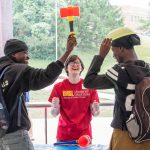
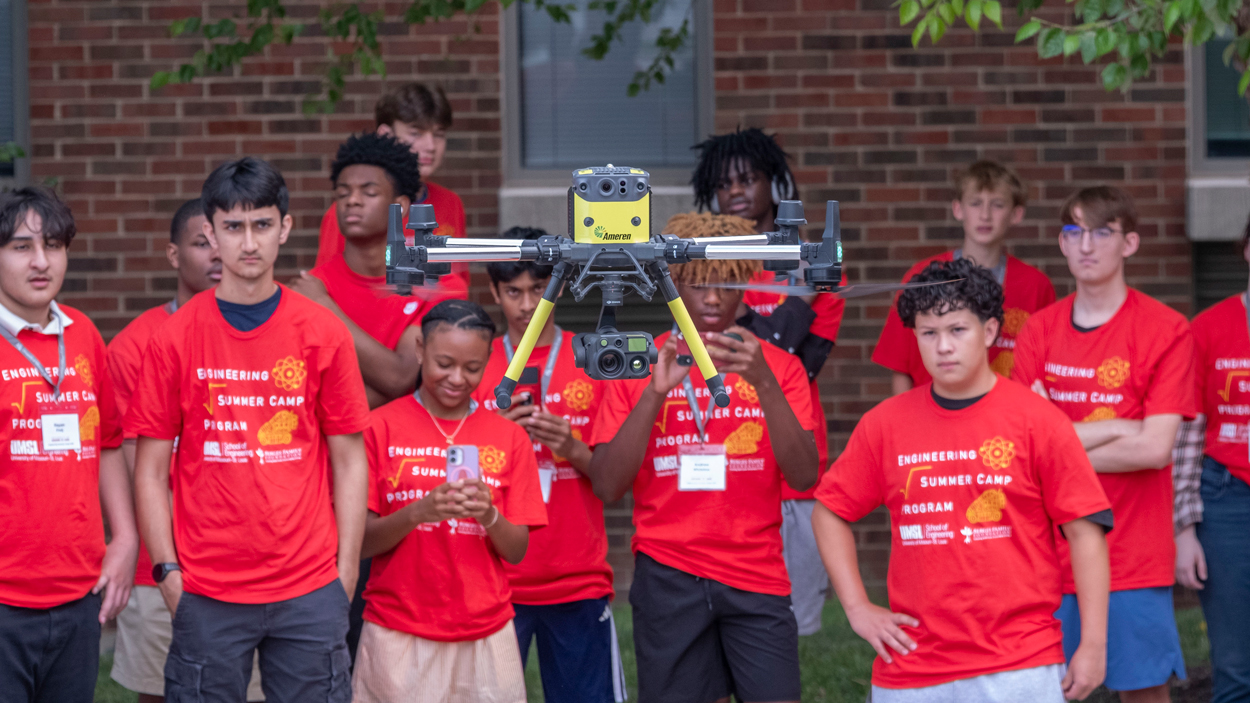
High school students observe a drone exhibition by an engineer from Ameren during the Engineering Summer Camp at the University of Missouri–St. Louis. The university hosted 21 students from over 10 regional middle schools June 15-18, while 40 students representing nearly 20 high schools from around the St. Louis metropolitan area attended the camp June 22-26. (Photos by Derik Holtmann)
The goal of the University of Missouri–St. Louis Engineering Summer Camps was simple: introduce middle school and high school students to the creativity, problem-solving and innovation that define the engineering field.
But the impact extended beyond hands-on projects and classroom experiences. The camps also gave students their first look at the opportunities available through UMSL’s School of Engineering and helped plant the seeds for a new generation of Triton engineers.
“UMSL really opened my eyes,” said Kirubel Samson, who will be a senior at Pattonville High School. “After taking this engineering camp, I’m really interested in coming here.”
Samson was one of 40 students representing nearly 20 high schools from around the St. Louis metropolitan area who attended the camp June 22-26. With financial support provided by the Berges Family Foundation, UMSL was able to expand access and provide more students with the opportunity to explore engineering through immersive, hands-on activities. The university also hosted 21 students from over 10 regional middle schools June 15-18,
It was the second year of engineering camps and first to involve middle school students at UMSL, which welcomed its inaugural cohort of students to the new engineering school last fall. For many students who attended the camps, the exposure challenged their previous perceptions of what engineering could be.
“I thought engineering was just like construction sites, and now I see that there are a lot of different things to it,” said Ian Johnson, a sophomore at Ritenour High School.
Students built robotic arms, designed drones, explored advanced manufacturing techniques and learned how engineers use technology to solve real-world problems. They saw engineers applying their skills in professional settings to design and build airplanes at Boeing, and to construct a high-rise apartment complex managed by Clayco. They participated in presentations delivered by several other major companies including Ameren, Spire, True Manufacturing, Terracon and the Mechanical Contractors Association of Eastern Missouri.
“Our goal was to show how math and science is applied to solve real engineering problems, while giving students a glimpse into an engineer’s daily life through field trips and guest speakers,” said George Nnanna, the School of Engineering’s founding director. “This camp is far from theoretical. It is completely hands-on, allowing students to apply these concepts and see exactly how engineers use them in the real world.”
The camp attendees worked with faculty from the School of Engineering including professors Hamid Sanei, program coordinator for mechanical engineering, and Xin Wang, program coordinator for electrical engineering. They also learned from members of the Department of Chemistry and Biochemistry – department chair Keith Stine and professor Jinjia Xu – and the Department of Mathematics, Physics, Astronomy and Statistics – biophysics professor Sonya Bahar and adjunct faculty member Ashlynn Conner, an engineering physicist. The students learned about robotics, automation, electrical systems, programming, 3D printing and advanced manufacturing while also seeing how those areas connect to industries ranging from aerospace and health care to transportation and energy.
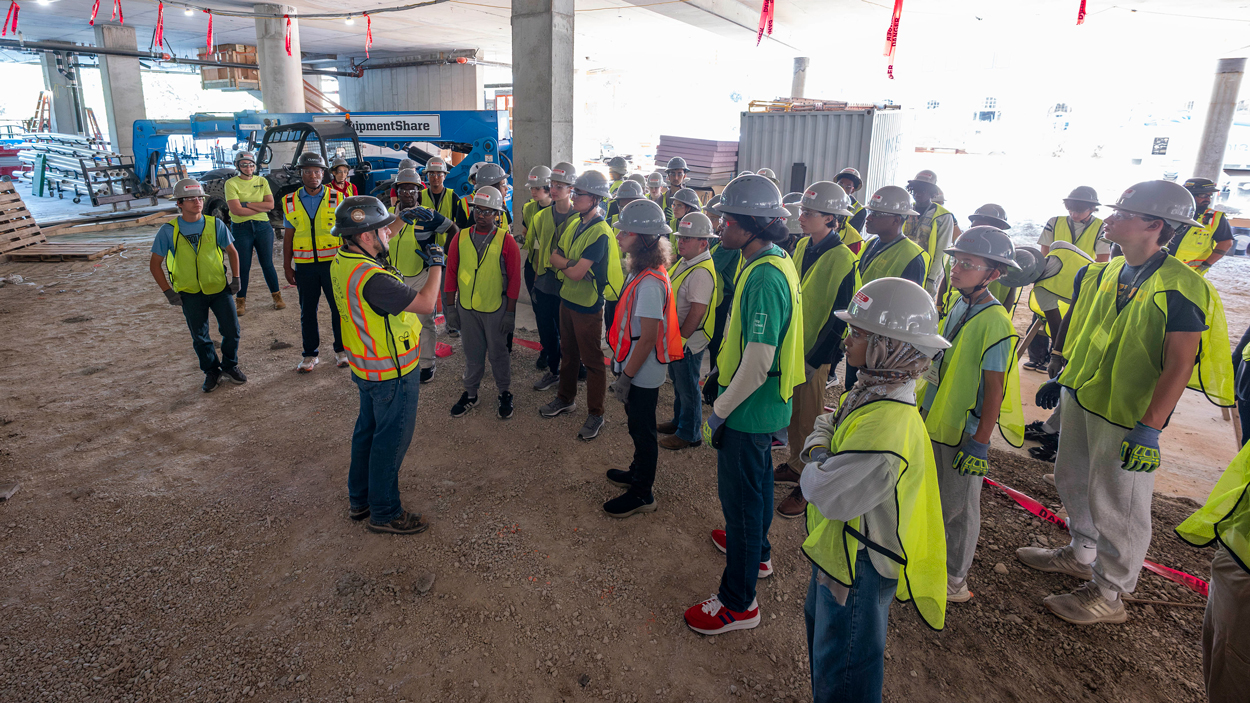
Senior project manager Matt Amrhein of Clayco addresses a group of high school students touring Clayco’s Albion West End Residential Tower construction site as part of UMSL’s Engineering Summer Camp.
“The future of engineering will require students to understand how different technologies work together,” Wang said. “So, by creating the UMSL engineering summer camp, we provide great early opportunities for middle schoolers and high schoolers to explore those meaningful fields and develop the essential skills and prepare them for the future workforce in the greater St. Louis area.”
Fanuel Amede, who will be a senior at Ladue Horton Watkins High School, said the camp helped him recognize that engineering is not limited to a single career path.
“This program has enlightened me on specific engineering concepts and specializations,” Amede said. “There are so many other things. It’s not just mechanical engineering, and I feel like going to these different places and having these presentations opened up what I want to be and opened up my brain to new possibilities.”
Creating those ambitions early is an important part of building the next generation of engineers, Nnanna said. The middle school portion of the camp was designed specifically to introduce students to STEM fields before they begin making decisions about their future.
“Studies show that if you don’t engage students at this early stage, they miss out on participating in the STEM ecosystem,” Nnanna said. “By the end of the week, 10 out of the 21 middle schoolers expressed interest in engineering. That is a great result. Moving the needle helps build the future workforce to drive our regional economy. Even if they choose another path, the camp succeeds by giving them a broader lens to see if engineering fits their future.”
For Missouri State Senator Brian Williams, who was heavily involved with securing funding for the UMSL School of Engineering, seeing so many middle school and high school students get exposed to these new opportunities through UMSL’s camps is what it’s all about. Also executive director of the Construction Career Development Initiative – a nonprofit organization connecting students with careers in engineering, construction and related fields that enabled the field trip to the Clayco job site in the Central West End – Williams said providing students with early exposure to engineering can help them envision a future in a field that offers meaningful careers and is critical to the region’s continued growth.
“I believe in what UMSL is doing,” Williams said. “Having a high-quality engineering program at one of the only public four-year research institutions in the St. Louis area is going to be a game changer, not only for the workforce, but it’s going to allow us to attract some of the most talented individuals from all over the world.”
Media Coverage
KSDK (Channel 5)