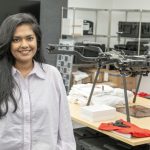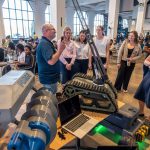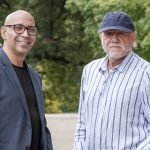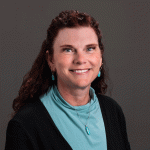
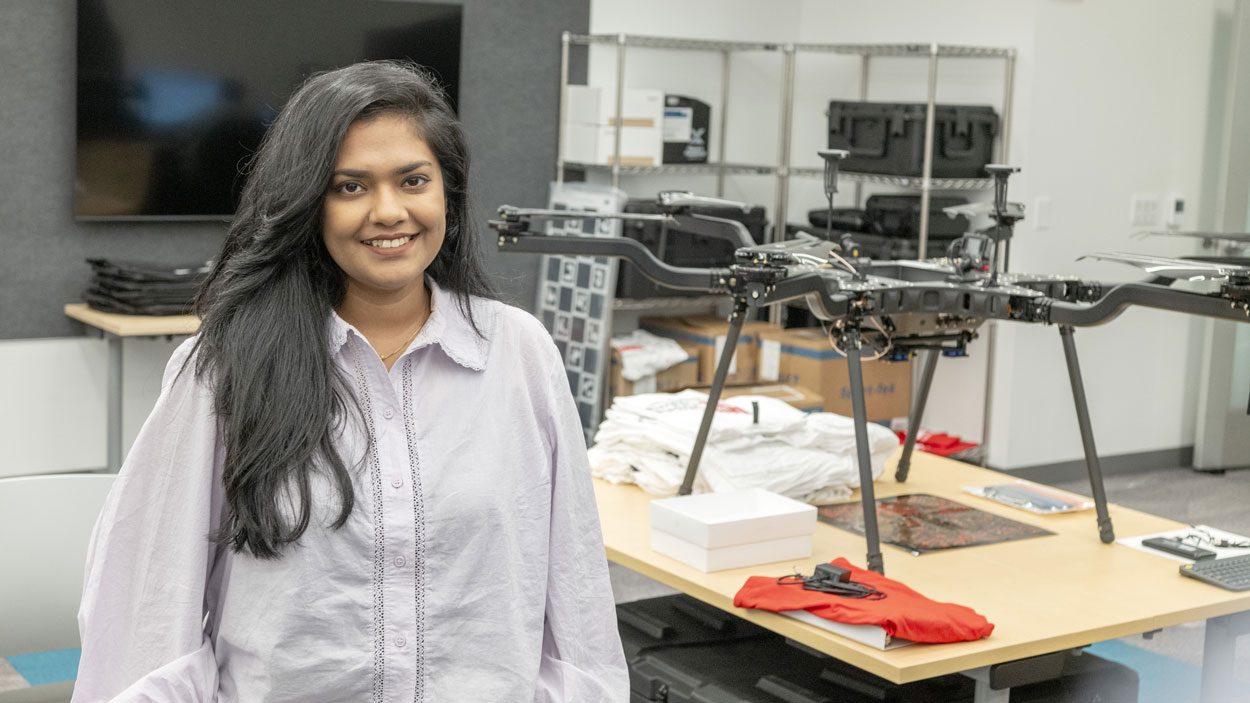
Supria Sarkar is serving as the Taylor Geospatial Research Scientist in the UMSL Geospatial Collaborative. (Photo by Derik Holtmann)
The University of Missouri–St. Louis Geospatial Collaborative is expanding its research activities with support from Taylor Geospatial.
Supria Sarkar has been hired to serve as a geospatial research scientist in a position funded through a two-year grant from Taylor Geospatial, a St. Louis-based nonprofit organization working to advance geospatial artificial intelligence – or GeoAI – and satellite data analysis for global public benefit, while increasing innovation capacity in the St. Louis region. She began her new role on Sept. 1.
“Supria’s appointment advances our vision for the UMSL Geospatial Collaborative as a university-wide hub for interdisciplinary research and innovation,” said Reda Amer, the director of UMSL’s Geospatial Collaborative. “Her expertise will deepen our partnership with Taylor Geospatial, a leader in geospatial research and innovation, and expand opportunities for faculty and students. We appreciate Taylor Geospatial’s investment in our shared commitment to advancing geospatial research and workforce development.”
She has also been tasked with identifying and pursuing grant funding opportunities through agencies such as the National Science Foundation, the U.S. Department of Agriculture, NASA, the U.S. Department of Defense and the National Geospatial-Intelligence Agency, to sustain and grow geospatial research at UMSL.
“We are happy to play a role in the continued growth of UMSL’s Geospatial Collaborative,” said Jennifer Marcus, Taylor Geospatial’s Vice President for Strategic Innovation. “We look forward to working with Supria to strengthen the foundation for GeoAI we are creating here in St. Louis.”
Sarkar arrived at UMSL after completing her PhD in geoinformatics and geospatial analytics from Saint Louis University in 2025.
Her journey into geospatial science started unexpectedly. She first enrolled at the University of Dhaka in her native Bangladesh, where she earned a bachelor’s degree in soil, water and the environment and studied the dynamics of climate change and the proliferation of greenhouse gasses. A course from her senior year provided her first exposure to geospatial technology and its power to help visualize and analyze complex data.
Sarkar came to the United States to pursue her master’s degree in geography and environmental resources at Southern Illinois University Carbondale. She served as a research assistant in the GeoFew Lab and developed predictive models for Harmful Algae Bloom intensity in Illinois lakes. She used ArcGIS to generate spatial prediction maps to support monitoring and decision-making efforts.
In her doctoral work at SLU, Sarkar shifted her focus away from environmental issues and toward projects involving agriculture and food security. As a research assistant in the Remote Sensing Lab, she pioneered advanced artificial intelligence techniques to sharpen satellite imagery for large-scale agricultural monitoring. She built and validated predictive models to assess vital crop biophysical traits, including biomass, yield and chlorophyll.
To tackle agricultural challenges on a massive scale, Sarkar developed fully automated software pipelines that process regional climate and Earth observation data, creating dynamic tracking tools for everything from simulating soybean growth trends to monitoring invasive species. She has published a pair of journal articles focused on predicting soybean seed composition using PlanetScope satellite imagery and machine learning and improving soybean yield and seed composition estimation.
“This is the perfect blend for my career,” Sarkar said. “It’s in the heart of geospatial science in St. Louis, and it’s the future. As a geospatial researcher, it’s incredible to see a true ecosystem emerging here. Between the NGA, Taylor Geospatial, universities like SLU, WashU and UMSL, and a booming startup scene, Saint Louis has become a remarkable hub. Being in this city and at this university is a tremendous opportunity.”