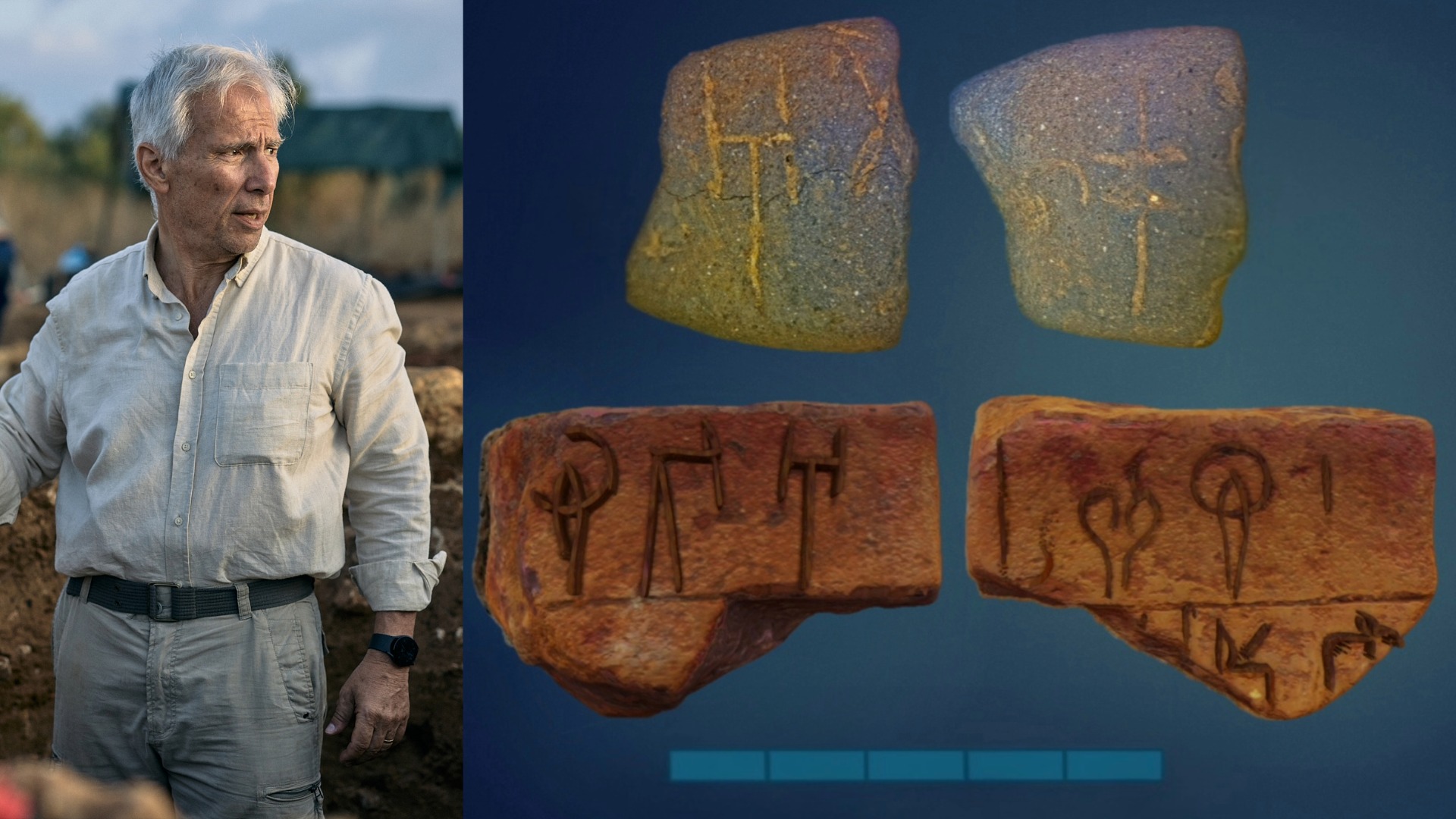
Archaeologist Michael Cosmopoulos and his team discovered a tiny clay tablet fragment, inscribed more than 3,300 years ago in Linear B, at Iklaina. The discovery offers evidence of local administrative recordkeeping in the ancient city at a time when the region was previously thought to have already been governed from the Palace of Nestor. (Photo courtesy of Michael Cosmopoulos)
A tiny clay tablet fragment, barely half an inch tall and inscribed more than 3,300 years ago, is helping archaeologists rewrite the history of how the earliest states and governments developed in ancient Greece.
The fragment, written in Linear B – the earliest known form of written Greek – was found at Iklaina, a major Bronze Age site in southwestern Greece, in 2025 during an excavation led by Michael Cosmopoulos, a Curators’ Distinguished Professor at the University of Missouri–St. Louis. It is the second tablet found at this site, after the discovery of the first one in 2010.
In the Mycenaean world, writing was a tool of government, used to record people, land, taxes and goods. The two tablets provide evidence of local administrative recordkeeping at Iklaina at a time when, according to the traditional view, the region was already governed from the Palace of Nestor.
“The discovery adds to growing evidence that the Kingdom of Pylos emerged through the consolidation of smaller, independent states towards the end of the Late Bronze Age, rather than developing under a single dominant center from the beginning,” Cosmopoulos said. “This gives us important new insights into how the earliest complex governments developed in Greece and other parts of Europe.”
Cosmopoulos gave the first detailed public presentation of the discovery on Thursday in a lecture titled, “Rewriting the History of Mycenaean Messenia: Iklaina and the Creation of the Kingdom of Pylos,” at the National Archaeological Museum in Athens. It was part of a lecture series accompanying the exhibition “Pylos of Nestor: A Mycenaean Kingdom Revealed.”
For decades, the prevailing view was that the Kingdom of Pylos, in Messenia, a region of southwestern Greece, had been unified relatively early under the rulers of the Palace of Nestor. But excavations at Iklaina have previously uncovered monumental “Cyclopean” architecture, beautiful wall paintings, elaborate infrastructure and evidence of sophisticated administration that challenge this traditional view.
These discoveries, together with the new tablet fragment, suggest that Iklaina was once the capital of an independent state that flourished alongside the Palace of Nestor before it was annexed by the expanding Kingdom of Pylos around the middle of the 13th century BC.
“What makes Iklaina especially fascinating is that its importance may have been remembered for centuries after its destruction,” Cosmopoulos said. “It looks like this powerful city is even mentioned in Homer’s Iliad, composed hundreds of years after the Mycenaean period. We cannot know exactly what memories survived, but it is remarkable that a place whose political importance had disappeared from history should still have a place in one of the foundational works of Western literature.”