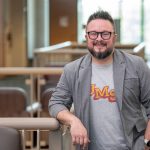
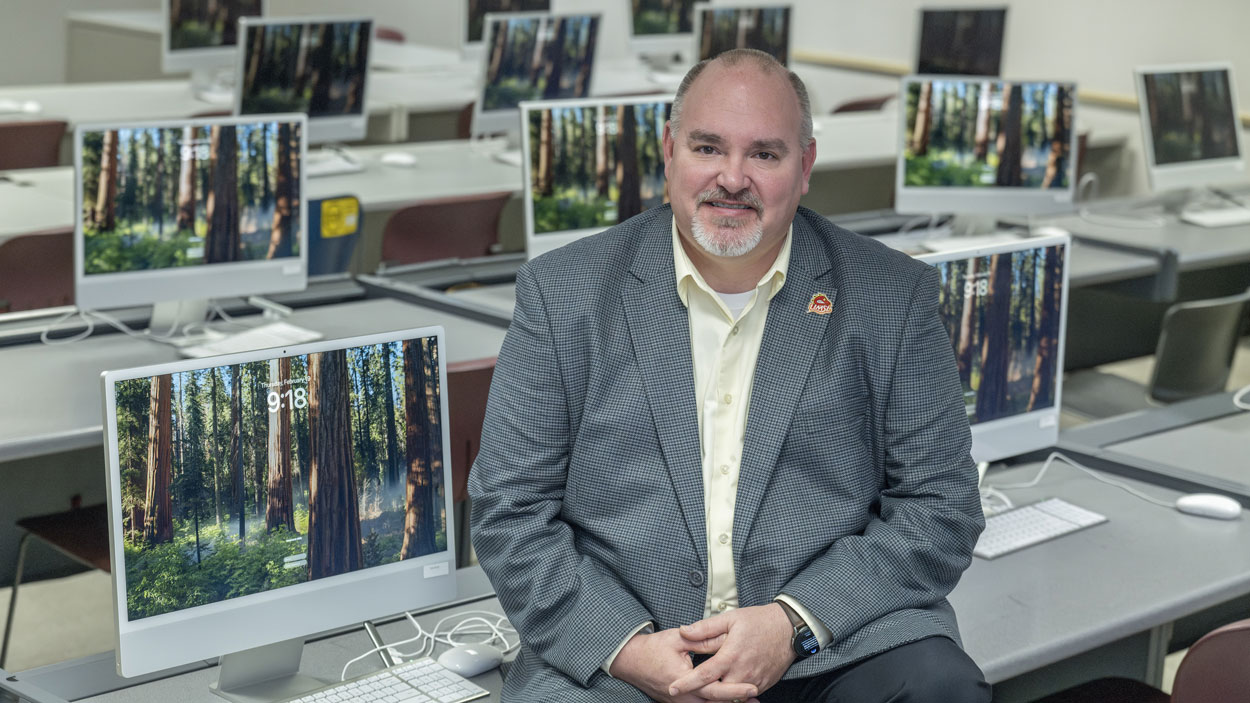
Chris Scheetz has been named the executive director of Information Technology Services and chief information officer at UMSL. He will officially begin his new appointment on March 1. (Photo by Derik Holtmann)
Chris Scheetz had a difficult time explaining exactly what he was feeling when he learned last week that he’d be getting the chance to serve as the executive director of Information Technology Services and chief information officer at the University of Missouri–St. Louis.
It marked the summit of a career climb that started more than a quarter century ago at UMSL.
Scheetz had kept the position as a long-term goal over the past decade while serving in other leadership positions within ITS. But he was still emotional when Tanika Busch, UMSL’s vice chancellor for finance and operations and CFO, informed him he’d earned the appointment. He officially begins his new role March 1.
“I don’t know if I’ve got the right word for it,” Scheetz said. “I was thoroughly excited. I had to take a breath and realize that what I had been working for or working toward for the past 25 years – I was going to get the opportunity to lead the department. I keep saying how thankful and excited I am for the opportunity. I’m just very appreciative – appreciative to be trusted to take on and lead this group of 44 staff and student employees. It’s humbling.”
Scheetz is well prepared after previously serving as director and associate director of IT for Customer and Support Services. He has directed IT procurement and led key initiatives to modernize core campus technologies, strengthen service delivery and guide important infrastructure transitions that support the university’s academic, research and administrative missions. He has also held the title of interim CIO since July.
“Chris has provided steady leadership and strategic direction for our Information Technology division for more than a decade,” Busch said. “I look forward to continuing our work together to ensure that technology remains a strong, innovative and reliable foundation for our university’s future.”
Scheetz’s first job at UMSL came as a student employee beginning in 1997. He had grown up in the town of Steele, in Missouri’s Bootheel, and enrolled at UMSL after receiving a Lillian L. Dahlen Payne Scholarship, which provided full tuition support to select students from Steele and surrounding areas at schools in the University of Missouri System. Scheetz had chosen UMSL because it took him away from home – but not too far – and provided a close community.
Joe Rottman, a professor of information systems and technology, offered him that first job supporting technology classrooms. At the time, Scheetz wasn’t certain of his career path, but he didn’t necessarily think it would be in IT. He remembers enrolling in a COBOL course as a freshman or a sophomore and realizing within a few weeks that programming was not for him. He dropped the class and switched his major to marketing.
But Scheetz, who earned his degree from the Ed G. Smith College of Business with a minor in transportation studies, has come to understand that there is far more to IT than the technical parts of field.
“I am never the smartest IT person in the room,” Scheetz said. “The goal is to surround myself with people that are experts in their field that can help us bring solutions to either a student issue or a faculty issue. I’ve always seen myself as more of a liaison between the IT people and our customer, being able to understand just enough of the technical to work with the end user to come up with the solution.”
That approach has served him well from his days as a student employee and into his first full-time position as a site supervisor managing the day-to-day operations of academic technology classrooms. He did that job for just over a year before getting promoted to supervisor over all the instructional computing computer labs and classrooms.
Technology touches areas all across the university and is always changing, so Scheetz found it to be a dynamic work environment, and UMSL afforded him opportunities for advancement.
He also found leadership support and training through participation in programs such as the UM System’s Administrative Leadership Development Program that have helped in his career growth.
“Several years ago, I took over operations for our Triton card,” Scheetz said. “It was an area I had no experience with, but I had some basic infrastructure knowledge, had management skills, and was able to develop a team. We went to RFP for a door access control system. There was an opportunity to be had due to the issues we were having with the previous system, so we built something that is in use today and continuing to be developed and grown.
“Being willing to take opportunities that may not be the most comfortable because I may not have the experience – that’s never phased me. I’ve always been willing to educate myself.”
That’s true even today as he works to ensure that ITS is meeting the evolving needs of the university community.
UMSL recently completed a migration from Xerox to Kyocera for printing services across campus. Scheetz expects ITS to soon be working to replace the university’s aging telephone system in a way that meets the needs of modern users in a day when Microsoft Teams and Zoom offer alternative tools for communication.
ITS is in the process of completing a SharePoint migration to the cloud, and he knows he and his team will have to think through other questions about the university’s footprint in a cloud environment and whether that should completely replace the need for servers in a physical data center.
The biggest changes ahead in IT revolve around artificial intelligence.
“We need to figure out how we can provide AI tools to the campus as a whole while ensuring everyone understands what AI is and the risk that can be associated with that and how we can maintain our intellectual rights,” Scheetz said. “The last thing we want to have happen is somebody’s research to be fed into an AI model prior to them getting to publish and present their work and their findings. So, how do we do that in a in a way that doesn’t inhibit our mission but enables us to do it smarter and faster?”
While Scheetz and his team work through those questions, he plans to maintain the same customer-centric approach he’s always taken throughout his career.
“We need to gain the trust of our users so that we can support them so that they’re willing to come to us and share whatever challenges that they may be having,” he said. “IT is probably at its best when it’s not being thought about. We don’t want to be out there because we’re having issues. We want to be there because the tools that we have are working and are allowing faculty, staff and students to do their research, take their classes and graduate.”