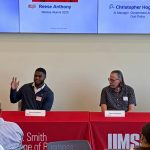
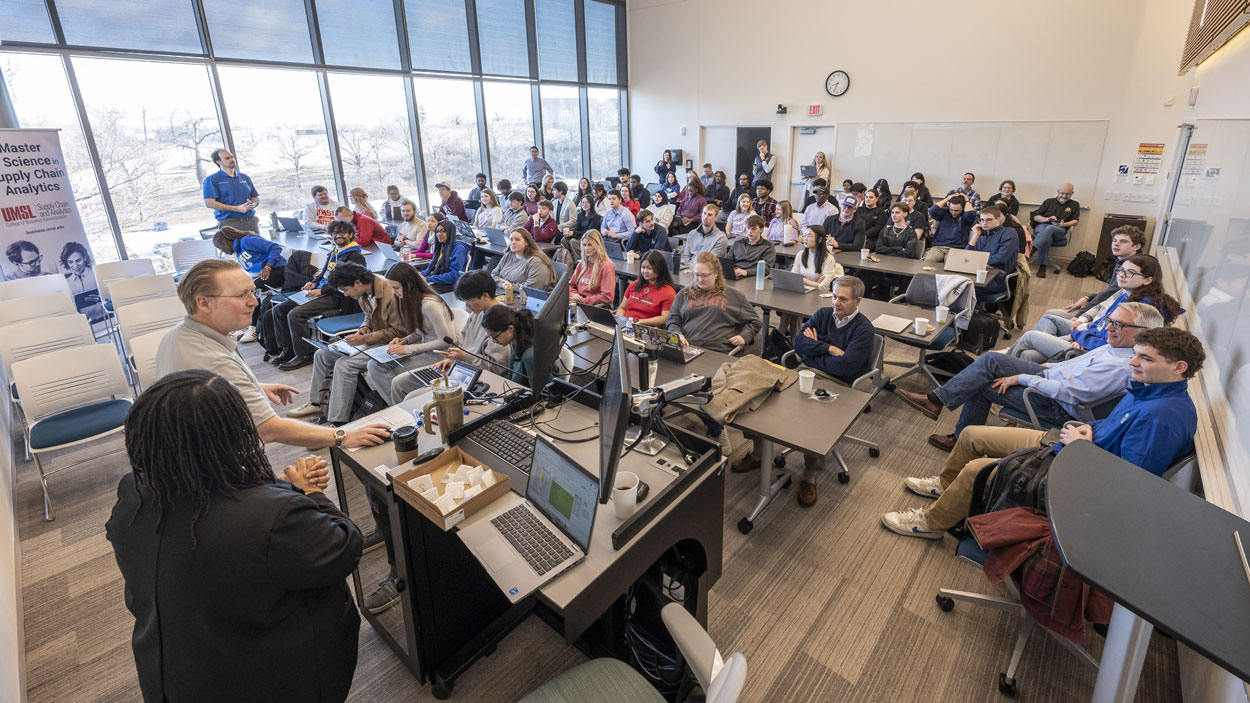
Jeffrey Mudd, president of the Midwest Gateway chapter of the Association of Supply Chain Management, and Assistant Teaching Professor Rhonda Hurd welcome students to the Midwest Gateway Supply Chain Student Case Competition on Friday in Anheuser-Busch Hall. (Photos by Derik Holtmann)
The University of Missouri–St. Louis hosted the first Midwest Gateway Supply Chain Student Case Competition two years ago, bringing teams of students from Saint Louis University, the University of Missouri–Columbia and Western Illinois University to campus to work through real-world supply chain problems.
The inaugural event resulted from a collaborative effort between Jeff Mudd, president of the Midwest Gateway chapter of the Association of Supply Chain Management, and Jill Bernard Bracy, the director of UMSL’s Supply Chain Analytics Center of Excellence and an associate teaching professor in the Department of Supply Chain and Analytics in the Ed G. Smith College of Business.
“At UMSL, we really, really value experiential learning opportunities,” Bernard Bracy said. “It’s critical to apply classroom knowledge to real-world experiences, and I think this case competition presents a fantastic opportunity for our students.”
Supply chain educators from other institutions appear to agree. In addition to SLU, MU and Western Illinois, the 2026 version of the competition also drew students and faculty advisors from Sam Houston State University, Kansas State University, South Dakota State University, Arkansas State University, Missouri State University, the University of Wisconsin-Eau Claire, St. Cloud State University, Southern Illinois University Edwardsville, the University of Kansas and Washington University in St. Louis.
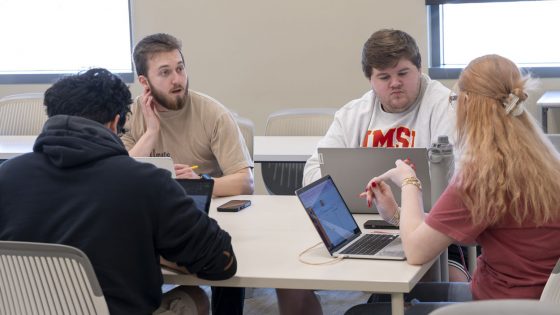
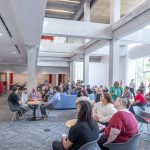
A group of UMSL students participates in the Supply Chain Case Competition on Friday in Anheuser-Busch Hall.
In all, 17 teams from 14 universities took part in the event, held Friday and Saturday and presented in partnership with the regional chapter of the Association of Supply Chain Management and Inchainge, a software company based out of the Netherlands. Assistant Teaching Professor Rhonda Hurd had an active role in coordinating the competition as a liaison between UMSL and ASCM.
“This event significantly enhances the visibility and reputation of UMSL’s Supply Chain and Analytics program,” said Haitao Li, chair of the Department of Supply Chain and Analytics.
UMSL alum William Ellegood, a 2014 graduate now serving as an associated professor of supply chain management at Sam Houston State, was excited to bring his students to his alma mater.
“It’s a great program here at UMSL,” Ellegood said. “We want our students to interact with other students from other universities and see that not everything’s around Houston, to get out and experience that and see some of the other opportunities.”
For this year’s competition, a simulation developed by Inchainge introduced a fictional Dutch company, called “The Fresh Connection,” that produced semi-fresh fruit juices but had suffered significant losses caused by bad managerial decisions. On the first day, the teams – each made up of four students – worked to address several issues along the supply chain, with measurables such as return on investment and sustainability used to gauge their success.
Day 2 involved team members making a presentation to the fictional company’s “board of directors,” which was comprised of representatives from several St. Louis area businesses and sponsors for the event, including Bayer, Ameren and Nestle Purina, who also served as judges.
“One of the things I am really proud of, that I think we do best is engage with industry, and have our students engage with industry,” Bernard Bracy said.
The teams were divided into graduate and undergraduate divisions. The UMSL team of graduate students Anhu Malik, Alexander Orywall, Rejina Shrestha and Prakash Dadi placed first among the five teams in the graduate division. UMSL’s undergraduate team, made up of Chloe Ake, Seth Gormley, Lucas Miller and John DeCampi, finished fifth out of 12 teams and achieved the best greenhouse emission results of all participating teams.
“The challenge we faced – improving ROI in a volatile, interconnected supply chain – felt less like a simulation and more like a compressed version of the real world,” said Uditanshu Mallick, a graduate student at UMSL working toward a master’s degree in supply chain analytics.
“This competition was one of the most valuable learning experiences I’ve had in my graduate program. It strengthened my technical and analytical skills, especially in forecasting, inventory planning and cross‑functional decision‑making. It also pushed me to communicate more clearly, collaborate under pressure and step into a leadership mindset, bringing people together, aligning decisions and thinking beyond my own role. Most importantly, it helped me connect the theory from my MS in supply chain analytics to real operational trade‑offs. It showed me how decisions interact, how systems behave and how alignment across departments can transform performance.”
Jackie Street, a senior specialist of digital brand management for Nestle Purina, said the event also provided the participants with a way to prove their worth to potential future employers.
“The more opportunities that students have to kind of get their hands dirty and be put into scenarios where they have to face the challenges that they might face in the workforce, that, for us, makes them much stronger candidates, better developed people,” Street said. “I think that it really does give you opportunities to, one, strengthen their skill set within their field of supply chain, but also build relationships with other students that are studying similar topics. That networking opportunity and the socialization, I think, is going to be fantastic for them.”
Mudd said the competition at UMSL has sparked a lot of interest in other parts of the country.
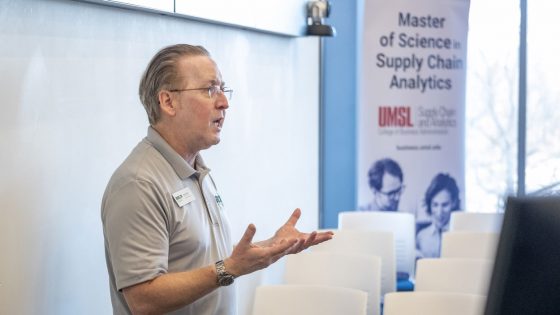
Jeff Mudd, president of the Midwest Gateway chapter of the Association of Supply Chain Management, speaks to participating students during the 2026 Midwest Gateway Supply Chain Student Case Competition on Friday at Anheuser-Busch Hall.
“I’ve already had other ASCM chapters reach out to me to learn about how we’ve done this, and so we’re looking at doing something similar in their regions as well,” Mudd said.
As for UMSL, the rapid growth in interest for its now 3-year-old event has Bernard Bracy, Li and other faculty members including Matias Enz and Siqiang Guo eagerly anticipating where things go from here.
“We didn’t expect to have this many teams and this many students, and we’re going to outgrow our space, which is a fantastic problem to have,” Bernard Bracy said.
Li also revealed one recent change that reflects UMSL’s commitment to being a top destination for students pursuing a career in the supply chain industry. Following the success of the case competition event in its first two years, UMSL launched a course co-taught by Enz and Guo, “Supply Chain and Business Integration,” that uses the Inchainge simulation as its foundation.
Li indicated that his department has since chosen to use the course as the capstone for students pursuing their BSBA with an emphasis in supply chain management.
“We are really leveraging this event to enhance the quality of our program and student learning experience,” Li said. “We definitely would like this case competition to be an ongoing event and to gradually expand it. I’d like to see it grow as a symbol of our Center of Excellence in Supply Chain and Analytics.”