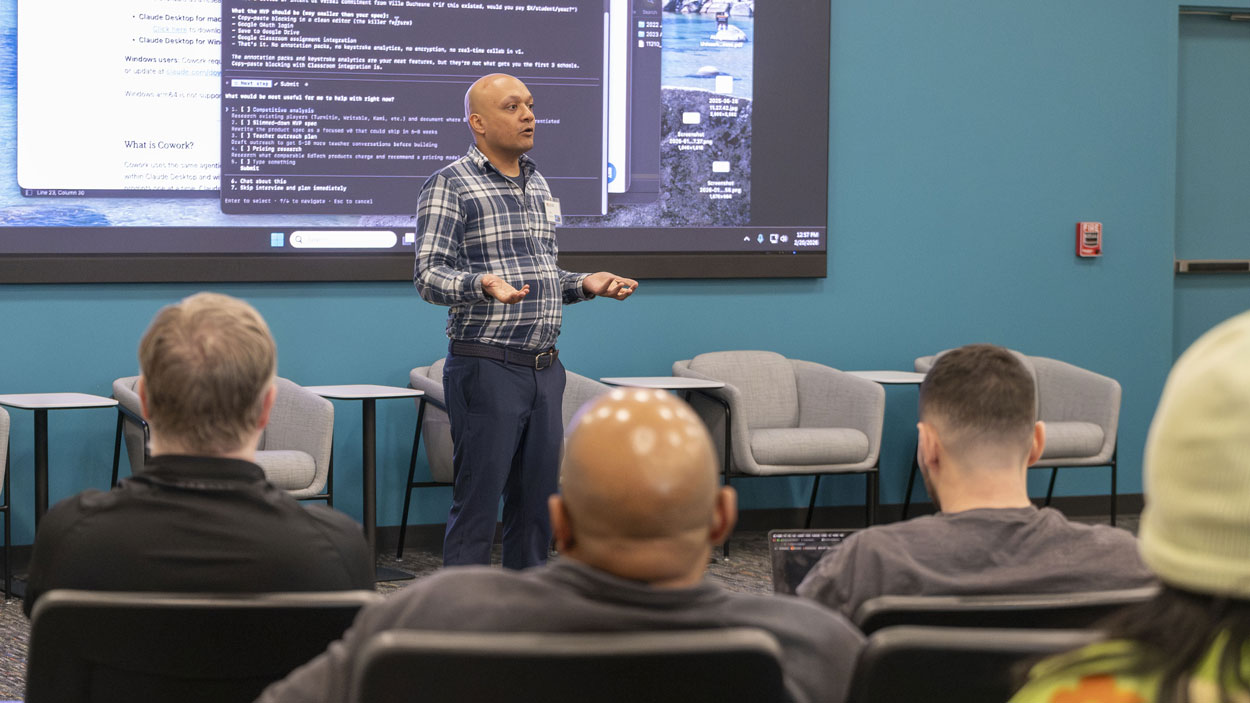
Amit Kothari, the CEO of Tallyfy, speaks during a lunch and learn event on Feb. 20 in the UMSL Innovation Center. Kothari discussed Claude Code and other tools that are revolutionizing software development. (Photo by Derik Holtmann)
More than 40 members of the University of Missouri–St. Louis community turned out on for an innovative lunch and learn hosted by the Office of Research and Economic and Community Development on Feb. 20.
A buffet spread complete with tacos, salsa, salad and dessert added to a welcoming environment for the students, faculty and staff members who made their way to the UMSL Innovation Center for the Friday afternoon workshop on an unseasonably warm winter day. But the main draw for attendees, as well as for Mike Seper, UMSL’s director of Intellectual Property Commercialization and Innovation and the event’s organizer, was the subject itself: Vibe coding.
That is the name applied to an emerging approach to software development, driven by artificial intelligence, that allows users to build applications by describing their requirements in natural language to AI agents rather than manually writing code.
The term was only coined about a year ago by AI researcher and OpenAI co-founder Andrej Karpathy, which speaks to how new and potentially revolutionary it is.
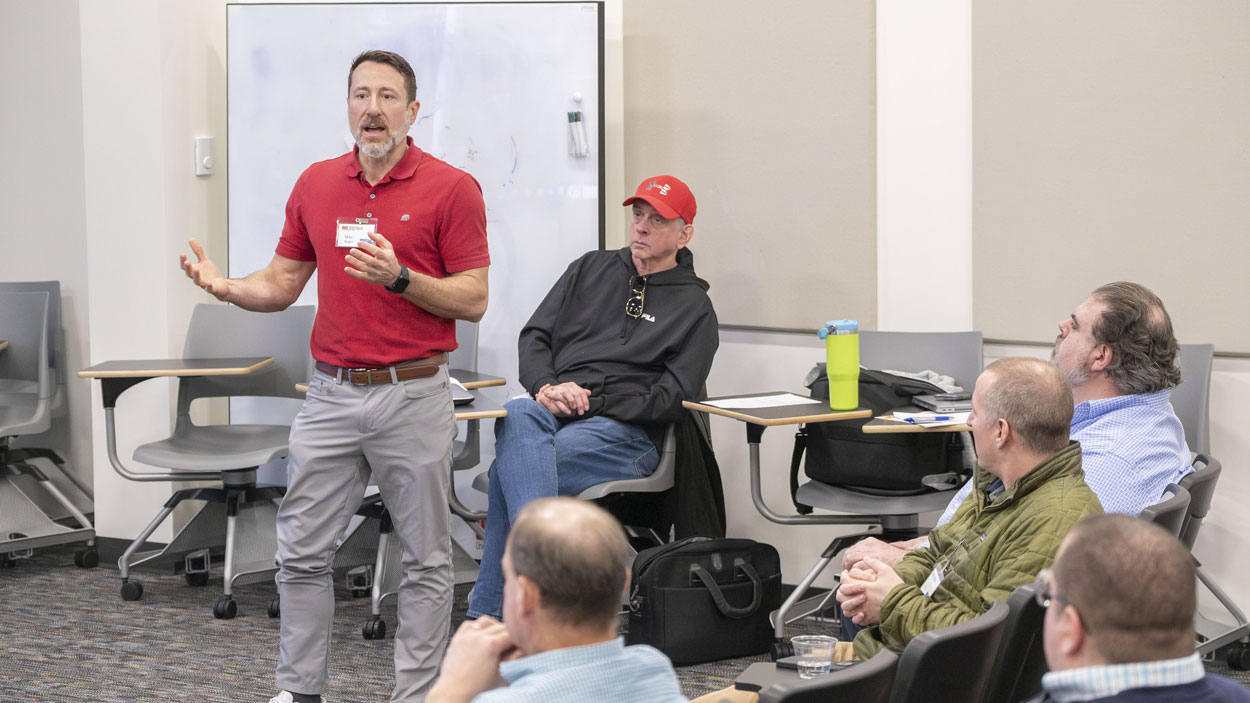
Mike Seper, the director of Intellectual Property Commercialization and Innovation, organized the Feb. 20 event in the UMSL Innovation Center. (Photo by Derik Holtmann)
The four-hour workshop was designed to expose students, faculty and staff to what is possible thanks to platforms such as Claude Code, Google AI Studio and Replit.
“It’s still such a new, developing technology,” Seper said. “I heard about it maybe when it was just launching. Some of these platforms are just building and taking off, and their valuation is already huge because there’s so much demand once people know that this exists. They’ve acquired customers really easily because you’re giving them a tool and access to the best coding capabilities, and they do not need to know how to code. It’s pretty neat and, I think, a paradigm shift here.”
He thought others could benefit from knowing the tools were out there, which is what led him to organize the workshop.
“I want to build a more innovative campus,” Seper said. “We want to be able to give people the tools to build. It’s great to have slides and share what you would like to build, but the ideas are currency. Now, when AI has democratized the building part of it, you don’t have to know how to code. Now you have a great idea, and you could get right to work on building something. So, I wanted to be able to bring down those barriers.”
Seper collaborated with Emily Hemingway, the founding executive director of TechSTL, as he put together a group of speakers to share their knowledge of using AI to build code.
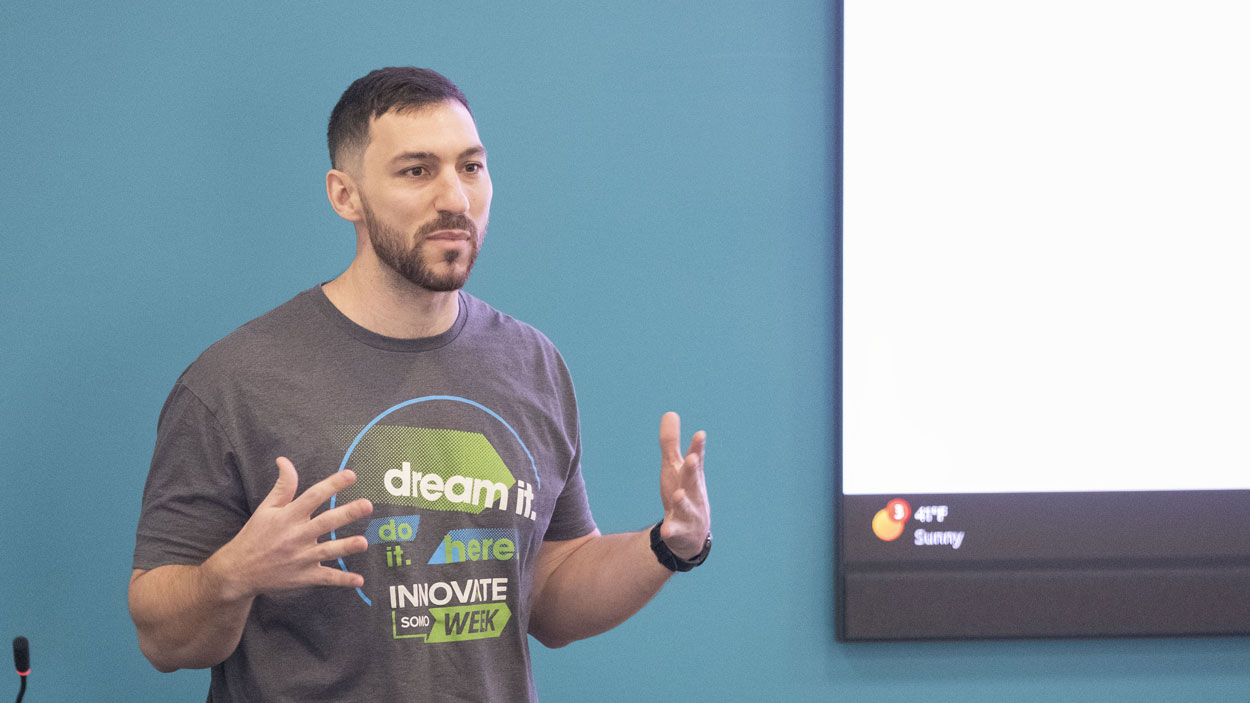
Garrett Duncan, a software engineer at Codefi, walks audience members through how to use Google AI Studio during a vibe coding workshop in the UMSL Innovation Cetner. (Photo by Derik Holtmann)
Among them was Amit Kothari, the CEO of Tallyfy and an entrepreneur-in-residence at Washington University’s Skandalaris Center for Interdisciplinary Innovation and Entrepreneurship, who shared his perspective on the quality of the tools.
“It wasn’t actually that great a year ago,” Amit said. “I couldn’t trust it, and we had lots of mistakes and so on. I would say that this exponential point has just been reached, maybe about a month or two ago, with Claude Opus 4.5 and Opus 4.6. It’s actually reached the point where I don’t even look anymore. It’s that good. So, I would say the curve of improvement has been exponential, not linear. We’re at that culmination point just recently.”
Attendees also heard from Garrett Duncan, a software engineer at Codefi, a nonprofit based in Cape Girardeau that “works to eliminate skills and opportunity gaps in rural digital economies.” The organization recently launched a series of new programs including AI skills and organizational AI readiness workshops that it is delivering across the state of Missouri.
Duncan walked the audience through how to use some of the tools, including Google AI Studio and Replit.
“Vibe coding in its current state is slightly looked down upon, but the possibilities and the things you can build quickly is very powerful,” Duncan said. “One of the cool things about it for everybody in this room, you guys can all lean in on your experience in your industry and the basics of talking with AI and prompting – then you can really come up with something amazing.”
Those in attendance got to spend about an hour working in teams, building something of their own, then presented their results to the whole group.
One group of students ended up building an app that could help people plan for retirement. Another created a wellness app geared toward students that tracks their wellness in categories such as body, mental health, study, social and support. Still another created a CRM platform that one of the team members hoped could help his parents run their health insurance business more efficiently.
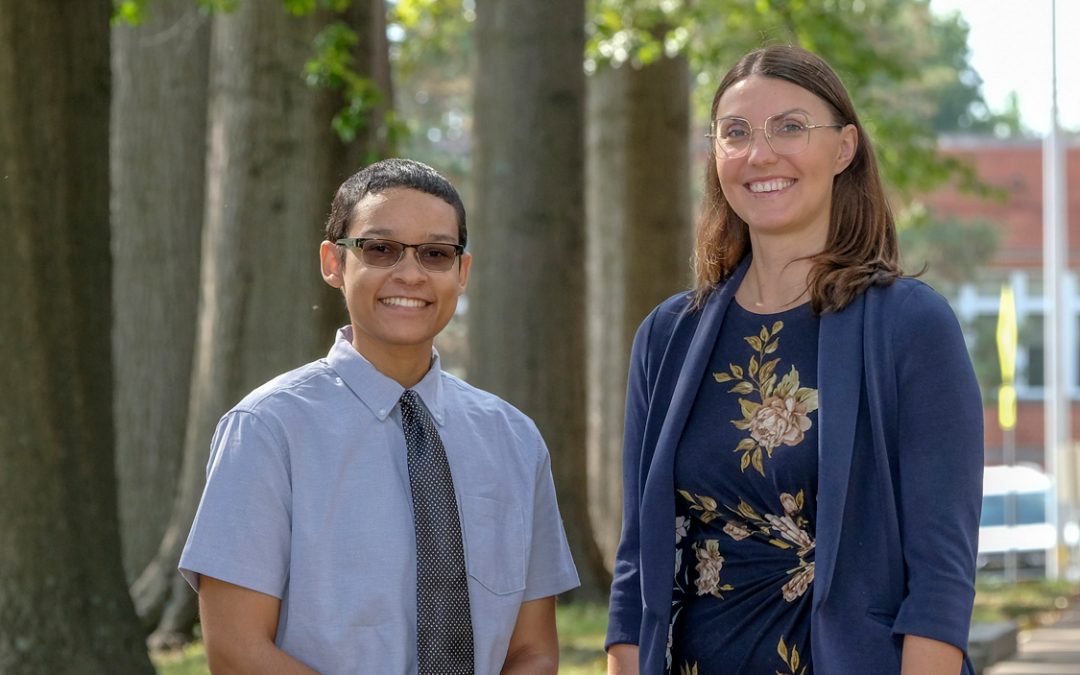
Students Etaf Abdallah, a cybersecurity major, and Asmahan Ghaleb, a pre-nursing major, worked together to create a tool that could identify and assist in sorting through options in the health insurance market.
Abdallah had experience in vibe coding, even taking a course through the University of California, Berkeley, but Ghaleb came up with the idea, having recently tried to acquire insurance for her aging mother, who moved to the United States last year.
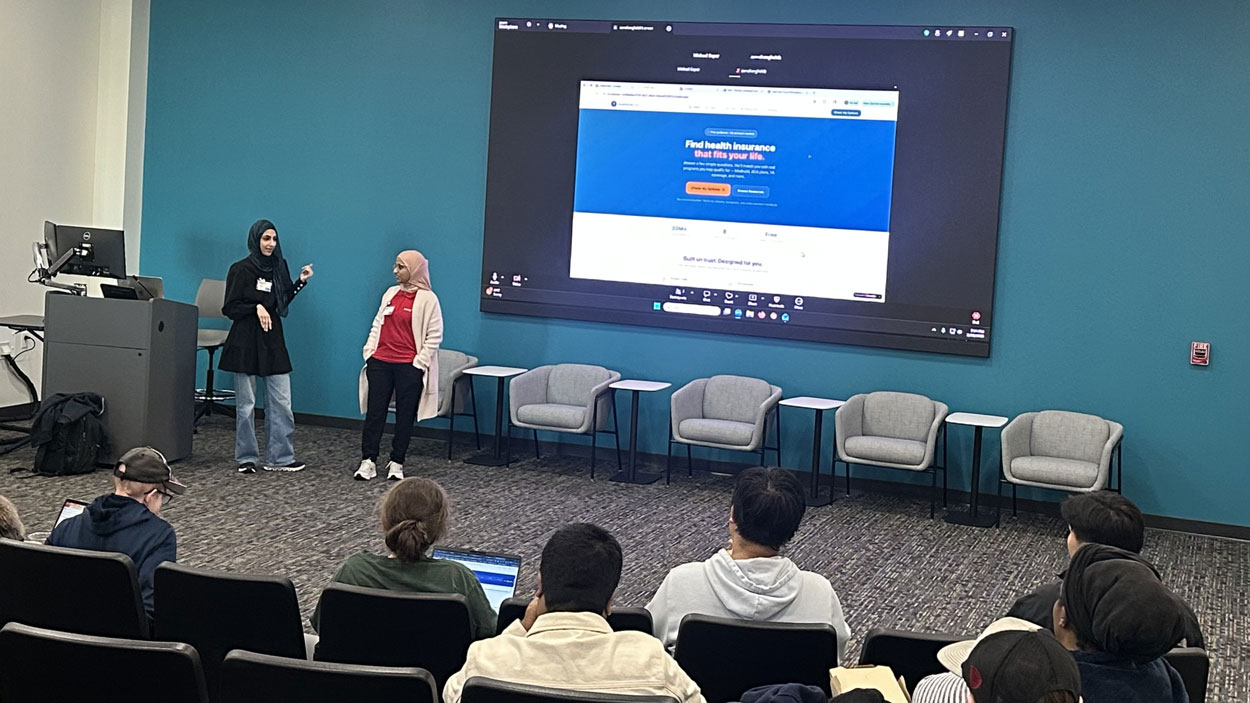
Students Etaf Abdallah and Asmahan Ghaleb discuss the tool they built to assist people looking to purchase health insurance. (Photo by Steve Walentik)
“There was a serious problem here, and we had to do something,” Ghaleb said. “We were very worried about her. So, ‘Where should I have to go?’ I was very lost.”
They used another platform, Lovable, and built something that could help.
“This project was just somebody’s idea, somebody’s story, that we turned into an actual resource,” Abdallah said. “It was a great experience, getting to apply what we learned in such a short period of time, seeing all those different resources are out there and how we can mobilize them as students.”
Kothari did have a few words of caution for the newly empowered audience.
“Instead of one app, there are going to be 10,000 apps,” he said. “How will you stand out? I want to caution you on that front, because it’s a real issue. Although you can play with vibe coding to build something for your own experience, don’t forget those basic things: Brand, distribution, who’s the market if you’re doing this to sell a product. How are you going to get that first $10, $100 of revenue? That’s the hard thing. That hasn’t changed.”