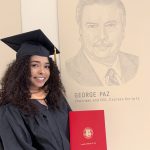
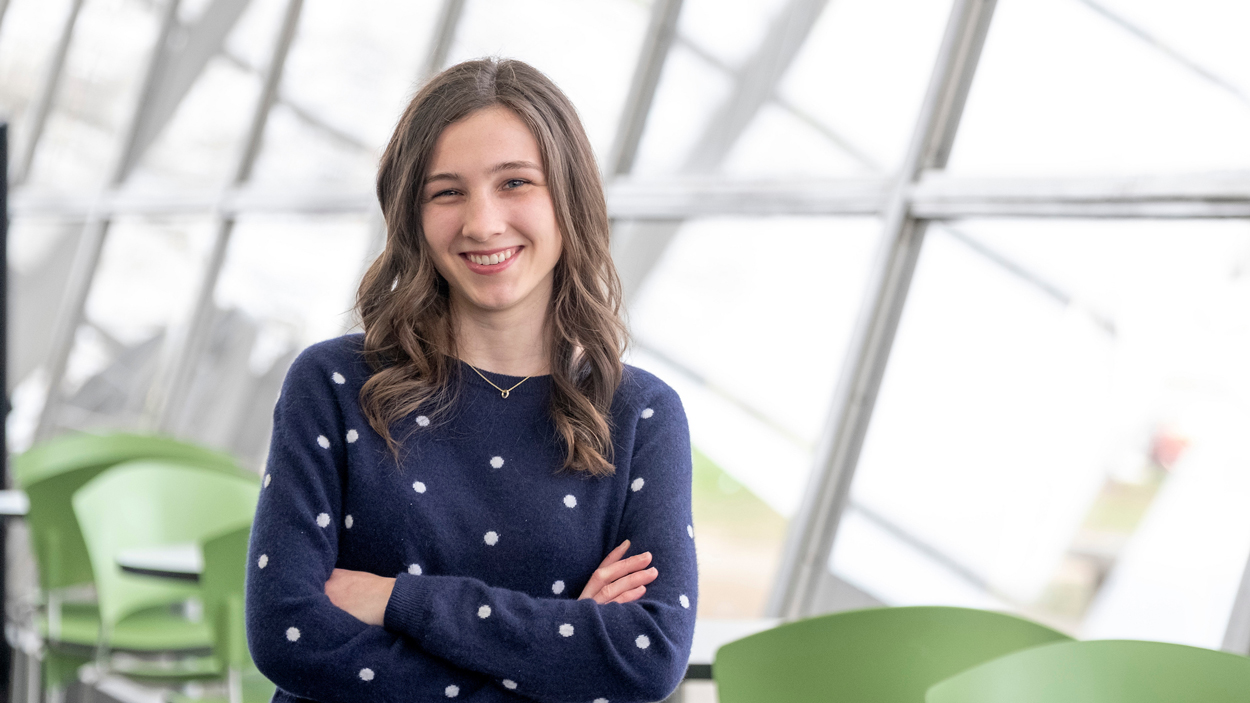
Hannah Rose will graduate from the College of Education with an Educational Specialist in School Psychology degree in May. During her time at UMSL, Rose has taken part in several research initiatives, served as a graduate assistant and adjunct instructor and helped the Graduate Association of School Psychologists grow. After graduation, Rose will begin a full-time role as a school psychologist with the Special School District of St. Louis County. (Photo by Derik Holtmann)
As Hannah Rose approached the breakout room listed on the program for the National Association of School Psychologists 2025 Annual Convention, she could hardly believe her eyes.
There was a line out the door. Esteemed professionals from across the U.S. were sitting on the floor of the Seattle Convention Center to ensure they had a seat for the next presentation.
They were waiting to hear a group from the University of Missouri–St. Louis led by Assistant Professor Katya Sussman-Dawson speak on her research related to policies on Developmental Delay, a special education disability category used by schools to provide young students who are struggling to meet developmental milestones with specialized services. Rose and another UMSL student helped present the findings.
“To think that people would care enough about what we were talking about,” Rose said, “that they would be willing to sit on an uncomfortable conference room floor, stay behind to ask questions, and be very complimentary of my presenting skills even though I’m just a graduate student, it really did make an impact on me.”
The NASP conference is just one of the many opportunities Rose has seized at UMSL, where she’s excelled inside and outside of the classroom.
This May, Rose will graduate from the College of Education with an Educational Specialist in School Psychology degree. During her time at the university, Rose has taken part in several research initiatives with faculty members and presented that work at professional conferences across the country. She has also served as a graduate assistant, tutoring undergraduates, and as an adjunct instructor with the Future Teacher Leadership Academy. As if her schedule wasn’t busy enough, she took on a committee position with the Graduate Association of School Psychologists and subsequently created and grew the chapter’s social media profile.
Rose’s dedication to research and campus engagement have justly earned regional and national recognition. In 2025, she received a Student Scholarship Award from the Missouri Association of School Psychologists. At the NASP 2026 Annual Convention in Chicago, the organization honored Rose as the Student Leader Champion for the 2024-2025 school year.
An early calling
Early on, Rose knew she would eventually go into the education field.
“I’ve always been really passionate about helping others become their best and also invested in inclusivity and access, especially when it comes to students with disabilities,” she said. “So, from the time I was a kid, I always knew that was my calling.”
After graduating from Westminster Christian Academy, she earned a bachelor’s degree in education from Saint Louis University with certifications in elementary and special education.
Rose initially became interested in special education because her younger sibling has dyslexia. She saw firsthand how much extra time and effort it takes students with dyslexia to show their potential and succeed in the classroom. She also saw what support systems were effective in making school easier for those who learn differently.
Ultimately, it pushed Rose to pursue school psychology.
“I wanted to become a school psychologist, as opposed to a classroom teacher, because I wanted to work more on systems-level change and really be an advocate for families and students looking to see if they would qualify for special education,” she explained.
After deciding on her next steps, Rose began investigating options to further her education. There was only one choice that would put Rose on a path to achieve her goal, UMSL’s EdS School Psychology program. It’s the only EdS-level school psychology program in the state accredited by NASP, and it promised the appropriate academic rigor to advance her career.
Rose was also intent on supporting St. Louis by giving back to the community that raised her and staying connected to her friends and family.
“UMSL felt like a very natural choice, and I’ve been very, very pleased with my decision to come here and my experiences as a student,” she said.
Academic opportunity
The College of Education proved to be a welcoming environment. Rose quickly found mentors in Assistant Professor Kristy Brann and Sussman-Dawson. As she’s made her way through the three-year, cohort-based program, earning an MEd in the process, she’s deliberately sought research and professional development opportunities on campus.
“I set a goal to earn my PhD one day,” Rose said. “So, I reached out to Dr. Brann and Dr. Sussman-Dawson because one of the things you need to get into a PhD program is prior research experience. I really just tapped them both on the shoulder and said, ‘Hi, I already have a graduate assistant position, but are there any volunteer research opportunities that I could become involved in?’”
Brann and Sussman-Dawson were happy to oblige.
As luck would have it, Sussman-Dawson had received additional funding to hire a graduate research assistant on her project to catalog Developmental Delay policies throughout the nation. Based on her high-caliber work in Sussman-Dawson’s course, Rose was an obvious choice to fill the role on the first-of-its-kind study.
“We were looking at state differences in the eligibility category of Developmental Delay, and our goal was to put together a comprehensive review of how the states differ in their criteria, in their classification methods, even in what they name it,” Rose said. “In Missouri, it’s called ‘Young Child with Developmental Delay,’ but in many other states, it’s just called ‘Developmental Delay.’”
Rose was instrumental in completing that work. She gathered documents from state education departments – from best practice guidelines to district-level policies – and combed through them, coding the nuances in a spreadsheet. Sussman-Dawson said her passion for the work and her professional acumen were evident.
“She can really understand the reason for the research, what we need to do with that research, and how we need to get the information out to make it meaningful for a practitioner and change education systems for students,” Sussman-Dawson said. “That’s something that usually takes years to accomplish, and some never do. I think that speaks volumes for her work, as she can see the impact and the purpose behind the research and apply it.”
After the leg work was done, Rose helped write the manuscript summarizing the project’s findings. She also presented the results with Sussman-Dawson at four conferences, including the NASP convention in Seattle.
In addition to the Developmental Delay study, Rose has contributed to ongoing research with Brann focused on levels of self-compassion and self-efficacy among teacher candidates. She also collaborated with both Brann and Sussman-Dawson on projects centered on the effectiveness of school problem-solving teams and executive function. The latter led to a featured presentation at the 2025 Executive Function Conference at Loyola University Chicago.
“I love infusing conversations into the presentation, so you also learn from the people in the audience,” Rose said. “I really enjoy facilitating discussions and getting others’ thoughts about something that I’m already passionate about. I wanted to engage in that. I think it’s also good to push myself because I can be more introverted. Stepping outside of my comfort zone and getting more public speaking experience is valuable for me personally.”
Career aspirations
Aside from her academic obligations, Rose began working with the Special School District of St. Louis County in August. In that role, Rose serves as a school psychology intern at Carman Trails and Sorrento Springs Elementary Schools in the Parkway C-2 School District.
There are many moving parts involved with the position, but Rose’s primary responsibility is to ascertain if students qualify for a disability under Missouri’s special education criteria. That could be anything from educational autism, intellectual disability, emotional disturbance or a more specific learning disability, similar to dyslexia.
To do so, she collects a variety of data points to determine if a student is eligible for an Individualized Education Program and specialized instruction. It involves observing students throughout the school day and distributing rating scales to parents and teachers to collect feedback on factors such as executive function, hyperactivity and social skills. Rose conducts one-on-one academic and cognitive testing, as well.
The process is highly routinized, but Rose does more than collect data. She also provides support to students struggling with self-esteem or emotional regulation, reframing negative narratives about themselves.
“I want to support students holistically,” she said. “Caring for your academics is, of course, a big goal of school. But I don’t feel that’s our only goal. We need to invest in students’ social and emotional wellness, character development, and critical thinking skills – all those parts of being a person that’s well developed.”
After graduation this spring, Rose will stay on with the Special School District of St. Louis County as a full-time school psychologist. She will also begin an online special education PhD program at the University of Northern Colorado.
Everyone who has worked with Rose knows both institutions are remarkably lucky to have her.
“She understands her role,” Sussman-Dawson said. “But she also understands where she needs to push to make sure that she’s providing students and families the best of the best and what they deserve.”