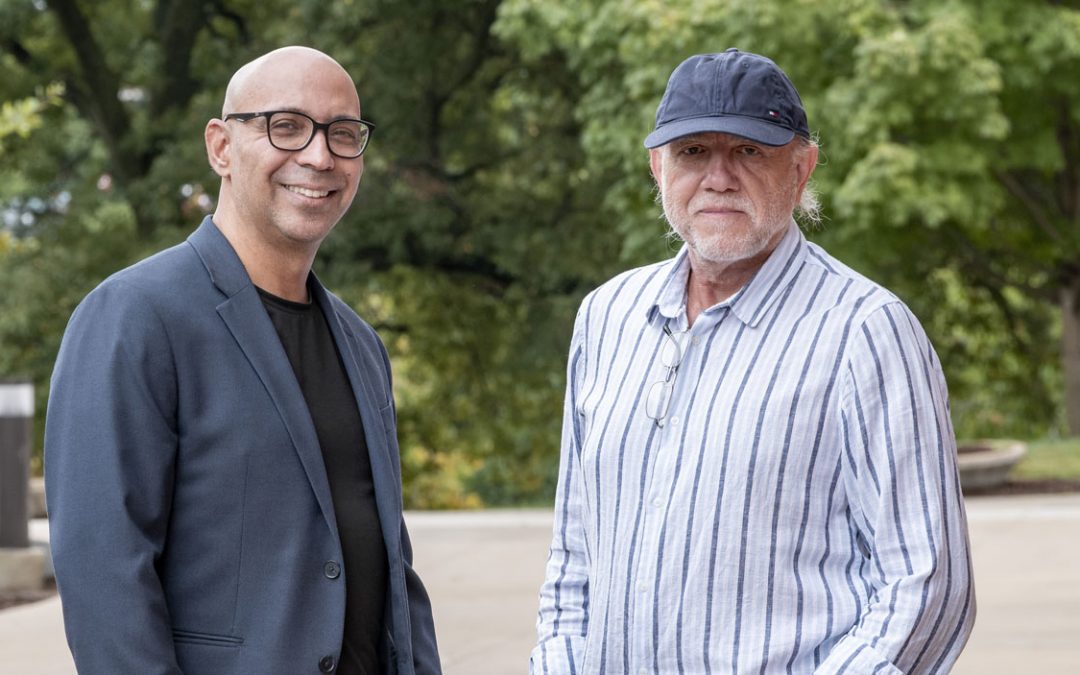

Clay Brigance earned a PhD in counseling from the College of Education at the University of Missouri–St. Louis in 2023. Soon after graduation, Brigance started Shiloh Counseling to serve families dealing with reproductive grief. He was inspired to start the practice after his own family’s struggle with infertility and miscarriage. (Photo by Tammi Camp Photography)
Clay Brigance knew he was destined to enter the mental health field. His family knew it, too.
“My mom used to always tell me I was either going to be a counselor or a politician one day,” Brigance said with a laugh. “And I definitely didn’t want to be a politician.”
Throughout his childhood in rural Muhlenberg County, Kentucky, he forged connections with others easily. When it came time for college, he decided to harness his gift and pursue his calling at Murray State University, where he earned a bachelor’s degree in psychology and an EdS in school psychology.
“I think I’ve always had an interest in the emotional experiences of others and how that determines what we do in life, our own personal lived experiences and how that drives us,” he said. “That’s always been in the back of my mind, and when I took Psychology 101 at Murray, I fell in love with it.”
He also fell in love with his now-wife, Marjorie, while earning his graduate degree. Aside from a passion for mental health, his foremost desire was to become a husband and father. The couple married and put down roots in St. Louis, his wife’s hometown, but becoming parents didn’t come easily. They struggled with infertility and miscarriage.
Suddenly, Brigance was faced with the possibility that the life he had imagined might slip away. But in early 2019, the couple welcomed their eldest child, Jonah, into the world. Despite the hardship and sorrow, their marriage not only survived but thrived. But why?
“I thought, ‘Well, what if I can help contribute to finding that answer?’” Brigance said.
That mission brought him to the counseling PhD program at the University of Missouri–St. Louis. Brigance focused his doctoral research on reproductive grief in couples, and after graduating from the College of Education with his doctorate in 2023, he opened Shiloh Counseling. The practice specializes in counseling services for all forms of reproductive grief and trauma, including infertility, miscarriage, stillbirth and disrupted adoption. Three years later, it’s thriving with 10 dedicated counselors and a full roster of patients.
Brigance has also continued his research on infertility and reproductive loss, publishing articles in respected periodicals such as The Journal of Couple and Relationship Therapy, The Family Journal, Contemporary Family Therapy and Psychological Trauma: Theory, Research, Practice, and Policy.
That work has quickly gained national attention. This year, Brigance has embarked on a speaking tour, presenting to clinicians, community organizations and researchers at events across the country from San Diego to Baltimore. In August, he will be a featured speaker at the American Psychological Association’s annual conference in Washington, D.C., and in October, he’ll deliver a TEDx Talk titled, “The Silent Shattering: What Infertility Teaches Us About Masculinity, Emotions, and Relationships,” at a community event in Montana.
He’s also bringing the subject of reproductive trauma, once taboo, to a wider audience. This spring, he guested on a First Alert 4 TV segment and launched Love & Infertility with Ginny Lupka. The new podcast is aimed at creating a space for thoughtful conversations about communication and connection between partners dealing with the weight of grief.
“Every human being has the innate need and desire to feel seen – not just be seen, but feel seen and understood,” Brigance said. “When we go through infertility, miscarriage or any other type of grief, really, and we try to keep it to ourselves, it’s a part of us that doesn’t really get seen, that doesn’t really get understood. That can start to make us feel lonely and isolated. So, the more that we talk about it, the more that we can normalize it, the more that people can start to feel comfortable to share that part of themselves, so that they can feel like they’re not alone.”
He knows that need all too well. It’s what inspired him to build Shiloh Counseling and create free resources, like Love & Infertility, that he once sought but couldn’t find amid his own family’s struggle.
Brigance had been working as a school psychologist with the Special School District of St. Louis County for nearly a decade when he enrolled at UMSL. He excelled at the work but felt he wasn’t growing or making the impact he wanted. He entered the PhD program with the intention of leveraging his doctorate to open a group practice in St. Louis County.
“After I defended my dissertation, I told myself, ‘If I can get 10 clients a week by the end of the year, I’ll quit school psychology and we’ll open Shiloh Counseling,’” he said. “I had 20 clients a week by July.”
One of the most common issues Brigance encounters with couples is misattunement. This happens when one person deals with grief in a certain way, whereas their partner might deal with it in a different way. When partners try to impose their own ways of grieving onto the other person, it can lead to a failure to perceive and validate each other’s emotions. Couples then start to drift apart because they don’t feel heard, which only amplifies conflict.
Brigance said one of the key strategies for dealing with misattunement is interpersonal mindfulness. It’s much like personal mindfulness, taking a deep breath and observing the emotions being felt.
“The ability to not react immediately to what my partner is saying but instead taking a second and really just observing what they might be feeling or what they might be experiencing, and then naming it out loud, that’s how we can get to that attunement,” he said. “Interpersonal mindfulness leads to attunement, which leads to connection.”
Brigance’s current counseling practice has been greatly informed by his time at UMSL. For his dissertation research, he surveyed 906 coupled individuals across the country experiencing infertility to investigate why some relationships remained strong and others didn’t. He found that humility, the ability to recognize being wrong, in each half of a couple was an essential factor in successful partnerships, in addition to interpersonal mindfulness.
He credits his seven cohort members and counseling faculty members including Associate Professor Emily Brown, Professor Emeritus Susan Kashubeck-West, Assistant Professor So Rin Kim and Associate Professor Phillip Waalkes for pushing him academically.
“A lot of times they would give us discussion topics and step back – every now and then direct us – but just let us learn from each other,” Brigance said. “It was just incredibly impactful. Our professors would challenge us because they knew that we could rise to the occasion.”
UMSL has been integral to Brigance’s current professional success, but more importantly, it led to the personal growth and change that he was searching for when he initially came to the university.
“I think I discovered a little bit more about who I am as a human, and not just researcher and therapist,” he said. “And a lot more about my fellow humans, too.”