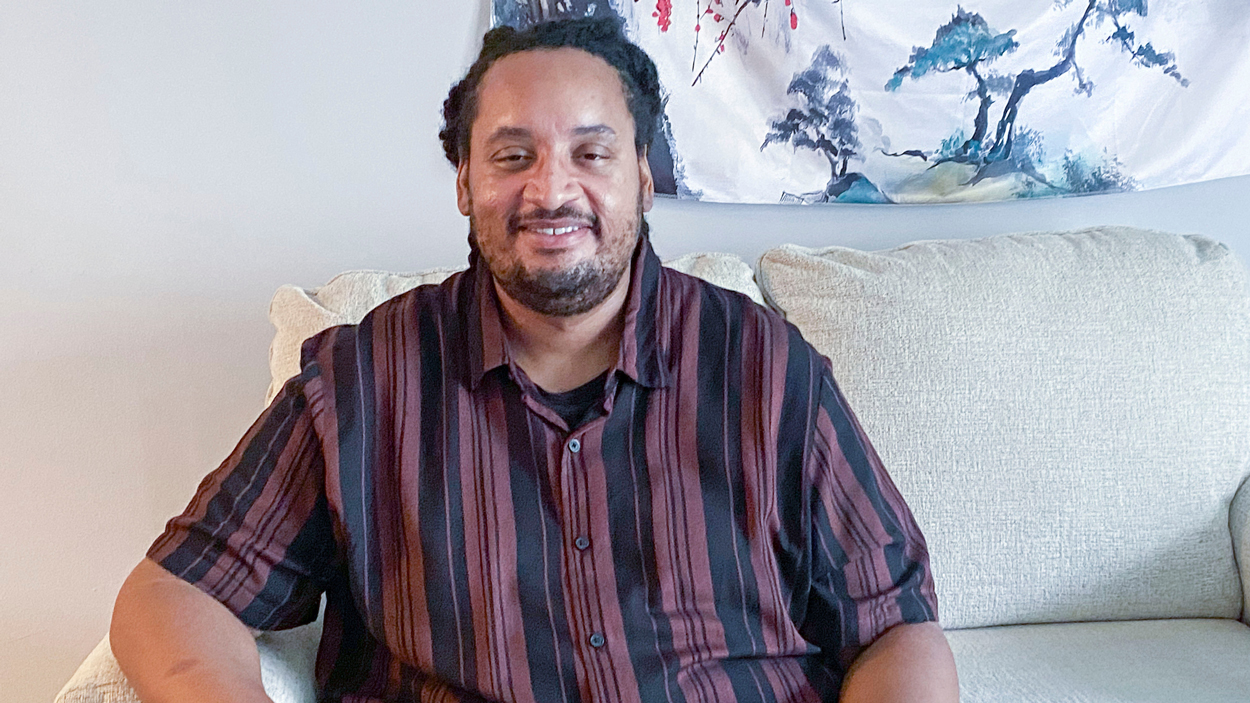
Stepheon Kaiser is pursuing his master’s degree in clinical mental health counseling at the University of Missouri–St. Louis, and the Missouri Behavioral Health Council recently awarded him a Roy Blunt Behavioral Health Scholarship. The scholarship comes with a $1,500 award, which will allow Kaiser to more fully focus on his studies and clinical training during the fall semester. (Photo courtesy of Stepheon Kaiser)
Stepheon Kaiser was at home sifting through his inbox when he spotted an email from the Missouri Behavioral Health Council. The message stated that Kaiser had won a Roy Blunt Behavioral Health Scholarship.
In the moment, he felt a mix of excitement, gratitude and validation, but he still read the award letter thoroughly to make sure it was real before sharing the news.
“I immediately called my mom because she was the first person I wanted to share the news with,” he said. “She’s been incredibly supportive throughout my educational journey, so it was a really special moment for both of us.”
The Missouri Behavioral Health Council established the scholarship program to honor former Missouri Sen. Roy Blunt and to support students dedicated to serving Missouri communities in the behavioral health treatment system.
Kaiser, who is pursuing his master’s degree in clinical mental health counseling at the University of Missouri–St. Louis, is a worthy recipient of the award. A former educator, he has excelled in the classroom and positively impacted his classmates and faculty members in the College of Education. In recognition of his commitment to the profession, the counseling faculty awarded him the Dean Rickey George Memorial Scholarship in April.
“Receiving both scholarships has been incredibly meaningful,” he said. “More than anything, they felt like an affirmation that the work I’ve put into becoming the kind of counselor I hope to be is being recognized. They gave me a sense that the direction I’ve been working toward internally is also being seen and affirmed by others, and that was a really rewarding feeling.”
The Roy Blunt Behavioral Health Scholarship is especially significant for Kaiser, who was born and raised in north St. Louis County. He plans to build his future counseling career in Missouri and feels compelled to give back to the communities that shaped him. That was the topic of his personal essay, which is a requirement of the application process for the highly competitive scholarship.
Kaiser received a $1,500 award that he plans to use for tuition and fees. That financial support will allow him to better focus on his studies and clinical development.
“Graduate school requires a significant investment of both time and energy, especially as I begin practicum and internship, and reducing some of the financial burden gives me greater freedom to be fully present in those experiences,” he said. “Beyond the financial impact, the scholarship also serves as a source of encouragement. Knowing that others have invested in my education motivates me to continue working hard and to make the most of the opportunities ahead.”
Throughout his childhood in North County, Kaiser was a natural observer of the people around him. As the youngest of three children, there was plenty to absorb, and he forged genuine connections with others easily thanks to his good-natured sense of humor and communication skills.
Those instinctive qualities initially led Kaiser to the education field. He earned a bachelor’s degree in elementary education and set out to create a classroom environment he wished he had experienced for his students. As a child, he often found himself facing disciplinary action, but in retrospect, he realized he was exhibiting behavior rooted in emotional dysregulation rather than defiance.
As a teacher, Kaiser loved building meaningful relationships with students, especially those that needed a bit of extra support, and their families. He enjoyed watching his students grow not just academically but socially and emotionally as well. The more he reflected on his experience in the classroom, it became clear that the interpersonal connections were where he came alive as an educator.
“While I loved teaching and remain incredibly grateful for that chapter, I eventually realized that what energized me most wasn’t just teaching content,” Kaiser said. “It was understanding students as people and creating the kind of relational environment where they felt safe, seen and understood. That realization naturally led me toward counseling. I found myself wanting to spend more time helping people make sense of their experiences than navigating everything else the profession required.”
The graduate counseling program at UMSL provided a perfect avenue to make a career transition. Its affordability, location and CACREP accreditation – the gold standard for counseling education – made it the clear choice over other programs.
Kaiser has found the College of Education to be an incredibly supportive environment. Fellow students have brought a wide range of perspectives to discussion-orientated classes, which have facilitated thoughtful, engaging conversations. Meanwhile, faculty members are genuinely invested in student success.
Former Assistant Professor Mary Edwin, Associate Professor Phillip Waalkes and Associate Professor So Rin Kim have been particularly influential, serving as mentors to Kaiser. Edwin’s Career Counseling and Ethics course provided a strong professional foundation, while Waalkes consistently offered guidance and helped Kaiser address any challenges that arose. Kim challenged Kaiser to grow professionally while supporting him through that development.
“During one particularly difficult classroom experience, she gave me the opportunity to navigate disagreement in a way that was both authentic and respectful,” Kaiser said. “That experience strengthened my confidence and reminded me that professional growth often happens through moments that are uncomfortable, not just the easy ones.”
Kaiser is pursuing the clinical mental health track, so that in the future, he will have the space to build deep relationships with clients and support their personal growth over time. The program has helped him develop tools to aid that goal, including active listening, case conceptualization, ethical decision making and reflection.
“More importantly, though, I’ve come to understand that one of the most important tools I bring into a counseling session is myself,” he said. “I’ve learned that the quality of my presence directly influences the quality of care I’m able to provide. Techniques matter, but I’ve come to appreciate that how I show up is just as important as what I say.”
During the fall semester, Kaiser will begin his clinical training at UMSL’s Counseling and Social Advocacy Center. The experience is where he’ll put theory and foundational skills from the classroom into practice. Eventually, he would like to build a small private practice to provide relationship-centered counseling that will help individuals better understand themselves and create lasting change in their lives.
He knows that his future career in counseling and the ability to meaningfully help others is a direct result of what others have poured into him.
“I’m incredibly grateful to everyone who’s invested in me along the way, from my family and professors to my mentors, classmates and the organizations that have supported my education,” Kaiser said. “None of us develops in isolation, and I don’t take those investments for granted. My hope is that the work I do throughout my career honors the confidence they’ve placed in me and allows me to make a meaningful contribution to the communities that have given so much to me.”