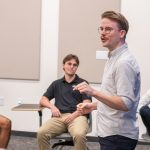
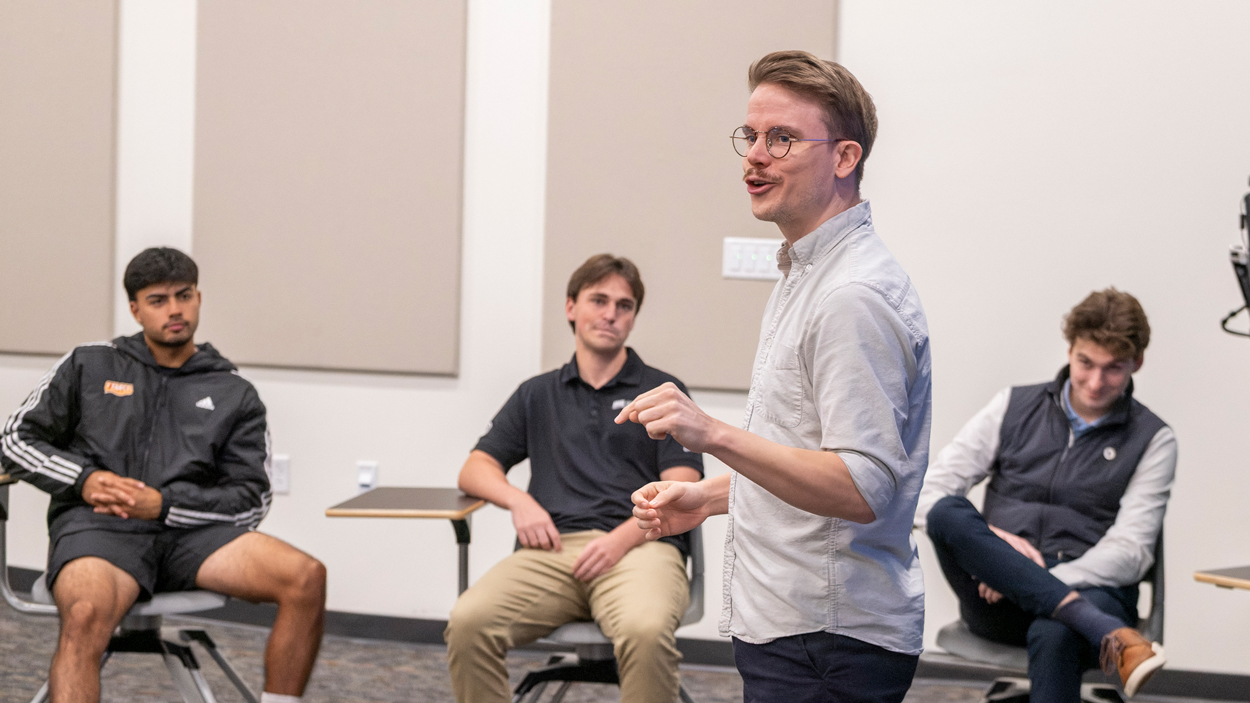
Ryan Myers, a 2011 UMSL graduate, talks to students at the Entrepreneurship and Innovation Center as part of a workshop highlighting the benefits of improvisational skills in a professional setting. Myers, director of marketing and business services for The Improv Shop, is co-creator of a professional-development program designed to help students and organizations improve communication, collaboration and workplace culture. (Photos by Derik Holtmann)
Being comfortable with uncertainty isn’t necessarily something that comes naturally, particularly for students preparing to enter a competitive job market. But learning to embrace the unexpected was one of the goals of a recent improvisation workshop at the University of Missouri–St. Louis.
Hosted by Beta Alpha Psi in collaboration with UMSL Career Services and the Finance Club, the workshop explored how improvisation can strengthen communication, encourage collaboration and help students become more adaptable in professional settings.
“I saw students really thinking about how to respond during the activities, and they shared some thoughtful reflections afterward,” said Associate Teaching Professor Johnna Murray, faculty advisor for UMSL’s Beta Alpha Psi chapter. “I hope they came away feeling more comfortable being caught off guard, handling an awkward pause, or speaking up even when they’re nervous. Most of all, I hope they remember how much support they have from the people around them.”
The program was held on Tuesday evening at the Entrepreneurship and Innovation Center. Led by Ryan Myers and Ashley Rube of The Improv Shop, it challenged students to step outside their comfort zones, participate in unfamiliar exercises and consider how their responses to unexpected situations can influence the way they work with others.
“It was a very interesting experience,” said Elliott Brandon, a second-year master’s student in the Ed G. Smith College of Business and president of the Student Entrepreneur Club. “I always thought of improv as theater-based and not business-based, but they showed that improv can foster collaboration within a community or even within any organization. Even just helping with idea development and innovation. It was very interesting.”
The workshop also provided Myers with an opportunity to return to the university that helped shape his professional journey.
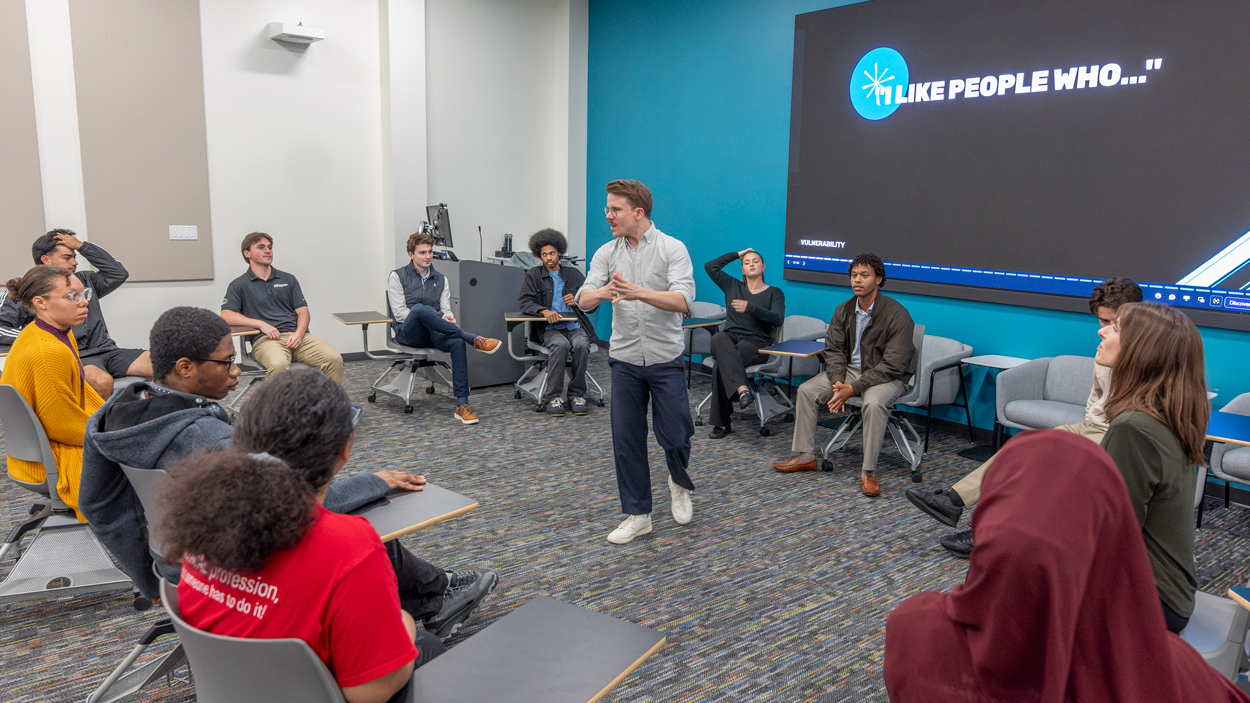
Ryan Myers directs students during one of the exercises using improv to help participants develop positive workplace skills including creative problem-solving, conflict management, public speaking and executive presence.
A 2011 UMSL graduate, Myers earned a degree in vocal performance and was deeply involved in the university’s opera program. Although he eventually moved into business-to-business marketing and sales, he discovered that many of the skills he developed as a performer translated into the business world.
That realization eventually helped inspire his work creating professional-development programming through The Improv Shop, where he and Rube use improvisational exercises to help organizations improve communication, collaboration and workplace culture.
“I think what we do is really about how we show up being a better teammate,” Myers said. “It’s not about how you become a sillier improviser.”
Myers and Rube began developing their professional-development curriculum during the COVID-19 pandemic, recognizing that the skills people practice through improv – including active listening, accepting new ideas and responding to unexpected situations – also have applications in the workplace. Their programming, known as The Improv Shop Means Business, has expanded to include creative problem-solving, conflict management, public speaking and executive presence.
Myers, director of marketing and business services for The Improv Shop, said one of the biggest challenges is getting people to look beyond the entertainment aspect of improv and recognize how its principles can help organizations function more effectively.
“Most problems, no matter what department or field you work in, most of the challenges are people challenges,” he said.
Creating an environment where employees feel comfortable sharing ideas, asking questions and acknowledging uncertainty can make a significant difference, Myers said. When people are reluctant to speak up or offer a different perspective, organizations risk leaving good ideas unexplored.
That willingness to consider other perspectives was one of the lessons Brandon took away from the workshop.
He said people often become attached to their initial ideas because they’ve invested time and effort in developing them. Improv can help participants become more receptive to outside input without viewing every suggestion as criticism. Brandon sees that approach as particularly valuable in entrepreneurship, where considering different perspectives can help ideas develop beyond their original form.
“I learnt a lot more about myself as well, like my reasonings of why I do certain things,” Brandon said. “If you’re always saying no, it’s because you’re trying to be more defensive. If you want to be more in control, you tend to pull back from things that you get uncertain about. So it was a little bit introspective as well.”
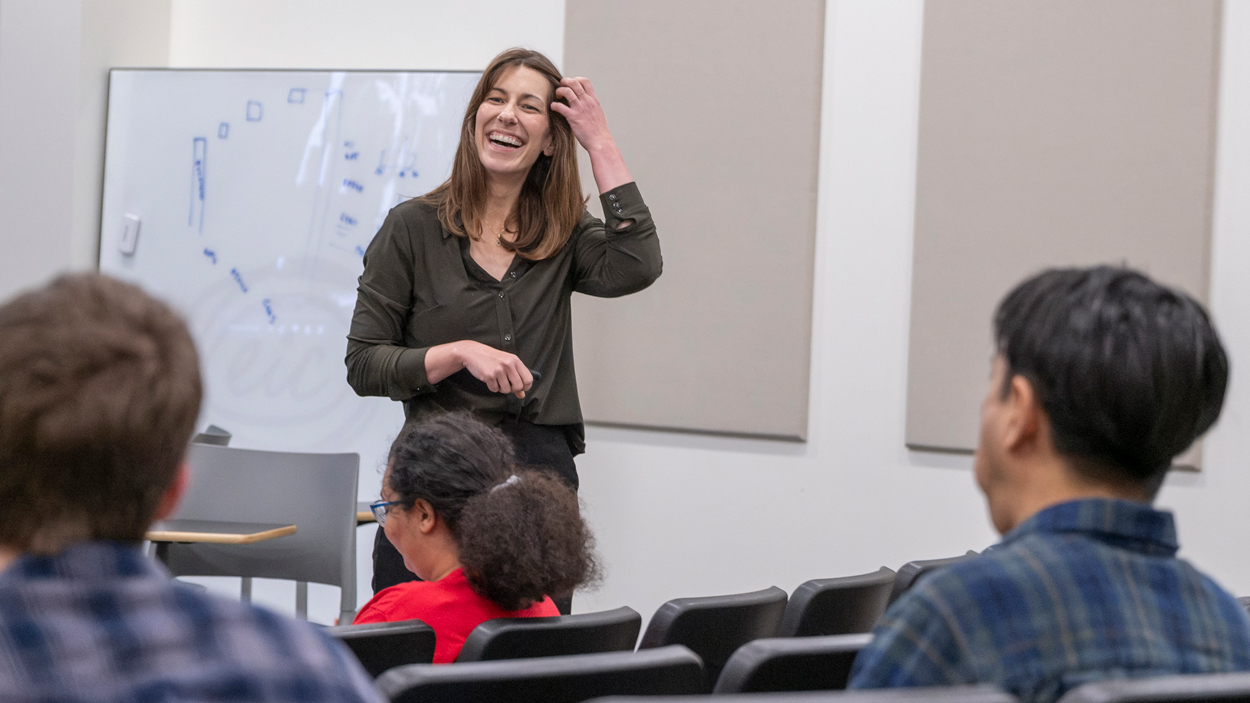
Ashley Rube, director of operations and business services with The Improv Shop, said she hoped the workshop helped students develop confidence in responding to workplace challenges.
For Taofeeqat Shittu, an accounting student and co-president of Beta Alpha Psi, the experience offered an unexpected opportunity to develop interpersonal skills in a relaxed setting.
Shittu initially expected something closer to a traditional presentation, with students interacting through discussions. Instead, she found the activities enjoyable and less intimidating than she anticipated. The informal approach also gave her an opportunity to engage with other students in ways she hadn’t expected.
“They didn’t actually put it out there like, ‘Oh, this is an interpersonal skill you’re learning,'” Shittu said. “But just from the topics, I learned vulnerability, how to relate with other people and how to be a team player.”
Ian Scott, a junior studying marketing, attended with a similar goal of becoming more comfortable responding to situations in the moment.
“I came out here in hopes of learning how to think more clearly and on the spot,” Scott said. “I think this will help me out one day greatly.”
Rube, The Improv Shop’s director of operations and business services, said the students’ willingness to participate helped make the workshop successful. Improv requires people to take chances, sometimes in front of strangers, and that vulnerability is an important part of the learning process.
“This was a really engaged group,” Rube said. “I’m always very thankful for folks that agree to come out to a thing, not be forced by a boss or a teacher.”
She said she particularly enjoys working with students because they are already accustomed to learning, asking questions and processing new information.
Improv provides an opportunity to continue developing those skills in an environment where making mistakes is part of the experience. Rather than worrying about getting everything right, participants can experiment with different approaches and reflect on how they respond to challenges.
“If there’s anything that I wanted for the students to get out of this, it would be permission and a reminder that they deserve to work and live in spaces and with teams where they can be not entirely in control all the time and still be confident that they’ll be okay,” Rube said. “They deserve jobs that let them have that because ultimately we can’t be in control of everything all the time.”