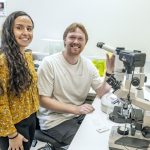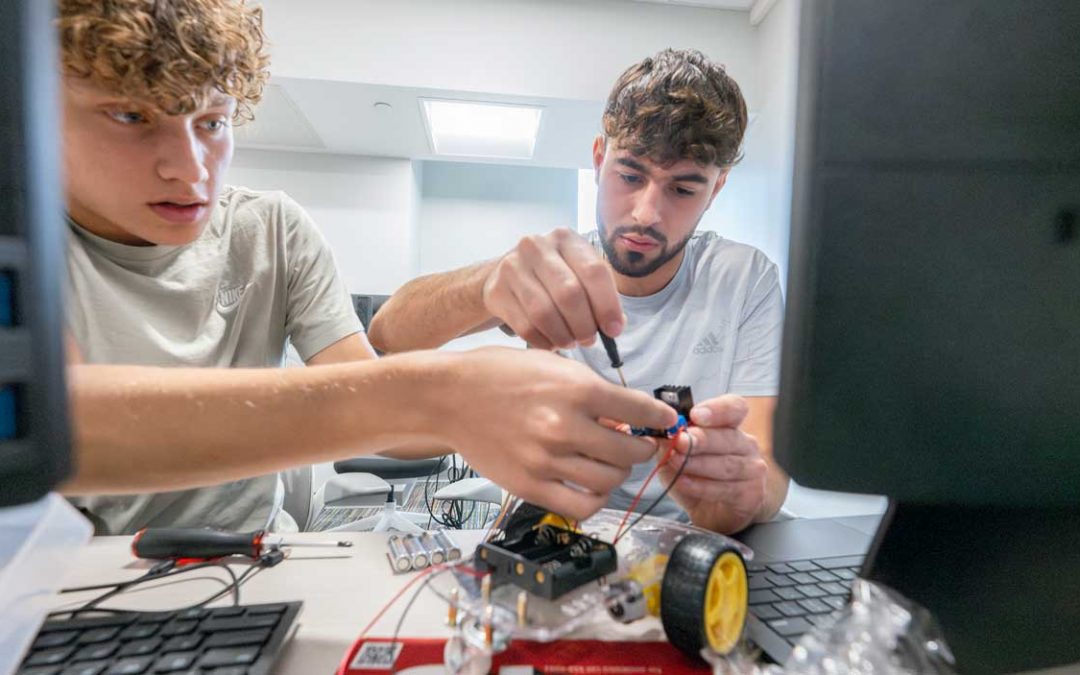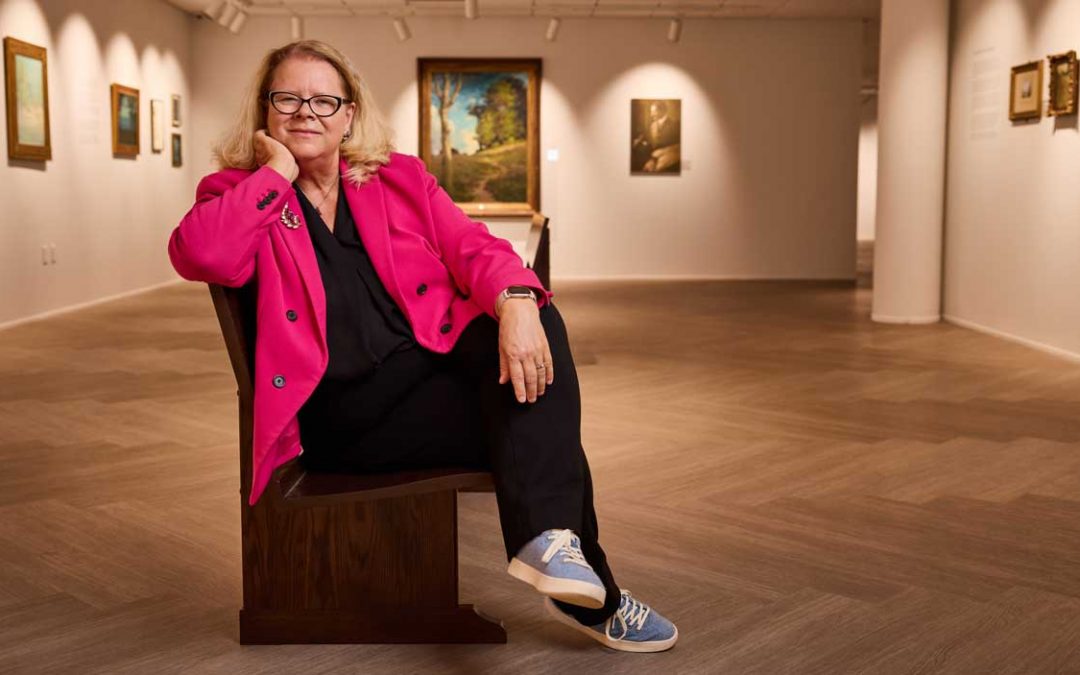
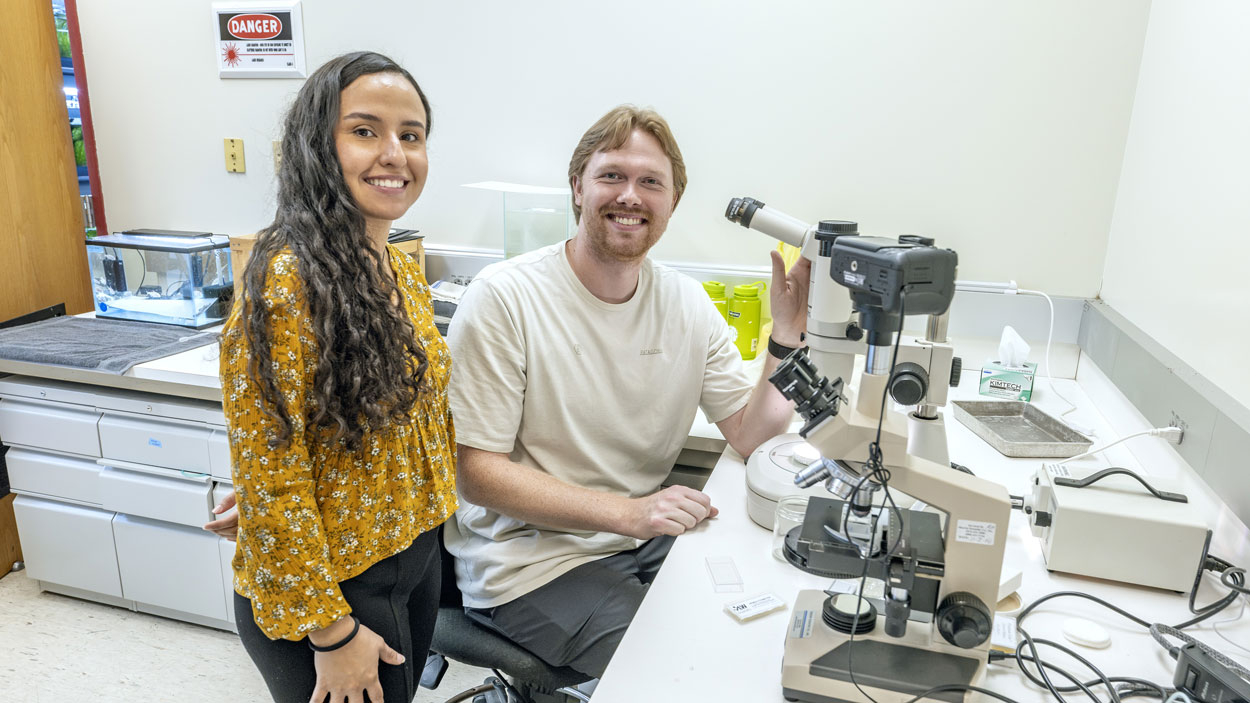
The Society for the Study of Evolution selected UMSL doctoral students Alejandra Serna Sanchez and Erik Johnson for prestigious grants to support their research. (Photo by Derik Holtmann)
The Society for the Study of Evolution works to promote the study of evolutionary biology and cultivate a new generation of scientists working in the field.
This year, the society awarded $145,000 in grants to support students from around the world in their graduate research, and University of Missouri–St. Louis doctoral students Erik Johnson and Alejandra Serna Sanchez were among the grant recipients.
Johnson received a Rosemary Grant Advanced Award targeted at graduate students nearing the end of their programs while Serna received the R. C. Lewontin Early Award, which supports master’s and doctoral students in the earlier stages of their work.
“Having two students receive these prestigious grants in the same year speaks to the caliber of students at UMSL and, more importantly, to what they are capable of accomplishing when given the opportunity to pursue ambitious research questions,” said Michi Tobler, the E. Desmond Lee Endowed Professor in Zoological Studies, who serves as chair in the Department of Biology. “These students are developing original ideas, tackling challenging scientific problems, and making meaningful contributions to their fields.”
The evolution of asymmetric traits
Johnson has been researching how asymmetric traits develop in bilaterally symmetric animals – think fiddler crabs that have one big claw and another small, horses that always seems to run with one foot in front of the other or even humans who are either right- or left-handed. His work involves the study of live-bearing fishes in the family Poeciliidae, including examining the genetic underpinning of the asymmetry.
The fish species he studies have native ranges across the Neotropics, including Costa Rica to southern Mexico, and he’s done field work there during his time at UMSL. He’s also been able to observe and test the fish in Tobler’s lab in the Research Building.
“It is a really great system to do this in,” he said. “The males express these external genitals that help them to inseminate females, and the modified fin used in sperm transfer is essentially either symmetric or asymmetric. So, using this family can help us to get at why asymmetry might have evolved, and then when it does evolve, how might it stick around. We usually think of symmetry as advantageous because it does come along with a lot of benefits, so, what are the scenarios that asymmetry would evolve?”
Johnson, a native of Utah, first became interested in these questions about asymmetry while an undergraduate student at Brigham Young University. He originally decided to continue exploring them in a doctoral program at Kansas State University, where he joined Tobler’s research lab. When Tobler moved to UMSL after Johnson’s first year at Kansas State, he happily followed his mentor.
“Michi’s a wonderful advisor, and St. Louis is a great place to do research,” Johnson said. “There are lots of good collaborations here. Just a vibrant ecology and evolution community.”
He’s had additional support from UMSL’s Whitney R. Harris World Ecology Center as he’s conducted his research.
“His dissertation builds on a line of inquiry he has pursued throughout his academic career,” Tobler said. “What is particularly impressive is how he brings together very different approaches to tackle this big question, combining behavioral observations, high-speed video, genomic analyses and comparisons across dozens of species. It is an ambitious and genuinely integrative project that reflects both his intellectual curiosity and his ability to connect ideas across disciplines.”
Johnson is on track to defend his dissertation this spring and said the $3,500 grant from the Society for the Study of Evolution will help him complete his family-wide comparative analysis.
“Having a little bit of extra funding like that to go and do those sorts of things,” he said, “really makes a world of difference in the depth and the scope of projects that you can envision.”
How forest fragmentation affects plant gene flow
Forest fragmentation has been increasing in South America’s tropical forests as land is converted for agriculture, including cattle pastures, crop production, as well as mining and other human activities. Serna is investigating how forest fragmentation affects pollinator-mediated gene flow among plant populations in tropical Andean cloud forests.
By comparing populations in continuous forests with those in isolated forest patches, she aims to understand how fragmentation influences genetic connectivity and genetic diversity.
“Not only that but also how it affects different pollinators,” said Serna, who has been doing different studies involving bats, hummingbirds and insects.
Her work has been focused in her native Colombia, in the northern portion of the Western Cordillera of the Colombian Andes. She hypothesizes that the effects of fragmentation should be greater for plants whose primary pollinators are insects because the range they can cover tends to be less than that of bats or birds.
“Reduced gene flow can decrease genetic diversity within plant populations, limiting their ability to adapt to environmental changes, resist diseases and maintain reproductive success,” she said. “Over time, these effects can increase their vulnerability to extinction.”
Serna came to UMSL in January 2025 after first earning a bachelor’s degree at Universidad EAFIT in her hometown of Medellín and a master’s degree at the University of Costa Rica. She received a Christensen Fellowship in Plant Conservation through the Harris Center, in collaboration with the Missouri Botanical Garden, and is working in the lab of Professor Nathan Muchhala.
“Alejandra is a really remarkable student; she started in my lab recently and has really hit the ground running,” Muchhala said. “She already put together an excellent plan to study how habitat fragmentation affects plant genetics, and over the summer collected a great dataset of leaf material from the plants to launch this project.”
She’s performing complex genetic testing, examining thousands of different markers, to determine the level of genetic diversity.
The $2,500 grant from the Society for the Study of Evolution will help cover part of the DNA sequencing costs for more than 1,000 plant samples, providing genomic data needed to investigate patterns of gene flow and genetic diversity across fragmented and continuous forests.
Serna has enjoyed her first two years at UMSL, though it hasn’t always been easy for the native Spanish speaker doing work in a second language.
“It was very challenging at first,” she said. “But over time, my English has improved significantly, and I have become much more confident in speaking, understanding others and participating in academic discussions. It takes discipline and persistence, but when you are genuinely interested in the research you are doing, those challenges become easier to overcome.”
Serna is on schedule to complete her PhD by the end of 2029.
Bright futures
Both Johnson and Serna plan to pursue careers in academia after graduating from UMSL. They’re part of a vibrant community of graduate students doing research in ecology and conservation in the Department of Biology.
“I’m really impressed with our current crop of graduate students,” Muchhala said. “They are a very enthusiastic group, excited about doing biology.”
He had particular praise for the drive and ability that Johnson and Serna displayed in winning these internationally competitive research awards.
Tobler echoed those sentiments.
“Their success reflects their talent, initiative and hard work,” he said. “We are incredibly proud of both of them and excited to see their work recognized at this level.”