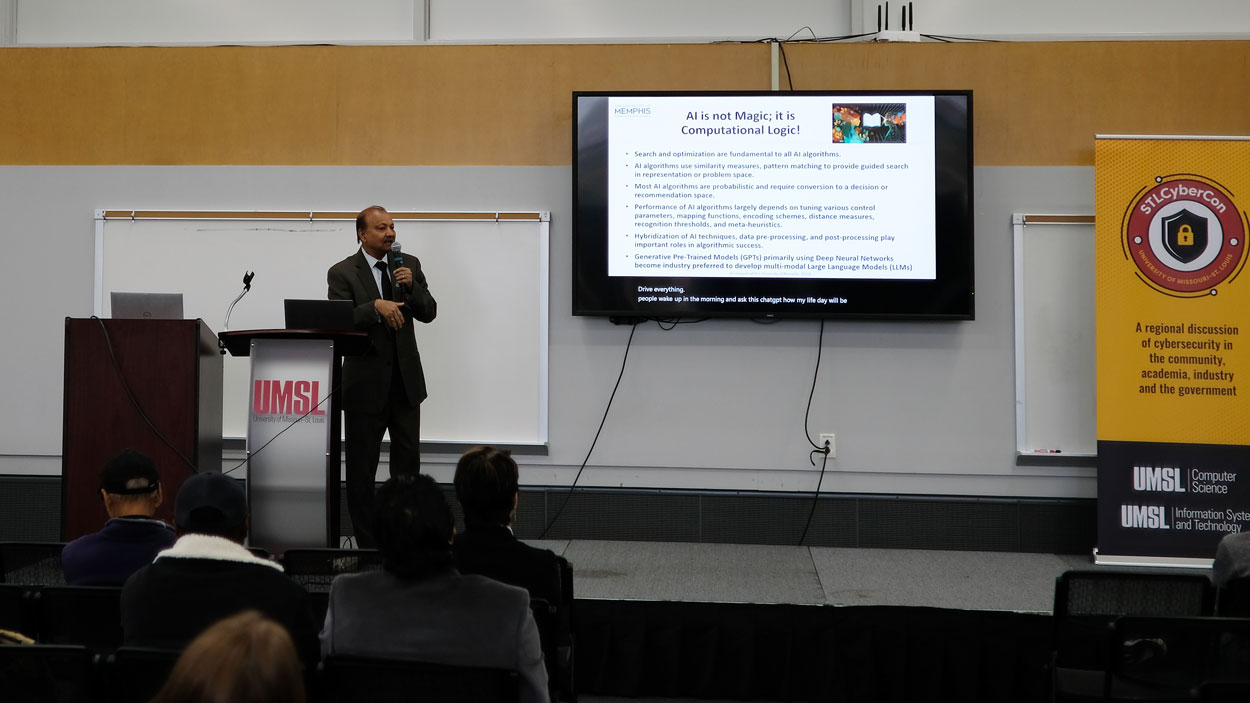
Dipankar Dasgupta, the Hill Professor in Cybersecurity and director of the Center for Information Assurance at the University of Memphis, discusses some of the new challenges in cybersecurity brought on by artificial intelligence during a presentation at STLCyberCon last Friday at the ED Collabitat. (Photos by Steve Walentik)
It was hard to escape discussion of artificial intelligence Friday morning as the University of Missouri–St. Louis Department of Computer Science and the Department of Information Systems and Technology hosted the 12th annual STLCyberCon in the ED Collabitat on UMSL’s South Campus.
More than 100 people attended the free regional conference meant to facilitate dialogue between academics and practitioners from across the region and help expose students to some of the latest trends in the ever-evolving field.
Nothing has led to more changes than the advent of AI.
“Cybersecurity is a big domain, including network security, system security, malwares, other different concepts of security,” said Abde Mtibaa, an associate professor of computer science and one of the co-organizers of the conference. “AI is in every one – every single part of these systems. AI is used to, unfortunately, do harm, and AI is also used to protect. Pretty much all the speakers are either using tools to hopefully defend their system or detect any malicious activities or flag any anomaly. And you’re going to see others also highlighting how damaging AI can be.”
Sajal Das, the Daniel St. Clair Endowed Chair in the Department of Computer Science at Missouri University of Science and Technology, delivered Friday morning’s keynote. He spoke about the importance of AI and data science for constructing secure and resilient Cyber-Physical Systems – or CPS – such as smart energy and utility grids, smart factories, smart buildings and even medical devices such as pacemakers and automated insulin pumps that make automatic adjustments based on feedback they receive from sensors.
Interdependencies can make it easy for cyberattacks to spread across systems.
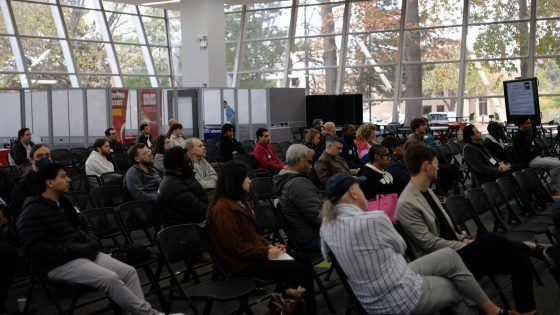
Students, faculty and practitioners from around the St. Louis region gathered for the 12th annual STLCyberCon.
“Anomaly is a very powerful technique to detect threats,” Das said. “It’s very powerful in many different contexts. For example, I am monitoring somebody’s health condition, and anomaly basically means a potential health risk. In the context of security, it may be a threat, right? In the context of agriculture, it may be an outbreak, a pest, an insect.”
His research explores mathematical invariants in time-series data that remain stable during normal operations but shift sharply during anomalies, attacks or malfunctions. Looking out for these anomalies can help speed up detection of new threats.
Attendees also heard a featured talk from Dipankar Dasgupta on the crossroads between AI and cybersecurity. Dasgupta spent a year as a visiting professor at UMSL in the mid-1990s and now serves as the Hill Professor in Cybersecurity and director of the Center for Information Assurance at the University of Memphis. He is currently collaborating with Mtibaa, UMSL Professor Cezary Janikow and others on a National Security Agency-funded project to develop a hands-on, experiential training curriculum designed to introduce high school students to concepts and applications at the intersection of AI and cybersecurity. They hope it will help inspire them to pursue education and training in the field.
In his talk, Dasgupta warned against relying too heavily on Large Language Models and treating them as universal problem-solvers. He noted the increasing resource demands to make the models function. He also said LLMs aren’t appropriate tools to solve data-driven problems.
Dasgupta seemed particularly skeptical of companies viewing AI-generated code as a replacement for human developers. It has the potential for greater security risks.
“How can you train someone without teaching those things and assume they can detect the bug?” Dasgupta said. “They have no knowledge about programming, data structure, and all these algorithm aspects.”
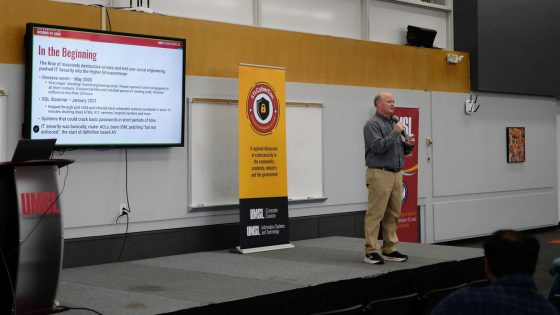
UMSL Information Security Officer Mark Monroe describes some of the new challenges he’s encountered in his work protecting the university’s systems.
He was also wary of an industry push to eliminate entry-level programming positions, wondering how anyone will be able to develop the five to seven years’ experience required for more senior positions.
“How will that happen if you don’t train them from the beginning?,” Dasgupta said. “This kind of business model I think there will be big issue. You’ll see there will be major concern.”
Those are all issues that will have to be dealt with because the models aren’t going away.
UMSL Information Security Officer Mark Monroe provided a brief break from AI when he described his work helping protect systems in higher education. Monroe became UMSL’s first-ever information security officer when he was hired in 2004 and has seen significant changes as cybersecurity tools and threats have both gotten more sophisticated.
“What we cannot do is get between the finger and the mouse and clicking on the button,” Monroe said. “There’s one thing that none of us can do in information security, and it is the one giant hole that sits out there for all of us, but it is changing.”
He noted developments such as multifactor authentication, passkeys and MFA, security keys and greater user education that have made security stronger in recent years.
Friday’s schedule included presentations from other industry professionals working in cybersecurity at Cigna Health, Evernorth, Saint Louis County, ezCater and Netskope. Students also had a chance to connect with potential employers at a career expo held in conjunction with the conference.
“The main reason that we keep this year after year, with all the challenges, with everything, is we are hopefully bringing all these stakeholders here in one place for our student to interact with them and to get some connections,” Mtibaa said. “Hopefully they’re going to get internships or jobs or things like this by interacting with these guys.
“We like this open space because it helps encourage discussion. I see students talking in the career expo there. Whenever I meet a student, I asked, ‘Have you talked to them?’ And they say, ‘Yeah, we went and discussed, and we shared CVs.’ I think that’s pretty much what we’re trying to do. The job market is really hard right now with AI, so we are doing our best to help them beyond the classroom.”
UMSL has been training cybersecurity professionals for more than a decade. The National Security Agency and Department of Homeland Security have named the university a National Center of Academic Excellence in Cyber Defense Education.