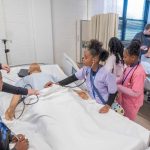
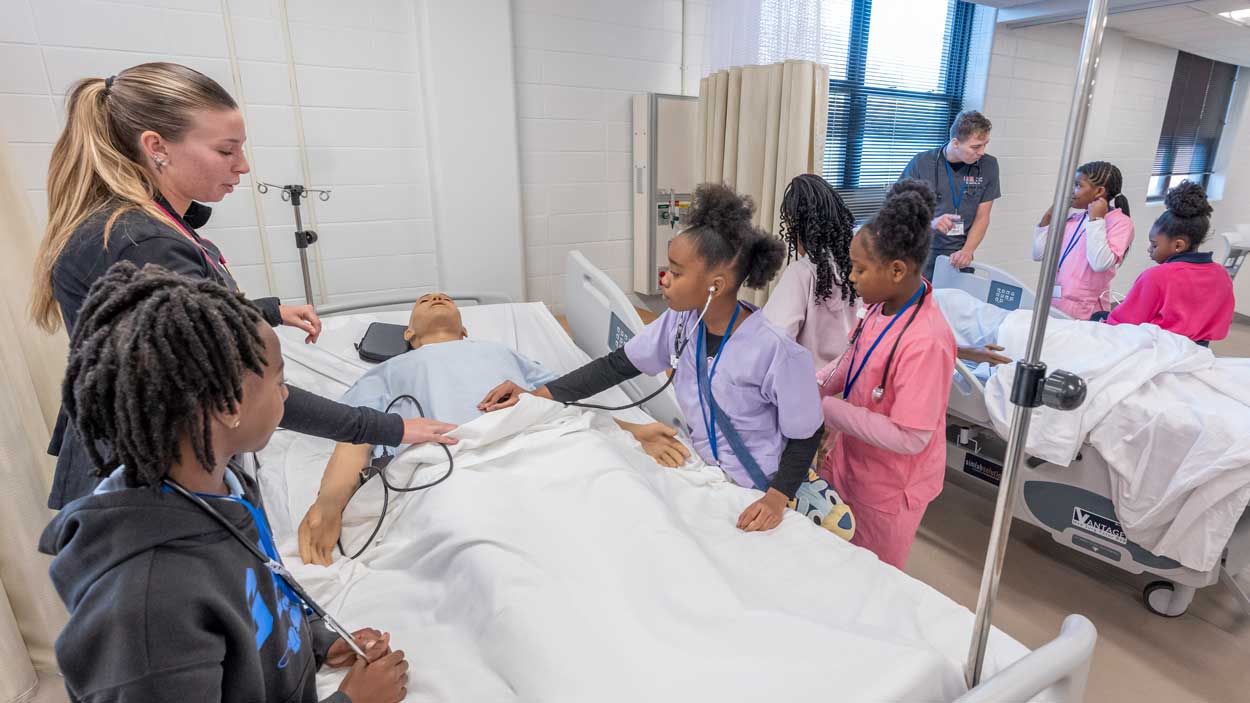
Under the supervision of UMSL BSN students, a group of students from Koch Elementary practice their nursing skills on a patient in the Nursing Simulation Lab. The students visited UMSL as part of their hands-on learning through the school’s Future Nurses Academy. (Photo by Derik Holtmann)
While Mina tried administering an EpiPen into the injection practice pad, a few feet away, her Koch Elementary School classmates practiced CPR on life-like adult mannequins, singing along to The Bee Gees’ 1977 hit “Stayin’ Alive” to correctly time their compressions.
It will be years before the budding nursing students are able to care for real-life patients, but they were able to get a head start practicing their skills thanks to a new partnership between Riverview Gardens School District and the University of Missouri–St. Louis College of Nursing.
On Nov. 18, a group of UMSL BSN students welcomed about 20 third-, fourth- and fifth-graders in Koch Elementary’s Future Nurses Academy to the state-of-the-art Nursing Simulation Lab on UMSL’s South Campus. Launched during the 2025-26 school year, the Future Nurses Academy aims to give elementary students early exposure to nursing and healthcare careers in a hands-on, age-appropriate way.
Principal Amy Foster has a grand vision of creating Missouri’s first career and technical elementary school, offering programs in nursing, culinary arts and technology that will foster career readiness through real-world learning.
“I always thought my little kids can do exactly what the big kids are doing, but they can do it on a different level,” Foster said. “Maybe it’s not as grand as what they do in high school, but they can learn some of those same skills. My goal is to give the kids as much exposure to career pathways as I possibly can. Even if they decide, you know what, that’s not for me, at least they’ve had an opportunity to decide.”
Foster said UMSL’s College of Nursing was a natural partner to help Riverview facilitate the hands-on learning for its students, and she hopes some of her students will eventually make their way back to UMSL to continue their nursing education.
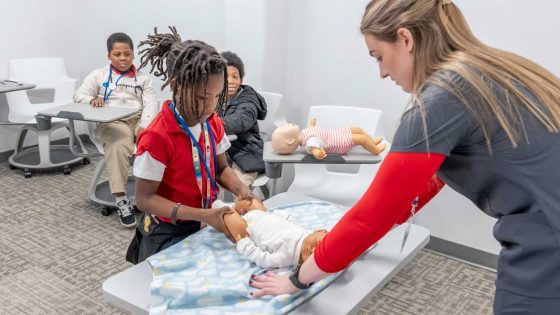
Senior BSN student Gracie Nickle helps a Koch Elementary student practice swaddling a baby. (Photo by Derik Holtmann)
Over the past three semesters, students in UMSL’s Community-Based Clinical Education Program – which is designed to show students how healthcare can be delivered in a variety of settings outside of the traditional acute care hospital experience – have helped Koch Elementary build out the curriculum for its Future Nurses Academy. Each week during the semester, they traveled to the school to meet directly with students and cover basic nursing topics such as first aid, CPR, nutrition, allergies and emergency situations.
Associate Professor and Director of Community-Based Clinical Education Sheila Grigsby, who oversees the Community-Based Clinical Education Program, said that the UMSL students focused on age-appropriate topics that the elementary school students could then take home to share with their parents and siblings. Whenever possible, they looked for hands-on approaches to learning those topics, from practicing CPR on stuffed teddy bears to using a black light and fluorescent powder to simulate germs and show where hand-washing can fall short.
Last week, the elementary school students were able to show off what they’ve learned and put their skills to the test in UMSL’s Nursing Simulation Lab. Overseen by seniors Anna Drummond, Kaylee Gerwitz, David Molina, Gracie Nickle and Sam Whitt and juniors Tyrha Gales, Sydney Hearing and Madisyn Johnson as their capstone project for the Community Health Course, the simulation assessed how well Koch students have learned those nursing concepts. They were able to connect their classroom instruction with hands-on practice on the Sim Lab’s life-like high-fidelity mannequins, which can simulate blinking, breathing and speaking.
Nickle, who is in her final semester of the BSN program, led the group of UMSL nursing students in running the simulation. She was excited to give the Koch students the opportunity to practice what they’ve learned in the classroom in a real-life setting.
“They are very much hands-on driven kids,” Nickle said. “We’ve done as much as we can in the classroom, but this was a lot more hands-on and allowed them to use those skills and tie together what we’ve been saying. We did CPR with teddy bears, and they’re like, ‘This isn’t the same.’ I was like, ‘Well, OK, we’ll get there.’”
During the simulation, Koch students rotated in groups through several different stations in the Nursing Simulation Lab, practicing nursing skills such as taking patient assessment, responding to a choking infant, building a first aid kit, swaddling a baby and inserting an Epi-Pen. After, they performed those skills in front of a nursing student instructor who graded them against a step-by-step checklist, mimicking the same nursing check-offs that the BSN students themselves complete as part of their coursework.
While the Simulation Lab has hosted countless UMSL nursing students as well as students in UMSL’s College of Optometry and the University of Health Sciences & Pharmacy, the group from Koch Elementary was by far the youngest so far to take advantage of the lab’s life-like adult, pediatric and infant mannequins.
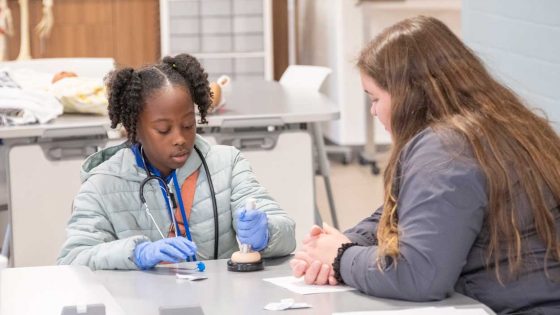
Students practiced skills including learning how to administer an EpiPen. (Photo by Derik Holtmann)
“We talk about a pipeline into healthcare, and there’s no reason we can’t start when they’re younger,” Simulation Lab Director Liz Gavin said. “In fact, I think that’s probably better – exposing the younger kids to healthcare in a hands-on way and getting them to start imagining themselves in those roles as early as possible. Traditionally, it’s middle schoolers and high schoolers that you bring in, but this is the best age because their sense of what’s possible is still completely open.”
Through the Future Nurses Academy and their hands-on lessons with UMSL nursing students, the Koch students have mastered many technical nursing skills, but Foster said the impact of the partnership stretches much further. She’s seen her students become more confident, take on leadership roles and improve their communication skills as a result of participating in the program.
“This builds their character,” she said. “They communicate in different ways now. They use different vocabulary because of the nursing language. It’s affected how they are seen around the school because they come in nursing uniforms on Nursing Academy days, and now they’re playing into this role that they are a professional, so they need to act a certain way. I’ve just seen them step up. I’ve seen some kids who are softer-spoken become leaders. They ask questions about college. And if I don’t get anything else, that is worth it. That’s absolutely worth it.”