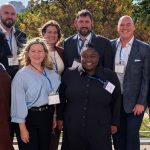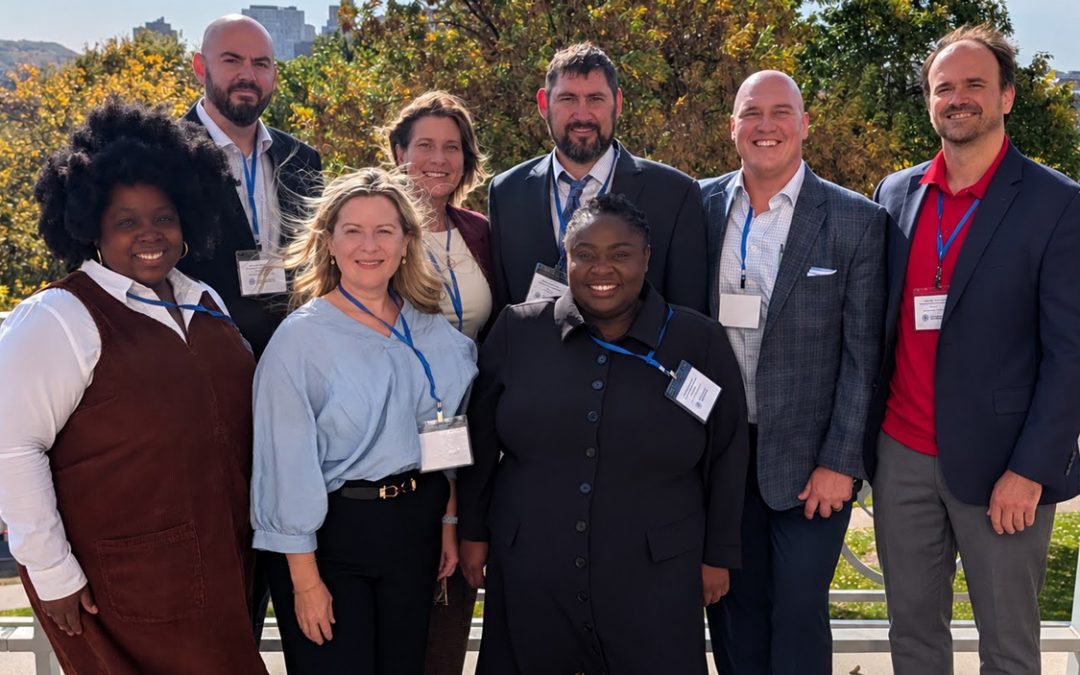
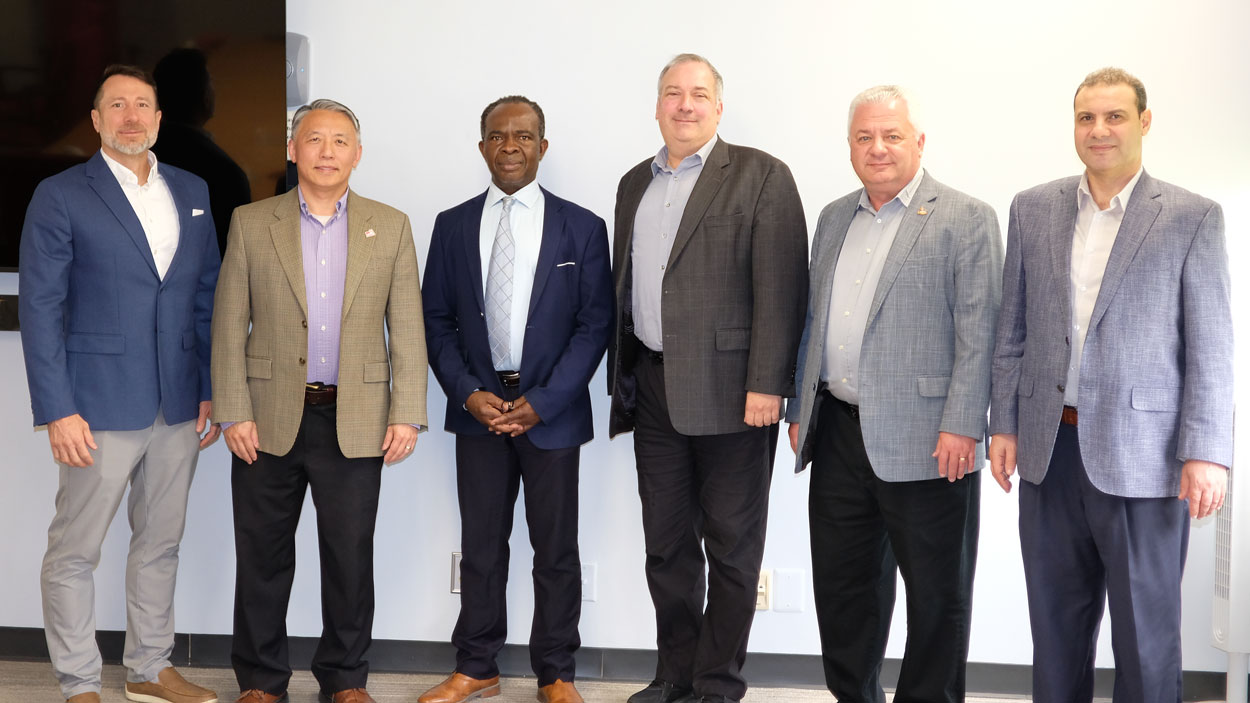
UMSL welcomed Air Mobility Command Chief Scientist Albert Lowas (third from right) for a kickoff meeting last Friday to discuss potential collaborations arising from a new Education Partnership Agreement between UMSL and U.S. Transportation Command and AMC. Provost Steven J. Berberich (second from right) took part in the meeting along with faculty and staff members (from left) Michael Seper, Haitao Li, George Nnanna and Reda Amer. (Photo by Steve Walentik)
The University of Missouri–St. Louis has entered into an Education Partnership Agreement with the United States Transportation Command and Air Mobility Command to enhance student learning while also fostering collaborations with UMSL researchers.
USTRANSCOM is a unified functional combatant command within the United States Department of War, with a primary mission to provide global air, land and sea transportation services to other U.S. combatant commands, military services, defense agencies and other government organizations to meet national security needs during peacetime and wartime. AMC is a major command of the U.S. Air Force and a component of USTRANSCOM that provides airlift, air refueling, aeromedical evacuation and global air mobility support to project, connect, maneuver and sustain the Joint Force.
Both USTRANSCOM and AMC are headquartered just across the Mississippi River from St. Louis at Scott Air Force Base in St. Clair County, Illinois.
The agreement will provide opportunities for UMSL students and faculty members to connect with practitioners at USTRANSCOM and AMC and work to tackle real-world problems that exist at the intersection of engineering, transportation, supply chain and analytics and geospatial technology.
“We are excited for the opportunities our faculty, staff and students will have to work with and learn from experts at USTRANSCOM and AMC as part of this agreement,” said Steven J. Berberich, UMSL’s provost and vice chancellor for academic affairs. “I think this will really bring some innovative ideas into the classroom, enhancing our curriculum. It will also shine a light on the capacity that exists here at UMSL and our commitment to help support the St. Louis region by developing practical solutions to modern challenges.”
Some of the biggest beneficiaries of the agreement figure to be students, particularly in UMSL’s new School of Engineering and Department of Supply Chain and Analytics. As part of the agreement, they may be provided access to government experts, test or operational facilities, information and research resources to work on shared projects. Students may also receive academic and career advice from USTRANSCOM experts.
George Nnanna, the School of Engineering’s founding director, believes students learn better when they’re tasked with thinking through practical problems.
“When we present the theories in the classroom, often it is insufficient to connect the science and engineering,” he said. “But when students can apply those theories to solve a specific real-world problem, I think that’s really huge.”
Nnanna hopes to facilitate frequent collaboration with USTRANSCOM and AMC experts on senior design projects, whereby students have the chance to work on specific projects throughout the semester with opportunities for students to receive advice both during the projects and when they deliver their final presentations.
Supply chain and analytics students, too, could gain greater insight by working through real-world logistical challenges that USTRANSCOM and AMC might share.
The agreement will also foster collaboration at the faculty level for shared research projects.
AMC is responsible for the planning that ensures the Air Force’s air transportation capabilities provided to multiple military service forces are responsive, dependable and resilient. UMSL’s expertise in supply chain research has the potential to help strengthen those processes.
“There are lots of opportunities to work with AMC’s team to help them either address their new planning needs, decision needs or improve what they have been doing,” said Professor Haitao Li, who chairs the UMSL Department of Supply Chain and Analytics.
UMSL’s Geospatial Collaborative can also support those efforts.
“This partnership creates a unique opportunity to advance cutting-edge research in geospatial technology and GeoAI, an emerging field that integrates artificial intelligence with spatial data to generate deeper insights, predictive capabilities and data-driven decision-making,” UMSL Geospatial Collaborative Director Reda Amer said.
“AMC deeply appreciates the opportunity to collaborate with UMSL and other local universities,” AMC Chief Scientist Albert Lowas said. “Working together with local universities gives students an important glimpse of the professional world – especially the defense industries critical to the St. Louis area. AMC looks forward to this new collaboration and to the innovative solutions that UMSL’s future technology leaders will bring to the challenges we face projecting power and providing hope anywhere, anytime.”
The Supply Chain Analytics Center of Excellence can also offer educational and training opportunities for USTRANSCOM and AMC personnel that help them better understand how to use data as they develop new solutions.
Nnanna envisions collaborative research opportunities for faculty in the School of Engineering, as well, including the chance for faculty members to utilize specialized operational facilities at Scott Air Force Base as a realistic environment for research trials and technology demonstrations.
“I’m looking at this as a win-win, both for the lab as well as for UMSL,” Nnanna said. “It will present opportunities to test innovative ideas or even to initiate and develop a specific curriculum, whether it’s in artificial intelligence or expanding our footprint in additive manufacturing and advanced manufacturing.”