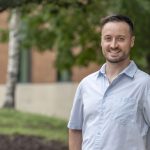
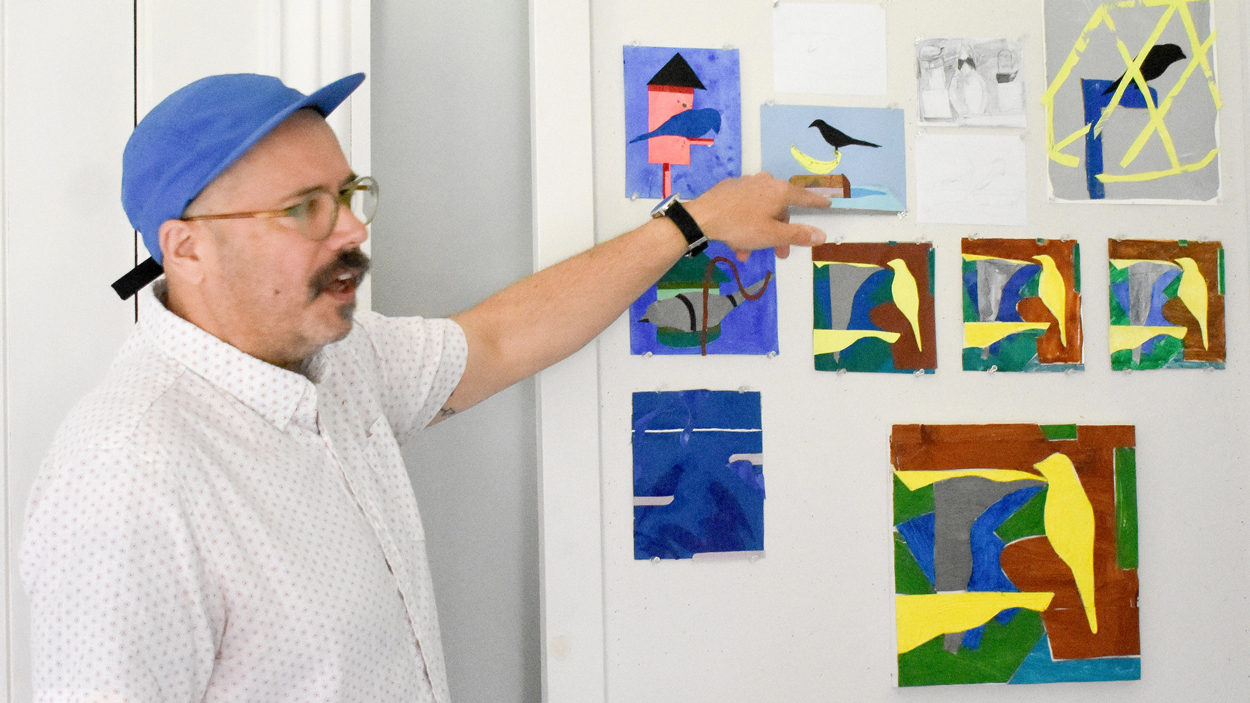
UMSL Associate Teaching Professor Michael Behle showcases several pieces he created during the two-week Farwell House Artists in Residency program. The paintings of colorful birds, employing bold geometric patterns, build upon a previous collection. (Photos by Sarah Pearce, West Central Watchdog)
Michael Behle had been looking for opportunities to reengage his creative practice this summer as his time as chair of the Department of Art and Design at the University of Missouri–St. Louis winds down.
The Farwell House Artists in Residency program provided Behle, an associate teaching professor, the time and space to do just that. The rural arts initiative supports artists from across the country with a two-week stay in a live-work space located on the first floor of a historic 150-year-old brick home in Frederick, Illinois.
“I thought I would apply, and it turned out they had a spot for me,” Behle said. “The thing that’s interesting about it, too, is some years back I was involved in running an artist residency, and it was a very small program, similar to the Farwell House. I think that struck a chord.”
In April, Farwell House founders Jason and Christy Ackman announced the 2026 cohort of eight artists-in-residence from different parts of the United States, from New York to Texas. The program hosts two residents per session, and Behle was paired with Ella Desmond, a senior technician and adjunct faculty member with the Parsons School of Design in New York, during the second installment from June 22 to July 4.
Charles Farwell, a wealthy entrepreneur in the freight shipping industry, built the stately mansion on a hill overlooking the Illinois River following the Civil War. The environment provides a stark contrast to the urban landscape of St. Louis, and Behle was struck by greenspace encompassing the sprawling estate. While Behle drew some inspiration from the natural surroundings, he said the ability to reflect, read and write for two weeks during the residency had a greater impact on the work he produced.
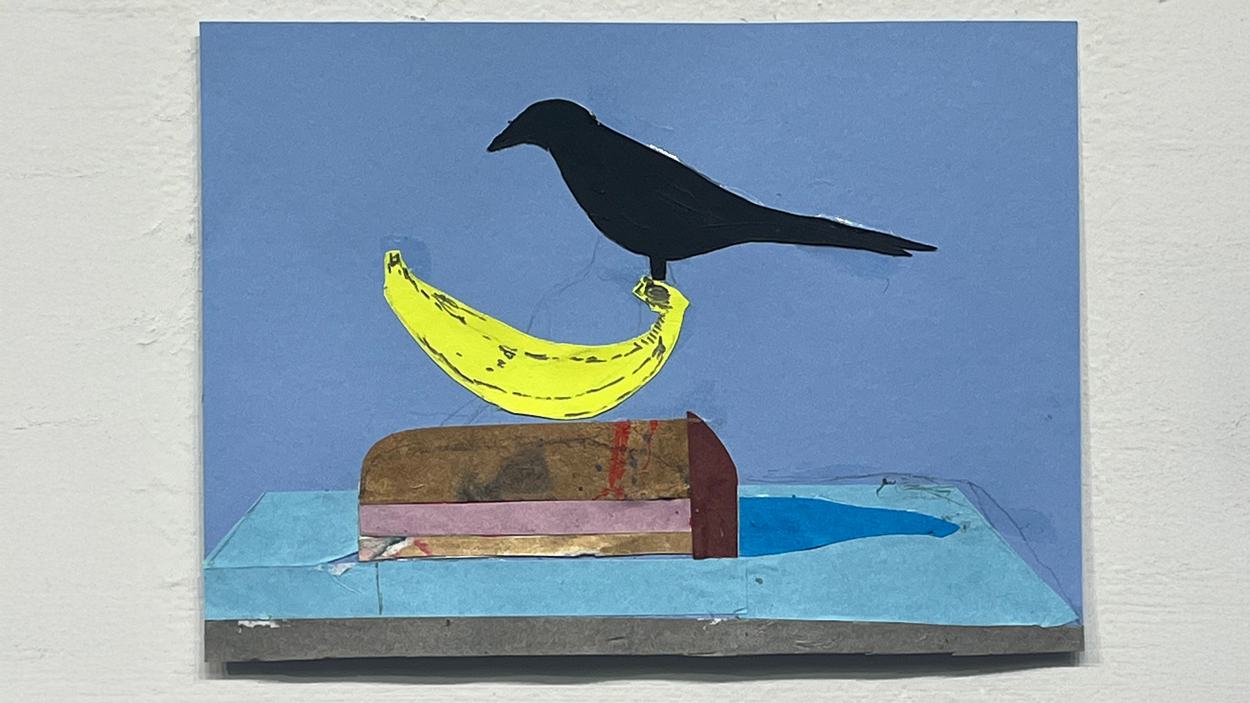
Artwork by Mike Behle created during his residency at Farwell House in Frederick, Il. The images are small 8.5” x 11” and 5” x 7” studies on paper (collages) that Mike made while at the residency.
“It wasn’t as much that the landscape and environment informed, but that the time informed,” he said.
At the Farwell House, Behle returned to a familiar medium and subject matter. He produced a series of paintings focusing on colorful birds and employing bold geometric patterns. The work builds on a previous collection he began during the onset of the COVID-19 pandemic when he was feeling unanchored.
“I was looking for something that I could build on,” he said. “Something that would not only lend itself to formal concerns of color, shape, organization and composition, all those formal elements that I really like to dig into, but also the metaphorical. As the pandemic came on, I found myself looking out my window and paying more attention to the bird feeding station, and it just hit me, ‘Well, there it is.’
“Prior to that, I had been making some things that were a little more abstracted, and they were dealing with this play between abstraction and representation. But the birds, because there is that recognizable subject, it allows an entry point pretty immediately for folks.”
Originally, the collection only depicted birds – recognizable species such as cardinals, mourning doves and woodpeckers – and their interactions and relationships. As time went on, Behle began to play with the idea of expanding the motif by introducing other elements into his compositions. The residency provided Behle time to plan the integration of human figures into the collection, a new direction for his work.
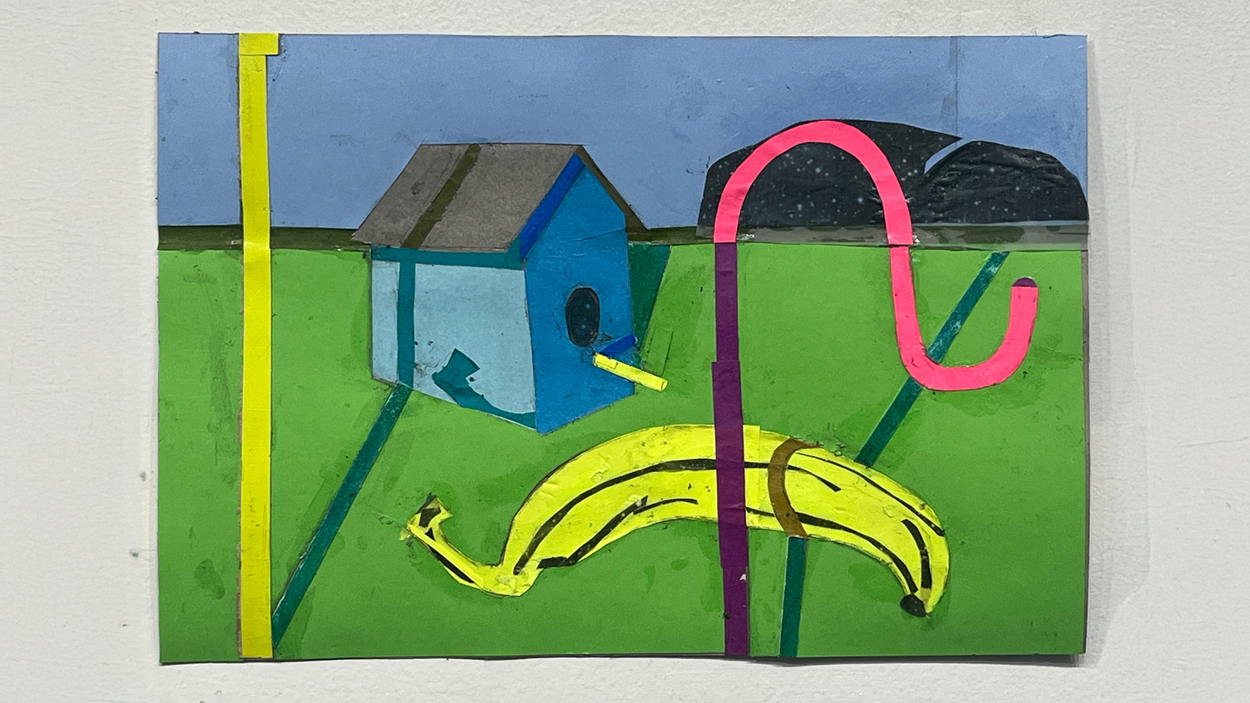
Painting of a birdhouse and banana
“Any time a shift like that occurs, it needs to feel authentic,” he said. “It needs to feel correct. It needs to conceptually make sense for me. What would that do to the paintings to introduce this other element? A big thing that I was wrestling with was that idea of introducing the human form into the paintings. I’m still kicking around some possibilities there.”
While the time and relative solitude of the residency was conducive to the creative process, it did occasionally present challenges. Given the remote location, artists are advised to bring any supplies they might need during the stay. Behle thought he was well equipped, but he still had to take a road trip to Jacksonville, Illinois, to secure more supplies.
At the end of each session, the artists-in-residence hold open studios to showcase the work they produced and interact with community members. Behle enjoyed speaking with visitors, particularly a few birdwatchers who were naturally drawn to his paintings. The conversations were refreshing and underscored the idea that art is a language that transcends boundaries and facilitates connection.
Behle also connected with his fellow artist-in-residence, Desmond, and valued the chance to network and grow his professional practice as an educator. He regularly leads trips to New York City with UMSL students as part of a professional practice course in the arts and is now looking forward to bringing his students to meet Desmond at the Parsons School of Design next spring.
But for the time being, he is focusing on his departure from the role of chair. The interlude has allowed him to participate in another artist residency toward the end of the month at the Vermont Studio Center in Johnson, Vermont.
“Artist residencies are really important,” Behle said. “They provide that very base level of time and space, and in a busy world, that’s sometimes the biggest gift you can get.”