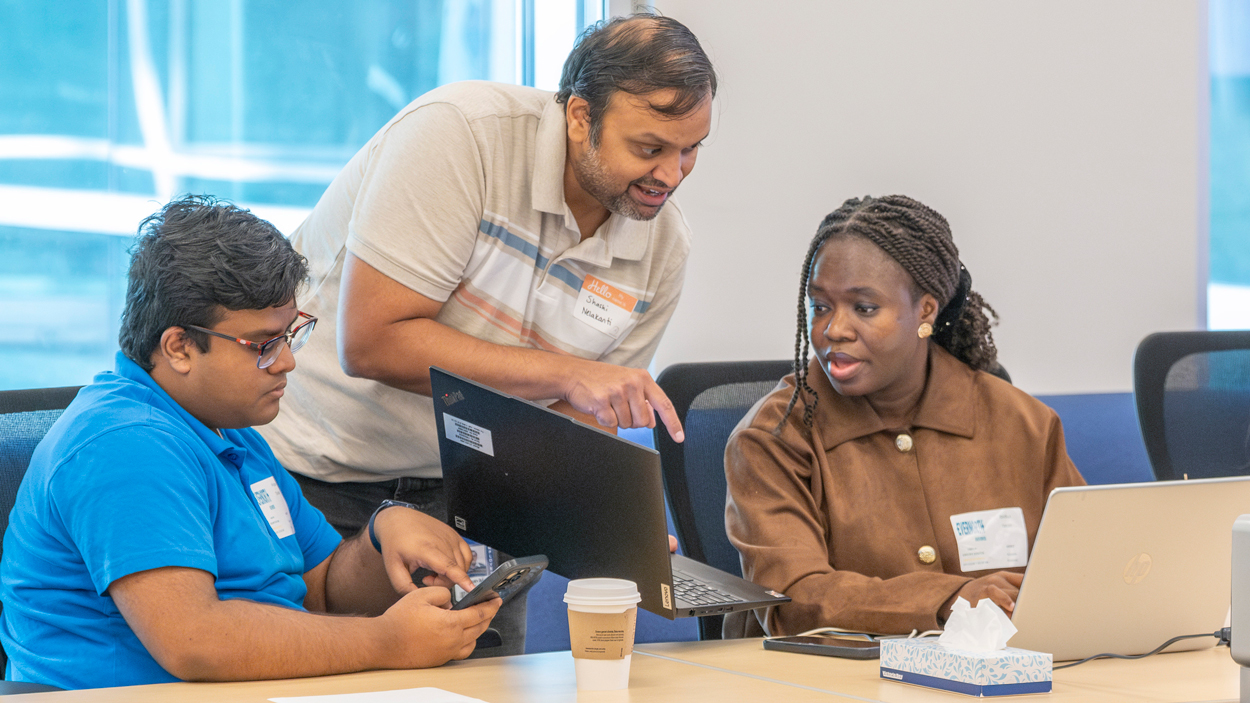
Shashi Nelakanti (center), an engineer with The Cigna Group, talks with UMSL students (from left) Aryaan Sheikh and Ibidun Issac as they prepare for their final presentation as part of the Nurturing Excellence and eXperience in Technology (NEXT) program, a 12-week initiative developed in a partnership with the leading global health company to help students who are struggling to find internship opportunities. (Photo by Derik Holtmann)
Internships provide college graduates with meaningful experience that helps them stand out from other job applicants.
But getting that internship can be as difficult as getting hired. It’s a frustrating catch-22 that Dinesh Mirchandani, chair of the Department of Information Systems and Technology at the University of Missouri–St. Louis, found often proves particularly tough for many UMSL students pursuing a degree in information systems.
Working students facing scheduling difficulties, international students dealing with visa-related complications or other students simply blocked by a challenging job market can all struggle to find opportunities to apply skills they’ve learned in the classroom. Fortunately, thanks in large part to UMSL alum and Information Systems and Technology Advisory Council member Suzi Kurtovic, UMSL found a way to help address those needs.
This summer, 12 UMSL students participated in the Nurturing Excellence and eXperience in Technology (NEXT) program, a 12-week initiative with The Cigna Group, a leading global health company. The program provided a flexible opportunity to gain hands-on, industry-relevant experience and develop skills essential to a career in technology. Working in teams of six, the students collaborated remotely with peers and received guidance from Cigna mentors while developing a technological solution for a real-world issue.
“This was a very intense program where the students designed, built, tested, deployed and secured a web application to tackle a significant problem that people deal with every day,” Mirchandani said. “For the students, this was a transformative summer, and it really showcases what can be accomplished through a public-private partnership like this.”
The program was open to undergraduate and graduate students who had completed at least one formal class in programming or coding. It began in late May, when the teams were tasked with creating a three-tier Amazon Web Services-hosted application to help address the mental health crisis in the United States.
Each team member committed a minimum of 10 hours per week to the project throughout the summer. That included weekly training sessions with Cigna representatives learning about the different processes involved in developing a solution. The teams met on Aug. 11, most of them virtually, to present their final product for Cigna managers and UMSL faculty members.
For Ibidun Isaac, who came to UMSL from Nigeria and is working toward a master’s degree in cybersecurity with an emphasis in information systems, NEXT was her first professional development opportunity, giving her a chance to add professional experience to her portfolio and greater confidence that she has the skills and credentials to compete for a job after graduation.
“It’s like giving us a key to the front door,” she said. “I wanted something that would serve as a kind of steppingstone, and I feel like these experiences are going to go a long way in improving our skills and helping us get jobs in the future.”
Isaac’s team, which included Aryaan Sheikh, Dami Fadeyi, Tunisia Johnson, Hamsini Reddy and Andres Caicedo, created MindWave, a mental wellness app designed to support young adults experiencing issues with anxiety, depression and stress.
MindWave serves as a daily mental wellness companion, offering users tools to track their moods, practice cognitive behavioral therapy exercises and coping techniques, and access crisis support resources. The app also includes one-touch emergency assistance, providing a simple way for users to check in with themselves, build healthy habits and connect with support when needed.
“I learned a lot as the program progressed,” said Sheikh, who graduated in May, earning a bachelor’s degree in business administration with an emphasis in information systems and technology. “Getting to learn more about the capabilities and the tools gave me a broader experience, and knowing what we accomplished and what it took to get here gave me a lot of confidence. All the different tools and resources we learned are things I can apply when I get a job.”
The other team, consisting of Emmanuel Adewale, Deepa Diyati, Maisa Salahaldin, Jason Costa, Rakisha Vinson and Jahnavi Mannam, cited the alarming rates of anxiety and severe depression among college students as the driving force behind the development of PulseNest.
Using hardware similar to a medical imaging device, PulseNest monitors health metrics such as respiration and heart rate in real time to identify potential warning signs of a mental health crisis and provide users with guidance and alerts when they may need help.
“I could see that the students were there to learn, they were eager to develop stuff,” said Cigna engineer Shashi Nelakanti, who along with Mike Shoemaker served as a mentor for the second UMSL team, while Cindy Chen and Mercy Olatunde mentored the other group. “They are very innovative as well.”
Mirchandani was effusive in his praise for the quality of the student projects and expressed his gratitude to the Cigna mentors who helped make the experience possible. He was especially thankful to Jon Clark, IT senior principal engineer and director at Cigna, who led the program, and Kurtovic, a vice president of client optimization for Cigna, who played an instrumental role in bringing the partnership to UMSL.
In spring 2025, Mirchandani asked members of the IST Advisory Council to help identify potential solutions to the challenges students faced in securing internships. That summer, Cigna launched its NEXT program with students from the University of Connecticut. Shortly after the program concluded, Kurtovic contacted Mirchandani to explore whether UMSL could establish a similar partnership with Cigna.
“I always look back at UMSL and everything that the curriculum taught me but also how the faculty made a huge impact in my life and gave me those foundational elements that I needed to get my first job and grow in my career,” said Kurtovic, a former student of the information systems and technology department who graduated in 2004 with a bachelor’s degree in management information systems and earned her MBA in 2005. “Joining UMSL’s Information Systems and Technology Advisory Board was just a way for me to give back to UMSL and share some of my talents and skills and some of my knowledge that I’ve gained in my career.”
Kurtovic was equally impressed by what the students accomplished, praising their creativity and innovation as well as the teamwork, communication and trust they developed throughout the process. She also saw potential value in the solutions they created, particularly as Cigna continues looking for ways to address challenges related to mental health.
“We are always looking for ways to help our patients and to help our members, and mental health is definitely a major pain point in society today,” Kurtovic said. “So, there is potentially something here that we can take back and see if it’s something we want to build upon.”