

Nick Bowman graduated from the University of Missouri–St. Louis with bachelor’s and master’s degrees in communication. Now, Bowman is a professor of communication in the Newhouse School of Public Communications at Syracuse University. (Photos by Derik Holtmann)
Nick Bowman began to reminisce about his time at the University of Missouri–St. Louis the moment he set foot in the Millennium Student Center on Thursday afternoon.
Memories of the former Pilot House and long hours as editor-in-chief of The Current came back to Bowman as he reflected on his formative experience as a communication student at UMSL. Now a professor in the Newhouse School of Public Communications at Syracuse University and nationally renowned scholar, Bowman returned to his alma mater to deliver a lecture on the psychology of video games to dozens of faculty, students and staff in the MSC Chamber.
“When you are in college, when you are finishing your undergraduate, when you’re in the middle of your master’s program, it is really hard to think about what any of that is going to look like,” he said. “You’re just happy to understand a theory, you’re happy to do an analysis. So, for me, it was this full-circle moment, especially in a building that opened when I was here.”
Bowman graduated from the Department of Communication and Media with bachelor’s and master’s degrees in 2003 and 2004, respectively, and he went on to earn a PhD at Michigan State University. His research is aimed at comprehending the cognitive, emotional, physical and social demands of interactive media content. He has produced a prolific body of work on the subject, publishing more than 160 peer-reviewed articles and co-authoring two textbooks on media psychology and emerging media.
But none of that would have been possible without UMSL. The Department of Communication and Media’s rigorous standards laid the groundwork for Bowman’s successful career in academia.
“UMSL was unapologetic,” Bowman said. “It was open. It was inviting. But it was not going to let you walk out the door without knowing what you’re doing. I think, at the time, you’re mad you didn’t get an A or got that question wrong. But things make sense today because they had to make sense between 1999 and 2004. Those five years set a foundation for what makes sense. Any college might teach the classes, but not any college is going to make sure you know the material.
“So, when I say it was unapologetic, I mean there was never an apology for the material being difficult. ‘We’re going to let you in. We’re going to let you do your thing. We’re going to support you. But we can’t make the content easier.’ That foundation, now that I think about my time at Michigan State and my time in the field and my time doing consulting, it’s so obvious today that none of that stuff makes sense if the fall of 2001 doesn’t make sense.”
Bowman endeavored to help an audience of more than 30 UMSL community members make sense of that work during his talk, “Video Games as Communication? A Medium That Demands Our Attention.” Over the course of an hour, Bowman illustrated how the human-computer interaction inherent in video games is, in fact, a rich form of communication.
Some people see video games as mindless entertainment – the player watches a screen and pushes buttons to make something happen. However, there is much more happening than meets the eye. Messages are encoded and decoded, and information is computed. Decisions are made based on the processed information. This communication cycle repeats throughout the life of a game, and the player and computer become relational partners.
Except, as Bowman pointed out, video games are often bad relational partners that demand a lot from players. Designers can program a video game to include a variety of features, with the intention of conveying a message that results in a particular outcome. Ideally, the relationship between the stimulus and the outcome is one-to-one, but that’s not always the case.
“You have to remember that squishy object in the middle,” Bowman said. “It is the person, the human, that’s going to process all of this. They have to process this, and they have limited bandwidth to do so. What we find in our research, and this is over quite a bit of time, is that we can parse these demands out to at least five things. There’s the cognitive, the emotional, the exertional, the controller and the social.”
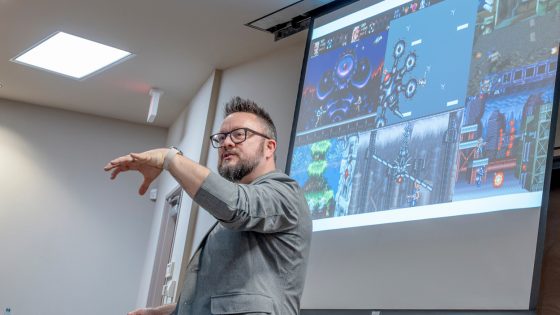
Nick Bowman explains the mechanisms at work during boss fights in the Contra video game series. Players learn that the flashing red orbs communicate a weak spot, and they figure out how to hit them without taking damage themselves. This represents a cognitive demand found in the popular series.
Just as people find ways to negotiate the demands of interpersonal communication with friends, family and coworkers, players learn how to navigate the demands of video games. For instance, cognitive demands involve making sense of a new environment, learning its rules and creating a new mental model.
To demonstrate, Bowman displayed the starting screen from the 1986 Nintendo action-adventure game, The Legend of Zelda. The landmark game gives players the freedom to move the game’s protagonist, Link, a variety of directions or enter a cave. Many young gamers found out the hard way that some mental models from the physical world don’t necessarily translate to the digital realm.
“If you were in the woods by yourself with no weapons, where would you go?” Bowman asked the audience. “Would you go in a cave? I would think that’s the worst place to go. I’d probably go left, go up, go right to figure out what’s going on in this world. I’m certainly not going in a cave. Well, in this game, if you go left or right or up, you’re going to die because you don’t have any weapons. But if you would have gone into the cave, you would have met an old man, and he would give you some fantastic advice. He says, ‘Hey, it’s dangerous to go alone. Take this.’ Then the old man again gives you a sword.”
The lecture then touched on the emotional demands of video games, which are more complex than many people realize. Even combat and fighting games can provoke emotions beyond aggression, with the winner of a match potentially feeling accomplishment, competence, pride or self-actualization. Additionally, modern blockbuster video game franchises such as Red Dead Redemption and The Last of Us explore themes of loss and morality that can spark self-reflection.
“Why wouldn’t games challenge your self-concept?” Bowman said. “No one would ever critique the idea of a film that pushes the boundaries of who you think you are.”
Bowman ran through the remaining communication demands and shared some of his current research before closing the talk with a lively audience Q&A. He was thrilled to see the spirit of inquiry was still alive and well at UMSL.
“In this age where we’re critiquing the value of an education, everything I picked up on in those years here, I’m still touching every single day,” Bowman said. “Full circle doesn’t even do it justice. I think it reminds all of us that this is what knowledge is. You create it, you distribute it and you do it again.”