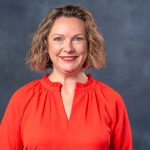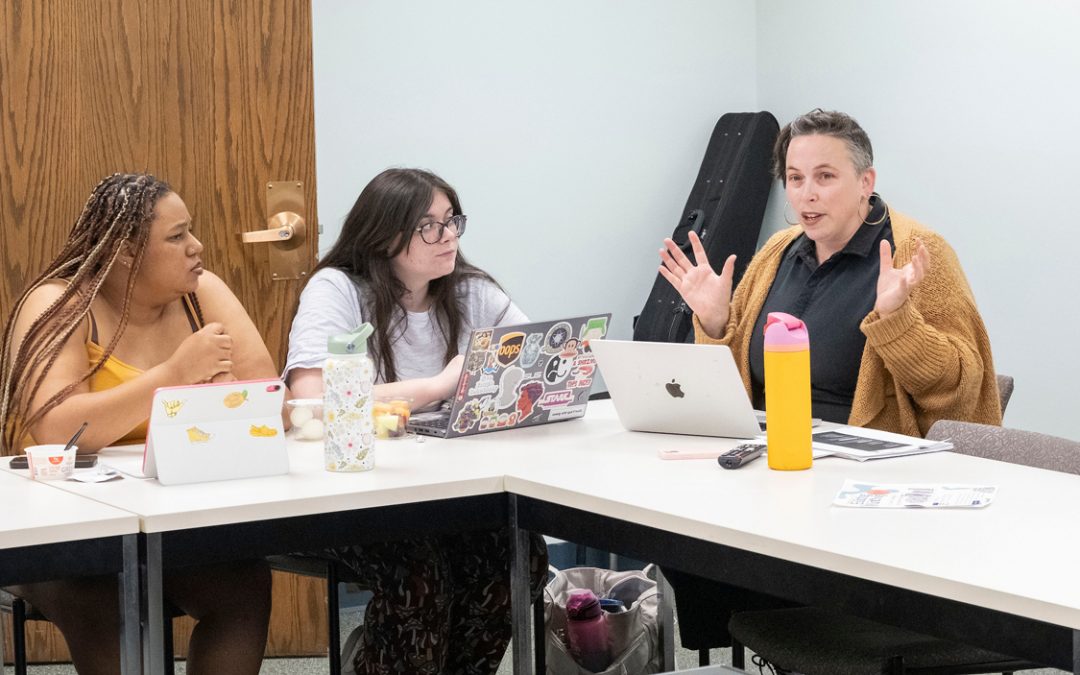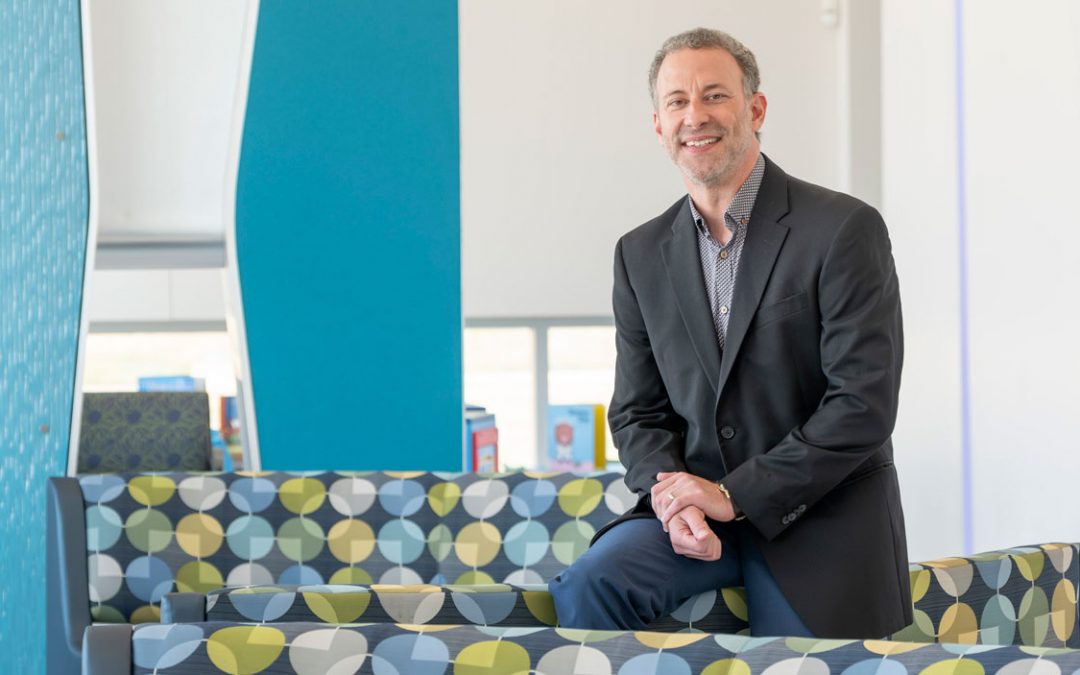

The DBA Class of 2028 includes industry leaders with a wide variety of backgrounds and specialties. (Photo courtesy of Ekin Pellegrini)
The Doctor of Business Administration program at the University of Missouri–St. Louis has built a global reputation for its ability to help professionals who are already leaders in their industries further their careers with a path forward that is both challenging and rewarding.
That reputation grows as graduates of UMSL’s DBA program share their stories, ensuring the cycle continues with each ensuing group of students. The Class of 2028, which started this fall and had its second in-person gathering on Dec. 5, is full of executives, directors and others who are committed to enacting change in their industries with their DBA research.
“We had high expectations when we built this program, but the demand and the high caliber of professionals attracted to UMSL DBA have surpassed all our expectations,” said Ekin Pellegrini, the founding director of UMSL’s program. “We are particularly proud of the societal impact generated by the scholarly research coming out of the program through dissertations that address real-world business challenges.”
Pellegrini created the blueprint for UMSL’s cohort-based program, which began in 2017 and is Missouri’s first and only AACSB-accredited DBA program offering research concentrations in all areas of business administration. UMSL is also a member of the Executive DBA Council; Pellegrini is the past president of that international organization of universities with executive-format doctoral degrees. UMSL’s program, which has annually been recognized as a premier global DBA program by CEO Magazine, offers a flexible format with two weekend trips to campus per semester for face-to-face interactions with faculty and fellow students.
The professionals who have chosen UMSL’s DBA program have not done so on a whim.
“I’ve been looking to get my doctorate for several years now, and I’ve done quite a bit of research on the programs that are out there,” said Jen Carron, who is the patient experience officer at BJC HealthCare. “I wanted one that had a good balance of virtual classes and in-person experiences. I wanted to meet other professionals across a vast array of industries so that I could get exposure to other schools of thought. UMSL had the good balance of both, and then I also was looking through the profiles of those who have gone through the program and just saw the added level of value and a level of exceptionalism that this program offers.”
Carron’s path to UMSL started with a terrifying moment in her life. An Air Force veteran, she exited the military planning for a post-service career with a defense contractor, and she took steps toward that by earning a master’s in business operations from the University of Arkansas.
“But then my son got sick, he received poor health care, and we almost lost him but the hospital that they ended up sending him to saved his life, and it was an amazing experience,” she said. “As I was sitting at his bedside for about five weeks, I determined that I was going to change health care. I went into health care quality and quickly learned the reason the health care industry is not improving the health of populations is because they sit within their four walls and they talk about the health of the population, and the data that they have access to is the data that’s within their four walls.”
She joined UnityPoint Health as a regional quality project manager, then convinced the company to create a department of patient experience, which she led for three years. Her career path has continued on that arc at the BJC HealthCare system. Her “listen to the patient” emphasis has struck a chord, and she chose UMSL to find a way to conduct research to further her mission.
“I want to do research in health care strategy and health care consumerism with an emphasis on improving outcomes and elevating the human experience,” she said. “That’s exactly where my head is at: improving the health of the population by approaching health care from a consumer perspective. So much of health care is what health care wants, what the doctor wants. The industry is changing quite a bit, but we still have a long way to go. Instead of viewing it as ‘Patients need us, and this is what we’re going to provide,’ it’s moving toward ‘What do patients need? What does our community need?’ And part of that is training our new professionals in the world of academia on listening to the patient first, then diagnosing. Research shows that we interrupt patients within 11 seconds of telling their medical history. That speaks volumes about what we are teaching residents and our fellows and our professionals.”
Marcus Glover is an Air Force veteran whose background in intelligence and analytical work made him a strong fit for a role on JP Morgan Chase’s anti-money laundering team. His experience in human resources during his military service later inspired him to return to that field and ultimately led him into academia, where he currently serves as the human resources director at the University of Missouri School of Medicine.
Glover was working as a human resources consultant for the University of Missouri System when UMSL’s DBA program started, and he was immediately intrigued by the program Pellegrini had launched, though the timing then wasn’t quite right. It is right now, especially considering, as he jokes, that his wife, LaVetta Posey-Glover, just finished her doctorate from the University of Missouri–Columbia.
“With some of the positions I’ve been in within the HR space and supporting an organization, I’m interested in performance management and the data analytics around people and processes and how that piece helps drive businesses and helps the organization to be more efficient,” he said. “That’s what I’m initially looking at going in, just thinking more broadly, and I know I’ll get help from Dr. Pellegrini and faculty to narrow that down.”
That process of carefully narrowing down and defining a research topic – at UMSL, the research must break new ground, not repeat research – is a key part of this DBA program.
“Dr. Pellegrini has told us we’re not even allowed to think about what we want to do for our dissertation the first year,” Christina Coyle said with a laugh. “Although, you know what that does? It makes you want to think about it, right? One of the areas of research that’s interesting to me is budgeting and accounting and financial reporting. I do a lot of work with Governmental Accounting Standards, and maybe there’s something in that niche that will work.”
Coyle is the director of finance for the City of Elmhurst, Illinois, where she oversees an annual city budget around $200 million. She earned her bachelor’s from the University of Illinois, a double major in finance and French commercial studies. She went into public accounting and earned her CPA. The not-for-profit sector appealed to her.
“To me, there’s just something about working for organizations where it’s not all about the bottom line, but it’s about service and it’s about the stewardship,” she said. “Those things are important to me. I worked for the government and not-for-profit sector at Baker Tilly, and I did audits for a long time for both governments and universities.”
From there, she worked as the finance director for the Village of Glen Ellyn, a Chicago suburb, for 10 years before taking the same job at Elmhurst, a bigger city about 15 miles to the east.
In addition to the research she’ll conduct, Coyle is excited for the experience of being in a DBA cohort with so many professionals from different industries and using the experience of being back in an academic environment to help with two other areas she enjoys.
“I teach a lot for the Government Finance Officers Association, both the national and Illinois chapters, and so I do a lot of webinars for them, and I really like that teaching aspect,” she said. “I also do a lot of technical work with the Government Accounting Standards Board and responding to exposure drafts, and so that’s very research-oriented and kind of aligns with some of the doctoral work. It’s just all very interesting to me, and something I’ve always wanted to do.”
For UMSL alum Christina Dancy, starting the DBA program is a bit of a homecoming. A St. Louis native who has long been passionate about helping her hometown, Dancy earned her bachelor’s in public policy and administration from UMSL in 2010, then earned her master’s in management from Webster University in 2012. Dancy, an assistant vice president at U.S. Bank, met Pellegrini at an Urban League event; she was sitting at a table and Dancy went over to chat.
“I had been considering pursuing an MBA to complement my master’s in management with a stronger business focus,” Dancy said. “When I discussed this with her, she questioned my reasoning and introduced me to the DBA program. She encouraged me to explore it, though it took me nearly a year to submit my application. Initially, I hesitated because of fear, and I had never envisioned pursuing a doctorate. However, after engaging with peers who hold doctoral degrees, I realized that doctoral study cultivates a distinct skill set, particularly in conducting research.”
Dancy realized those skills could help her advance the work that she wanted to do, which was to be more impactful to communities, and to dive into the actual challenges that people are facing.
Like others in the Class of 2028, she’s in the process of narrowing her research focus.
“I don’t have the perfect words for where I’m headed, but I know my purpose: to shape economic mobility for low- to moderate-income communities,” Dancy said. “Too often, development benefits are claimed by industries, developers and financial institutions. My focus is on the people … understanding how these efforts touch and improve the lives of individuals at the core of every community.”
As with the other 14 members of the Class of 2028, Dancy will lean not just on the faculty members but the other professionals in the group.
“A close-knit cohort community is one of the defining strengths of our program,” Pellegrini said. “Our cohort model provides a strategic learning ecosystem as student identity shifts from practitioner to scholar-practitioner. We have successfully cultivated a culture of collaboration across cohorts and alumni that is central to our program’s high retention and graduation rates. The DBA cohort experience often becomes as valuable as the degree itself.”