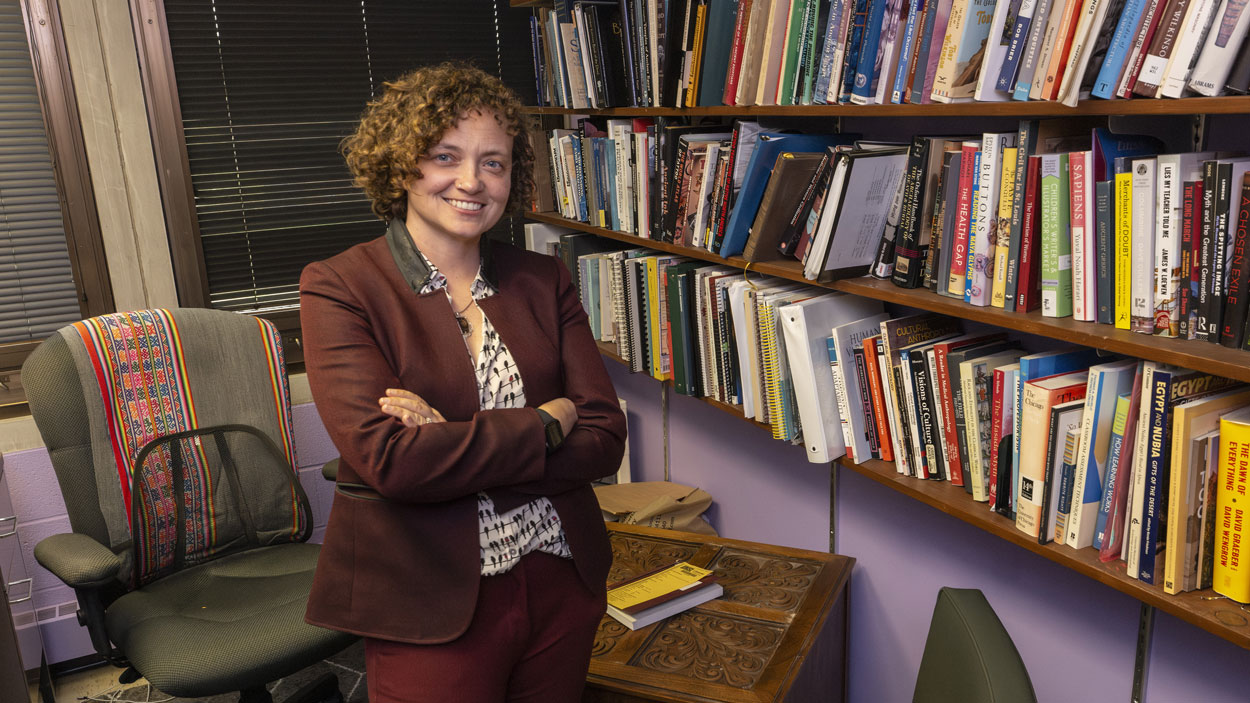
UMSL Associate Professor Anne Austin and her collaborators at Arizona State University have uncovered extensive evidence of tattooing in the ancient Nile Valley civilization of Nubia, including tattoos on the remains of young children. They’ve published their findings in a new article titled “Revealing Tattoo Traditions in Ancient Nubia through Multispectral Imaging” in the journal PNAS. (Photo by Derik Holtmann)
University of Missouri–St. Louis anthropologist Anne Austin, working with colleagues at Arizona State University, has uncovered the most extensive evidence yet of tattooing in the ancient Nile Valley civilization of Nubia, including the consistent presence of tattoos on the remains of young children.
Austin, an associate professor in the Department of History at UMSL, worked with Professor Brenda Baker and research assistant Tatijana Jovanović in the School of Human Evolution and Social Change at Arizona State University to conduct a systematic survey of tattoos among the remains of more than 1,000 individuals found in three different sites in Sudan – Semna South, Qinifab School and Kulubnarti – and spanning the period from 350 BCE-1400 CE.
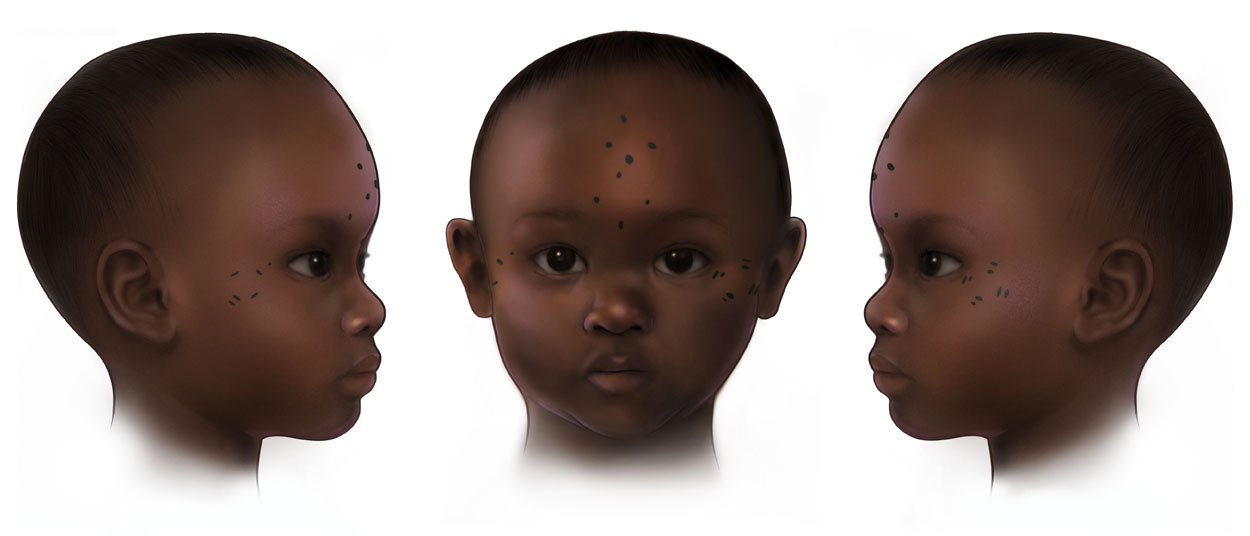
Anne Austin and her colleagues at Arizona State discovered the consistent presence of tattoos on the remains of young children. The tattoos were often found on the faces of the children, sometimes arranged in the shape of a cross on the forehead. (Illustration by Mary Nguyen)
Using multispectral imaging technology, Austin, Baker and Jovanović found 25 previously unknown individuals with tattoos – nearly doubling the known number of tattooed individuals from the Nile Valley. Microscopic imaging and the distribution of the tattoos further revealed a shift in tattoo practices during the Christian period, including tattooing on children under age 3. They have shared their findings in a new article titled “Revealing Tattoo Traditions in Ancient Nubia through Multispectral Imaging,” published by PNAS.
“This is the first time that I know of where we find such consistent evidence on really young children,” Austin said. “We have somebody who’s under 1 that possibly has tattoos, definitely a 1-year-old with tattoos, and we find multiple children, even a child who’s 3, who has multiple tattoos, one over another. This is not just showing that they were tattooed, but it might have even happened multiple times during that really early period.”
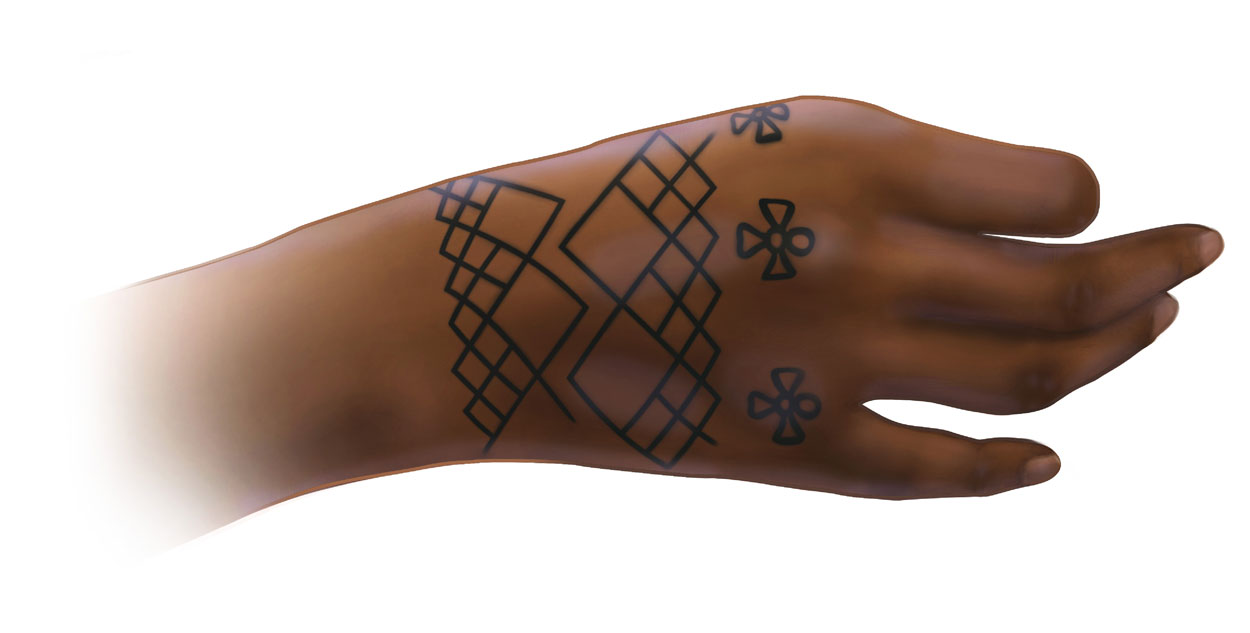
Anne Austin and her colleagues discovered tattoos discovered on the hands of the remains of individuals from ancient Nubia. (Illustration by Mary Nguyen)
Austin, Baker and Jovanović, now a graduate student at University College London, only identified tattoos on individuals at two of the three sites – Semna South and Kulubnarti.
The latter is a known Christian community, so extensive tattooing at Kulubnarti – including what may be cross-shaped markings on the forehead – provides the earliest evidence for Christian tattoo traditions in northeast Africa and could be ancestral to modern Christian practices in the region. Tattooing might also have been done for medicinal purposes, as a way to prevent or treat illnesses.
“We’re seeing super imposition of new tattoos over older tattoos, even in children as young as 3 or 4 years old, so that may be due to illness – something like malaria that caused recurrent fevers and headaches,” Baker said. “We know that malaria was prevalent in the area, and other diseases, of course, can cause high fevers. There may have been some sort of curative aspect to the tattoos, and there is some ethnographic evidence for that.”
Baker added that some adults had tattoos on their backs, which may have also been for medicinal purposes.
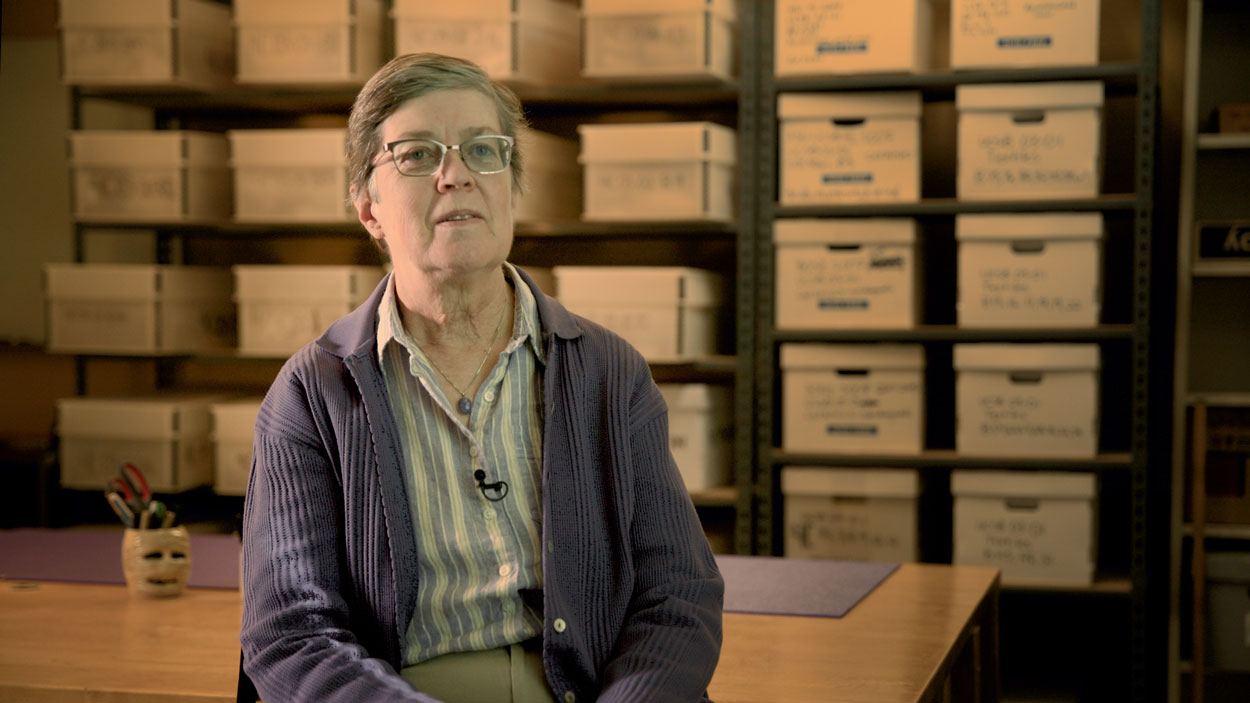
Brenda Baker, Anne Austin’s collaborator, serves as a professor in School of Human Evolution and Social Change at Arizona State University. (Photo courtesy of Arizona State University)
The excavation of cemeteries at Semna South and Kulubnarti were conducted by the University of Chicago and University of Colorado, respectively, in the 1960s and 70s as part of the UNESCO International Campaign to Save the Monuments of Nubia, while work at Qinifab was conducted by an ASU team under Baker’s direction as part of the international Merowe Dam Archaeological Salvage Project. All remains were gifted to the institutions by the government of the Republic of Sudan and are cared for at ASU. The collections had undergone further examination in the years since. But the evidence of tattoos had not been readily apparent without the use of modern near infrared technology and software.
Austin, who previously discovered some of the first figural tattoos identified in ancient Egypt while conducting research at Deir el-Medina, believes there is a need to reexamine other collections.
“We are looking at the tip of the iceberg on tattoos that could be identified,” she said. “We really need to do a kind of systematic investigation of other people to see if they have evidence of tattoos, and even if they don’t, a lack of evidence is still really useful, because it’s telling us where this practice existed and where we don’t see any evidence that it was happening.”