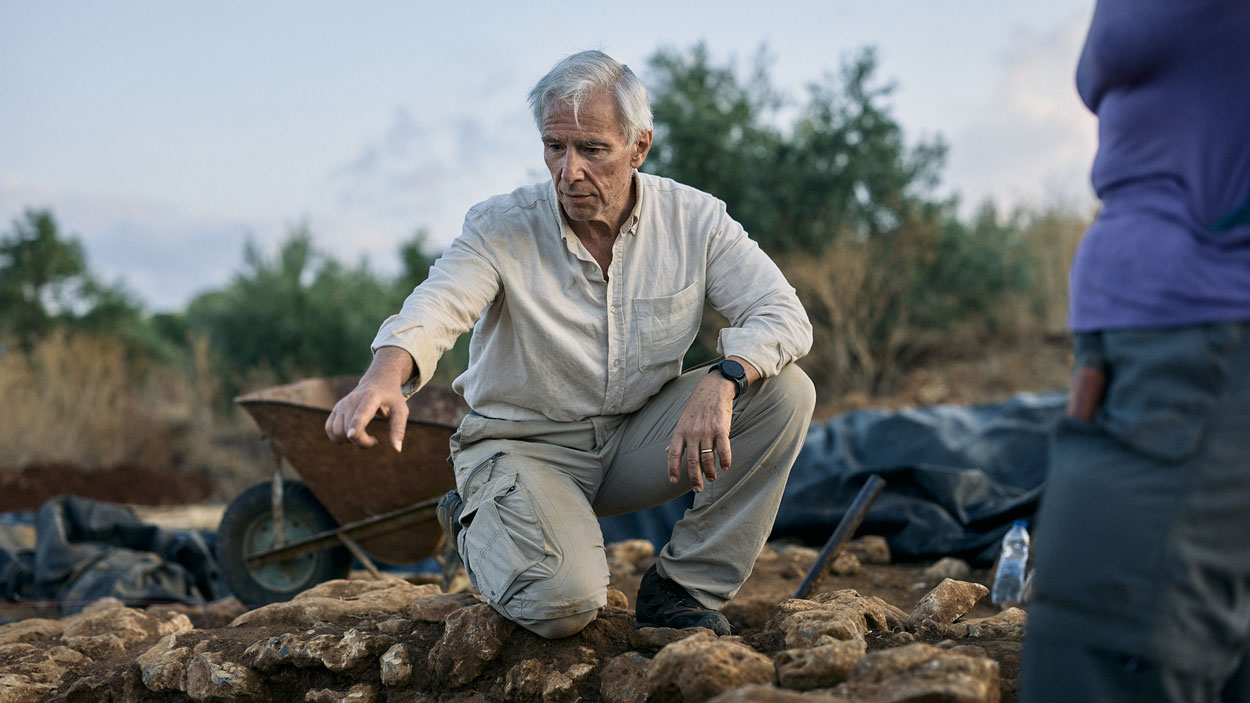
Michael Cosmopoulos was one of 223 individuals chosen to be part of the 2026 class of Guggenheim Fellows. Nearly 5,000 people applied for the honor. (Photo courtesy of Michael Cosmopoulos)
The John Simon Guggenheim Memorial Foundation unveiled its 2026 class of fellows this week.
Michael Cosmopoulos, the Hellenic Government-Karakas Foundation Professor of Greek Studies and professor of archaeology at the University of Missouri–St. Louis, was among the 223 distinguished individuals to be honored from among nearly 5,000 applicants for the fellowship’s 101st class.
“Our new class of Guggenheim Fellows is representative of the world’s best thinkers, innovators and creators in art, science and scholarship,” Guggenheim Foundation President Edward Hirsch said in announcing the fellows. “As the Foundation enters its second century and looks to the future, I feel confident that this new class of 223 individuals will do bold and inspiring work, undaunted by the challenges ahead. We are honored to support their visionary contributions.”
Cosmopoulos was one of two recognized in the Classics, along with Karen Stern, a professor at Brooklyn College and the Graduate Center of the City University of New York.
“It is a tremendous honor, especially given how competitive these fellowships are,” Cosmopoulos said.
Since its founding in 1925, the Guggenheim Foundation has awarded nearly $450 million in fellowships to more than 19,000 Fellows who have broken new ground in the creative arts, natural sciences, social sciences, humanities and a range of fields crossing different disciplines. This year, applications in the creative arts and humanities were up by 50% and applications in the sciences were up by 86%.
The 2026 class of fellows spans 55 scholarly disciplines and artistic fields, 97 academic institutions, 33 U.S. states and the District of Columbia, three Canadian provinces and eight countries beyond the United States and Canada.
Cosmopoulos received the recognition for his work over the past two decades leading the archaeological excavation in Iklaina, Greece. But he’s now working to present all that he and his team have unearthed to the world. Among their many findings is evidence of the origins of a two-tiered system of government.
“The excavation at Iklaina is now reaching its completion, which creates a rare opportunity to step back and assess its larger historical significance,” Cosmopoulos said. “The Guggenheim Fellowship is designed precisely for this kind of moment, when long-term research can be brought together into a synthetic work.”
Cosmopoulos’ project is titled “Pathways to Power: The Emergence of States.” With support from the fellowship, he’ll be able to devote uninterrupted time to writing the book, which will bring together archaeological, textual and comparative evidence for how early states formed. He said his goal is to “produce a book that not only advances scholarship but also explains, in accessible terms, how complex societies emerge, organize power and sometimes fail.”
The Guggenheim Fellowship is also significant for UMSL.
“Guggenheim Fellowships are among the most prestigious awards in the humanities,” Cosmopoulos said, “and bring national visibility to the university and its research.”