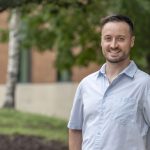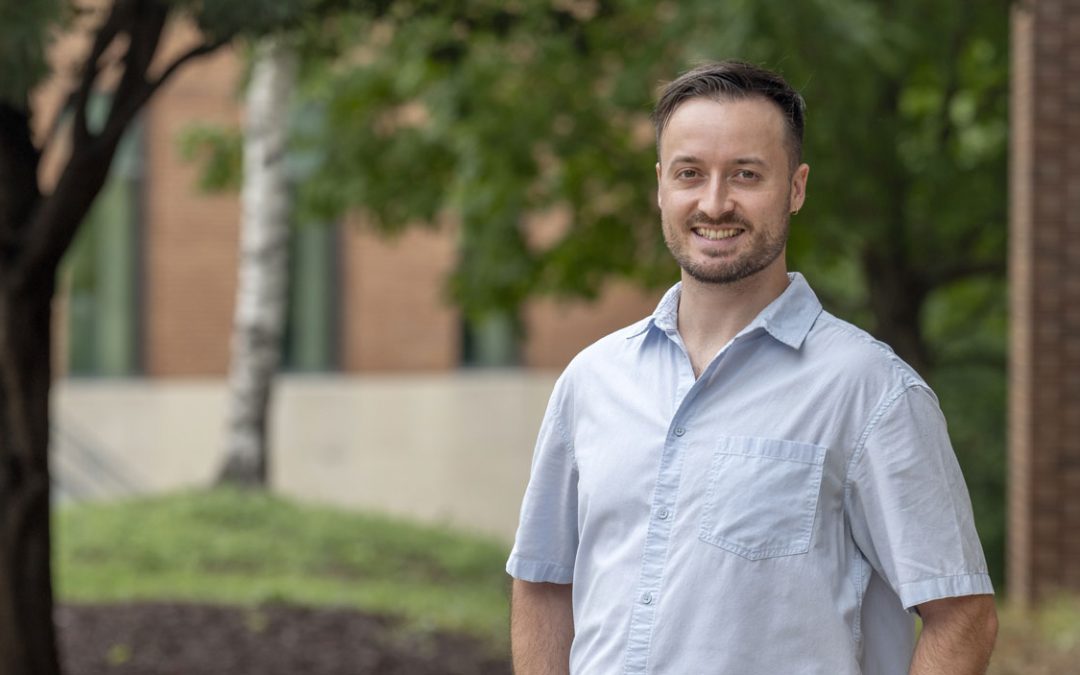
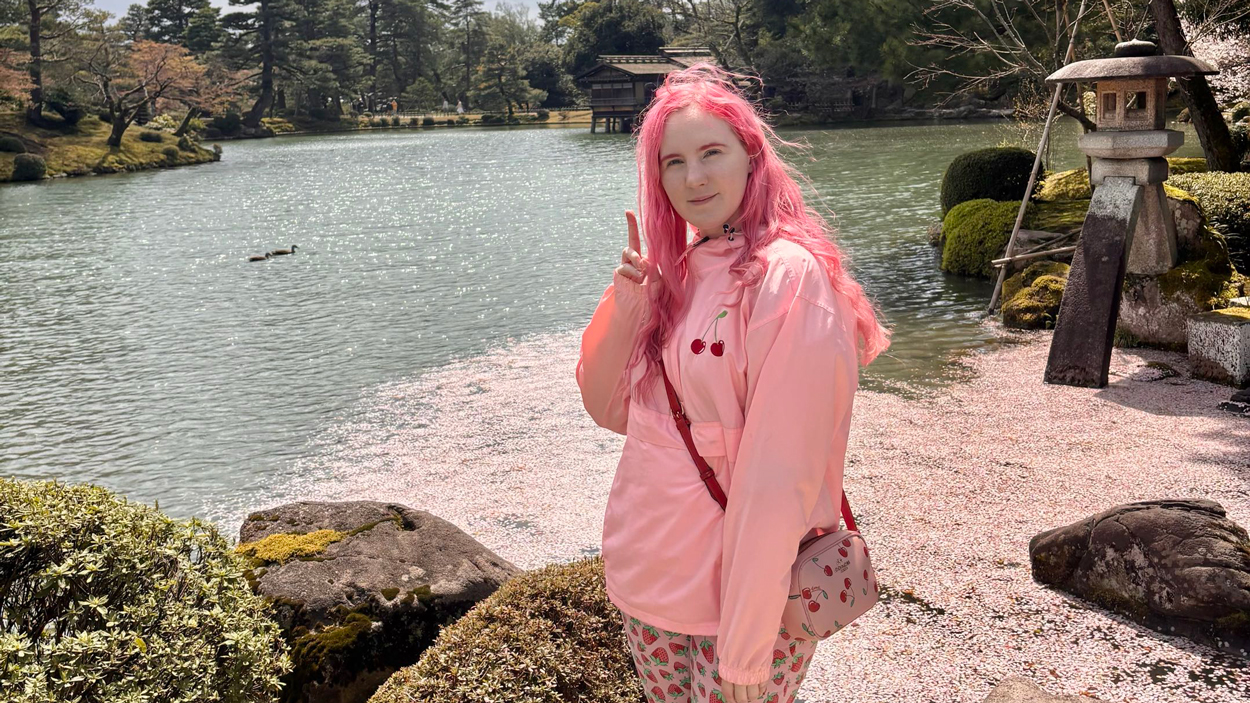
Brittany Henry visits the Kenroku-en in Kanazawa, Ishikawa prefecture. It is one of the three great gardens of Japan. Henry majored in biology and minored in Japanese at the University of Missouri–St. Louis. Her unique multidisciplinary education has made it possible to pursue a graduate degree at the University of Tokyo. (photos courtesy of Brittany Henry)
Throughout her childhood, Brittany Henry would faithfully tune into Cartoon Network’s Toonami – a block of Japanese anime programming – on Saturday nights with her brothers.
At the time, Henry didn’t imagine watching “Cowboy Bebop” or playing Japanese video games would lead to living and studying abroad in Japan. She didn’t even think it would lead to taking Japanese courses at the University of Missouri–St. Louis.
“In high school, I took French classes,” Henry said. “I really enjoyed French. I really liked learning another language, and I was convinced I was actually going to get a French minor. But, always in the back of my head, I would see that UMSL offered Japanese courses. I thought, ‘What if I try that?’”
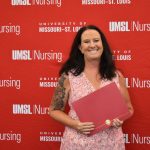
Halfway through her undergraduate career, Henry listened to that urge and enrolled in a Japanese class. That decision changed the course of her academic and professional trajectory. More courses followed, and in 2020, she graduated from UMSL with a bachelor’s degree in pre-med biology and minors in Japanese, anthropology, chemistry and global health and social medicine.
Now, Henry has leveraged her unique multidisciplinary education at UMSL to earn a place at the University of Tokyo, Japan’s most prestigious higher education institution. Henry is pursuing a master’s degree in international health in the Graduate School of Medicine’s School of International Health. In April, she joined Moi’s Lab, a preeminent virology and tropical disease research group and has been working on the development of a Dengue fever vaccine.
A winding path
Henry’s interest in virology dates back to high school when she contracted a severe case of mononucleosis.
“I was just so fatigued and exhausted that I couldn’t last an entire school day,” Henry said. “I would crash. I could maybe do half days, so I started doing block scheduling.”
It was a trying ordeal, especially because Henry’s physician was not particularly supportive. But the experience sparked an interest in pursuing a future career in healthcare or public health to provide the support she was denied.
At UMSL, Henry discovered rigorous but rewarding coursework in the Department of Biology. She also found mentors in Associate Professor Lon Chubiz and Assistant Teaching Professor Christopher Wolin, who provided guidance and later wrote a letter of recommendation for Henry’s application to the University of Tokyo.
“I’m so incredibly grateful to him,” Henry said.
The Japanese language program was equally impactful. Henry appreciated the tight-knit learning community as well as the cheerful and supportive faculty members, including Associate Teaching Professor Keiko Ueda, Associate Teaching Professor Hiroko Yoshii and former Associate Teaching Professor Amy Michael.
“The way that the classes are set up helped tremendously,” Henry said. “All of my French classes were taught from an English language perspective. They teach you the grammar, and they explain everything in English. Maybe you do some exercises and answer in French. The Japanese courses were entirely immersive. You pick up a lot by context.”
A turning point
Henry further immersed herself in Japanese culture and language via the 2018 Japan Study Tour offered through UMSL Global and the Department of Language and Cultural Studies. The two-week, summer study abroad program provides a transformative experience for students as they visit businesses, cultural sites and universities in Nagano, Nikko and Tokyo. The trip was a turning point for Henry.
“I had taken maybe two semesters of Japanese at the time,” she said. “I was like, ‘I know 20 Kanji. I’m on top of the world.’ But when I got there, I thought, ‘Oh, I don’t know anything.’”
But she wanted to know more, to see more.
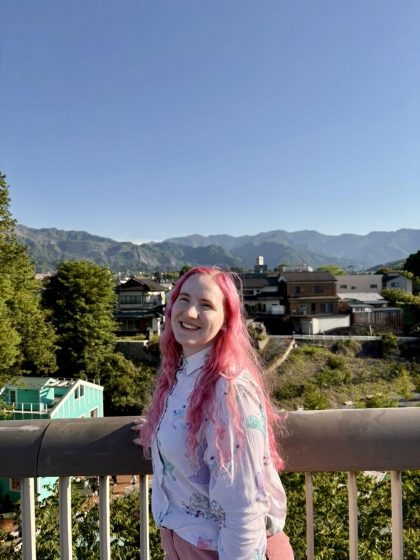
Brittany Henry visits Chichibu, Saitama prefecture, during Golden Week, four back-to-back national holidays grouped closely together from late April to early May. The holiday period offers Japanese workers and students time to travel and relax.
“I remember our last day in Japan,” Henry said. “We were all so happy to be on the trip. We were in Osaka, and we went to a KitKat store, and then we had to get on the train and head back. Everyone was happy and content but also wanted it to last just a little bit longer.”
The experience motivated Henry to travel to Japan again in December 2019 to visit Molly Okawa (née Motes), a friend from the Japanese program studying abroad at Toyo University. Upon arriving back in the U.S., Henry immediately began devising her return. She intended to apply for the Japanese government’s MEXT Scholarship to study at a Japanese university after graduating from UMSL in May 2020.
However, those plans were waylaid by the onset of the COVID-19 pandemic in March 2020. Due to precautions related to the pandemic, Japan closed its borders to virtually all international travel.
Henry would have to wait.
A triumph
After a year of idleness and uncertainty, Henry was desperate to build her resume and gain more lab experience in preparation for her MEXT application. In 2021, she joined the Laidlaw Lab at Washington University in St. Louis.
The lab, led by Assistant Professor Brian Laidlaw, investigates the development of immunological memory with the aim of facilitating the development of more effective vaccines. Laidlaw actively worked to support Henry’s goal of pursuing graduate school abroad.
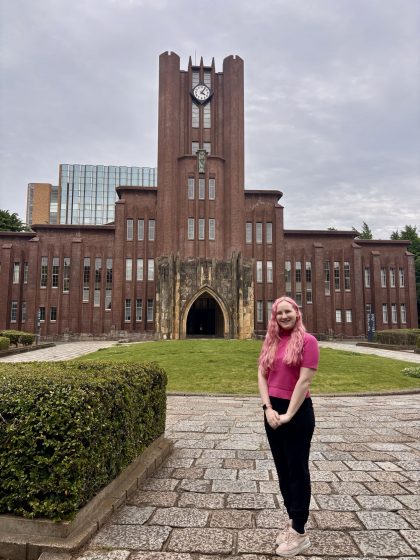
Brittany Henry stands in front of Yasuda Auditorium on the University of Tokyo campus. The University of Tokyo is one of the oldest and most prestigious higher education institutions in Japan.
“I felt like I was treated more like a PhD student,” she said. “I would have different protocols set up, and he’d ask, ‘Do you know why you’re doing this? What type of results would you expect from this? What does that mean? How do you interpret the data?’”
After two years in the lab and the loosening of travel restrictions, Henry applied to the MEXT Scholarship through the Japanese consulate in Chicago but found out just how competitive the scholarship is. She was one of six applicants chosen to interview in 2023 but was ultimately rejected then and again in 2024.
Disappointed but undeterred, Henry decided to apply once more in 2025, but this time, she applied directly through the University of Tokyo. The arduous task required navigating the university’s Japanese website, mailing a paper copy of her application internationally and passing a two-day entrance exam.
The hard work was worth it, though. In September, Henry learned she’d been accepted to the Moi Lab in the School of International Health. After years of single-minded focus, it was a bit hard to believe she’d finally achieved her goal.
“It felt surreal,” Henry said.
A new chapter
The Moi Lab is a flagship hub for research on mosquito-borne illnesses such as the Dengue and Zika viruses. Henry’s education at UMSL and immunology work in the Laidlaw Lab have prepared her well for her current position. She’s also enjoyed the global nature of the School of International Health, which conducts coursework and research projects in English. Many of her colleagues are also international students.
“Our lab experience is 50% Japanese and 50% English,” she said. “It’s a good fit because we’ll present in English, but people will ask questions regarding the research in Japanese.”
Henry’s language skills have helped greatly with informal interactions, and she’s gradually improving in more formal situations. However, there have still been a few hiccups. Due to a miscommunication related to the differences in the Japanese and English versions of the university website, Henry wasn’t actually eligible for the MEXT Scholarship because she matriculated during the spring semester; however, she did receive a scholarship from the Japan America Society of St. Louis.
Clearing the many hurdles set in front of her has led to extraordinary experiences in Japan. Henry recently reconnected with a Japanese exchange student who studied at UMSL in 2020. She’s also witnessed the celebrated spring cherry blossoms bloom, strolled through vast fields of baby blue eyes flowers and explored Tokyo’s Harajuku district – the city’s epicenter of fashion and youth culture.
Ultimately, Henry hopes her time at the University of Tokyo will be a springboard to a position researching mosquito-borne diseases with the Centers for Disease Control and Prevention or the World Health Organization. It’s only a possibility because she was able to fulfill her passion for Japanese culture and language alongside her STEM education at UMSL.
“I hope my experience will inspire more people in STEM fields to learn a different language,” Henry said. “Business and teaching are often the fields where people learn a foreign language, but language skills can be so valuable in science and research.”