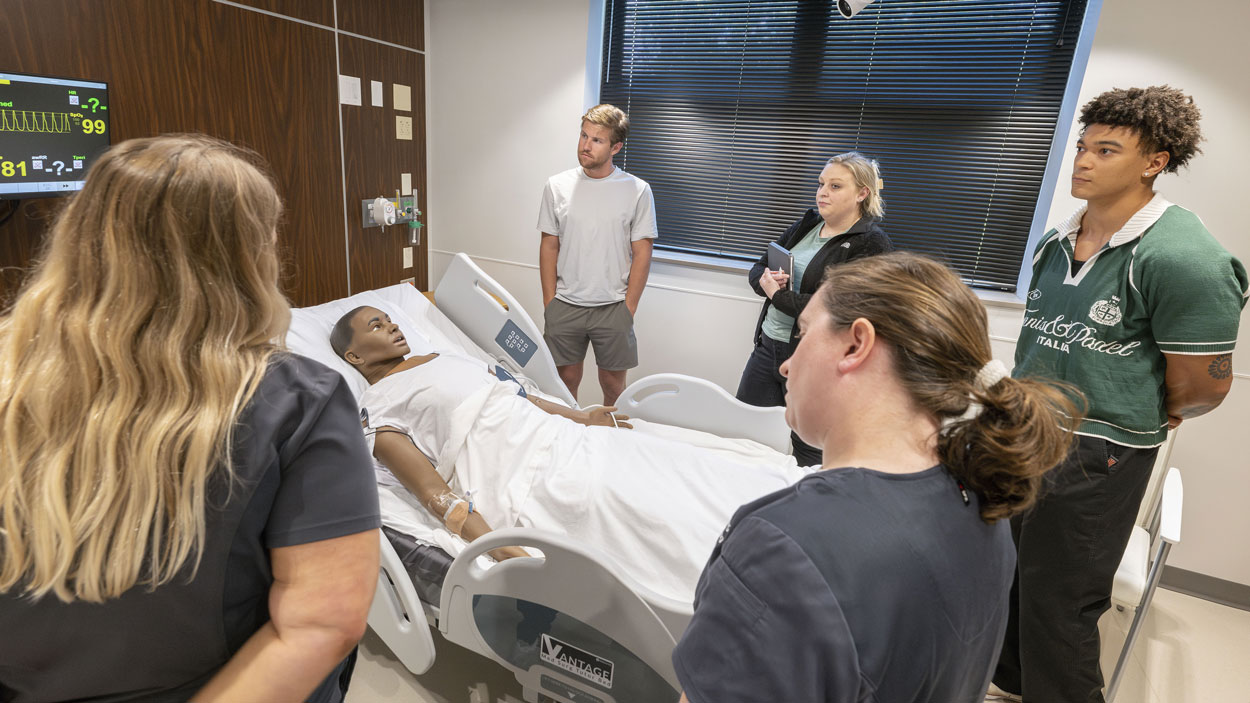
UMSL students gather around a mannequin in the College of Nursing’s Learning Resource and Simulation Center. (Photo by Derik Holtmann)
For more than four decades, the University of Missouri–St. Louis College of Nursing has prepared nurses to deliver high-quality care in hospitals, clinics and communities across the St. Louis region and beyond.
The Commission on Collegiate Nursing Education, a national accrediting agency that evaluates the quality and integrity of baccalaureate, graduate and post-graduate nursing education programs, recently granted reaccreditation to UMSL’s Bachelor of Science in Nursing and Doctor of Nursing Practice programs, as well as the post-graduate advanced practice registered nurse certificate program. All three programs earned the maximum 10-year reaccreditation period, extending through June 30, 2036. The result is a strong affirmation of the College of Nursing’s academic quality, student outcomes, faculty expertise and commitment to continuous improvement.
The full 10-year reaccreditation is especially meaningful because it signals confidence in the college’s ability to prepare nurses who are ready to meet the needs of patients, health systems and communities. For students, it reinforces the value and credibility of their degree. For clinical partners and employers, it affirms UMSL’s continued role as a trusted source of highly prepared nursing graduates.
“Earning the full 10-year reaccreditation is a powerful affirmation of the quality, rigor and impact of our programs,” said Alicia Hutchings, interim dean of the College of Nursing. “It reflects the hard work of our faculty, staff, students, alumni and clinical partners and confirms that we are meeting national standards while preparing nurses who are ready to care for patients, support health systems and serve communities. Most importantly, it gives our students, partners, and future employers confidence in the value of a UMSL nursing education.”
Months of effort went into the accreditation process, demonstrating that the university met CCNE standards for effective educational practices across all its programs, which served more than 500 students per semester in the past academic year. The process is designed to encourage self-assessment by the institution and supports its continued growth and improvement.
“CCNE standards are not something we think about only during an accreditation visit; they are embedded in the way we make decisions, evaluate outcomes and strengthen our programs,” Hutchings said. “The self-study gave us an opportunity to demonstrate how we meet those standards while also reflecting on where we can continue to grow. That commitment to continuous improvement is what helps move the college forward.”
UMSL has made strategic investments to improve the experience of its students since it last earned accreditation. Most significant among them was the $7 million renovation and expansion of its Nursing Learning Resource and Simulation Center, which opened in 2024.
The upgraded center has increased the amount of simulation rooms from five to 11, allowing the college to grow the number of pre-licensure BSN students it graduates by 20% annually. It also provides students with space to practice skills such as catheterization, IV insertion and defibrillation on life-like, high-fidelity manikins that can simulate blinking, breathing, speaking and even giving birth.
“Simulation is an integral part of our curriculum,” Hutchings said. “It allows students to engage in patient care outside of clinical facilities and practice low-frequency, high-stakes scenarios they need to be prepared for. We can replicate those situations, help students build confidence and give them the skills and abilities they need before they care for patients in clinical settings.”
Many of the most important lessons UMSL nursing students receive continue to come in their clinical experiences, and the College of Nursing maintains strong partnerships with providers, including BJC HealthCare, SSM Health, Mercy and the VA St. Louis Healthcare System.
“The strength of our clinical partnerships is one of the reasons our graduates are so well prepared,” Hutchings said. “Students gain experience across the region’s major health systems, learning from practicing nurses while caring for diverse patient populations. Those experiences help them build confidence, understand the needs of the patients and communities they will serve and enter the workforce ready to strengthen health care across the St. Louis region and beyond.”