
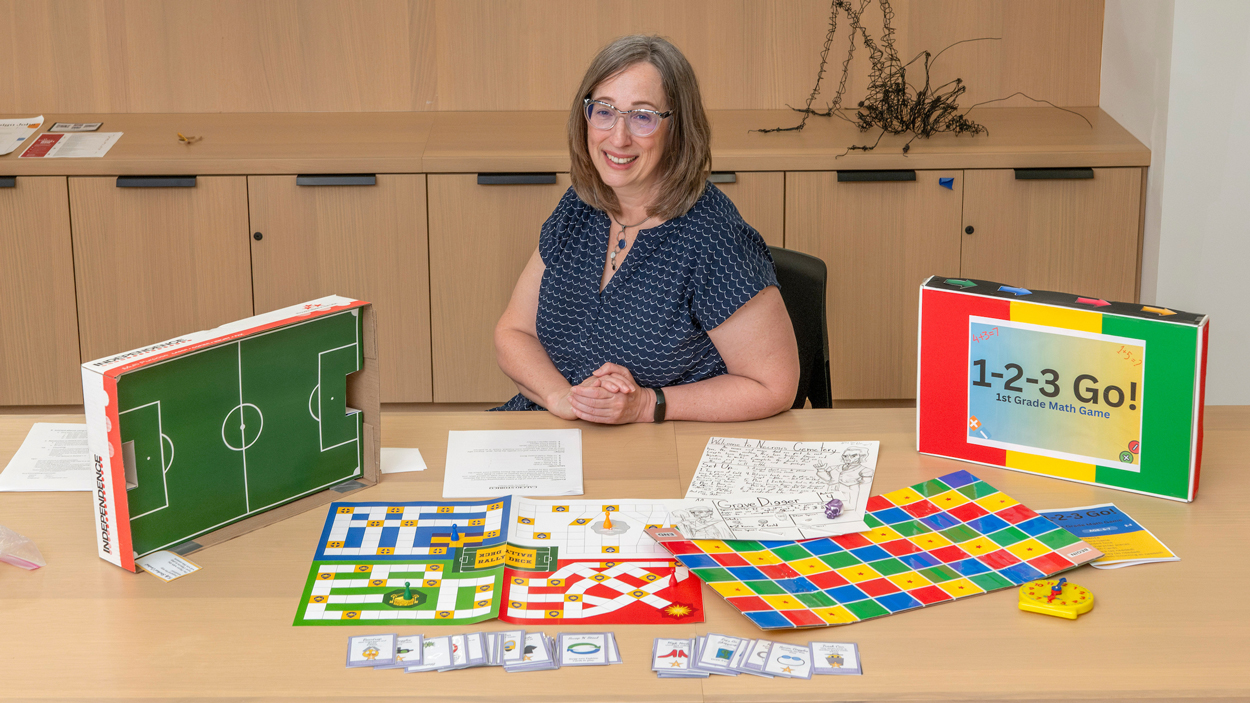
Teaching Professor Maureen Quigley is surrounded by games – Calcio Storico, Settle the Dead, Dress That Duck and 1-2-3 Go! – designed by UMSL students in her class, Making Games: Design and Theory. Quigley began integrating games into her curriculum 10 years ago and first taught the game design course in 2020. At the end of the summer, she’ll pitch her game, Dissolution, to Central Michigan University Press. The game focuses on King Henry VIII’s dissolution of the monasteries in the British Isles. (Photo by Derik Holtmann)
King Henry VIII is a towering figure in European history. Today, he is often remembered for his six wives, and their sometimes-gruesome ends, as well as his excommunication from the Catholic Church.
However, Henry’s dissolution of the monasteries in the British Isles often receives less attention. Maureen Quigley, teaching professor of ancient and medieval art at the University of Missouri–St. Louis, is trying to help students understand what happens in the aftermath of such a sweeping decree through her game, Dissolution.
The policy – enacted in the 1530s – set the stage for the crown to seize the assets and wealth of monasteries and convents and eventually destroy their buildings and relics. Quigley said it also destabilized the era’s version of public services and social safety nets.
“It really undercut the social network of medieval England in particular, but it had implications throughout continental Europe as well,” she said. “Primarily what happens is you lose your care for the poor, so the alms for the poor, but you also lose public libraries, public education and spaces where you had access to art and memory holding. The game is about having students play the roles of people who might be affected by this and what they might do to replace this structure.”
Quigley’s scholarship has primarily focused on the history and visual culture of the medieval world, but within the past decade, she has also become interested in the gamification of the humanities classroom. Quigley has used games in the classroom to help students learn since 2016 and has taught a popular course on game design and theory at UMSL since 2020. She’s also published a role-playing game focused on the end of the Capetian dynasty in France and is currently pursuing a Graduate Certificate in Serious Games and Simulations at the University of Missouri–Columbia.
“I think a lot of people in my generation of scholars, who grew up playing games but hadn’t really considered them as a serious pursuit, started to realize later in our careers that games could not only teach, but become a focus of our research,” Quigley said.
The Assassin’s Creed video games, in particular, were a revelation and initially inspired the integration of games into Quigley’s curriculum. She was first captivated by Assassin’s Creed II, a blockbuster action-adventure game set in 15th-century Renaissance Italy. It was acclaimed for its gameplay as well as its accuracy in depicting Italian cities such as Florence and Venice.
In some cases, playing a level of Assassin’s Creed II or Assassin’s Creed Revelations has replaced more traditional educational media such as documentaries in her classroom. The major advantage is the interactivity of the games, which offer students hyper-realistic walkthroughs of major cultural and historical sites such as the Hagia Sophia in Istanbul.
But Dissolution was inspired by the intersection of current events, local history and pop culture.
“I was working with Laura Westhoff on the church closures in St. Louis,” Quigley said. “A lot of Catholic churches ended up leaving their communities, and at least historically, the Catholic Church in St. Louis had functioned as a stabilizing anchor in not just parishes but neighborhoods. I had gotten further and further into that and started thinking, ‘Where do I see this in historical precedents?’ Around this time, I also went to the musical ‘Six.’ It’s about Henry VIII, and I thought, ‘OK, this actually connects several of my areas of knowledge.’”
With Dissolution, Quigley is experimenting with cooperative mechanics that lead toward an unexpected and irreversible ending. While the card-based game follows the well-known mechanic of resource management found in games like Agricola and This War of Mine, it sets up an institutional barrier to success in the historical dissolution of the monasteries.
“Henry VIII is out there as an NPC – non-playable character – making royal decrees that interrupt the game with elements of historical simulation,” Quigley explained. “It’s been a fun challenge to think my way through both the real history and the intentionally frustrating mechanics.”
While a game without a win state is unusual, it pointedly illustrates the plight of ordinary people under authoritarian conditions and invites students to think about the repercussions of the decree that lasted well past the 1500s.
“With the dissolution of the monasteries, the next structure that England develops is the poorhouse,” Quigley said. “So, you go from a social aid to a criminalizing of poverty, and it makes for some interesting situations with both history and art history.”
This kind of meaningful reflection exemplifies Dissolution’s goal as a Serious Game, or a game designed with a purpose other than pure entertainment. Players are encouraged to actively participate in their own learning on a specific topic through engaging gameplay or simulation.
UMSL students get to try their hand at balancing education and entertainment in Making Games: Design and Theory. Quigley taught the course for the first time in 2020 through the Pierre Laclede Honors College. It became so popular after the first year that the Department of Art and Design started regularly offering it as an elective. During the spring semester, students developed four games, including a Serious Game.
“The class is very much about learning about the science of games and the design practice that goes into game mechanics,” Quigley said. “It’s a very mechanics-based class. We talk a lot about the psychology of who you’re designing for and how you design for people who are not you, which is really hard.”
It’s a challenge Quigley has grappled with working on Dissolution for the past two years, but that careful consideration has paid off as she gets ready to pitch the game to Central Michigan University Press at the end of the summer.
In preparation, she’s spent the past few months fine-tuning the gameplay and studying to make the game as historically accurate as possible. That’s especially important for games intended for an academic market. Not only are they play tested, they’re also peer reviewed like any other form of academic research.
“This is intended as peer-reviewed research that reaches audiences beyond traditional academic publications,” Quigley said. “Academic game designers make sure that the research is solid while the mechanics reflect the learning goals of whatever the game is meant to teach – but in the end, it’s also meant to be fun!”