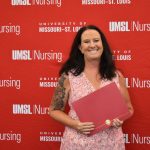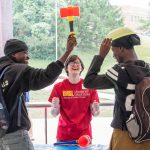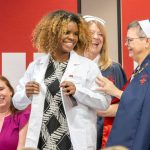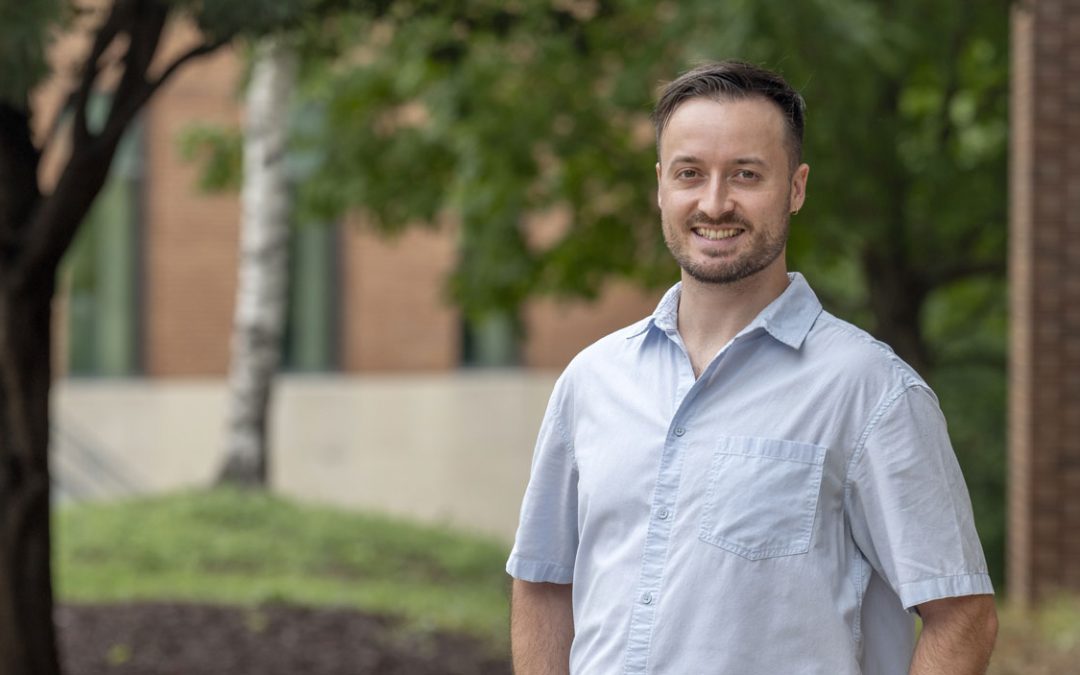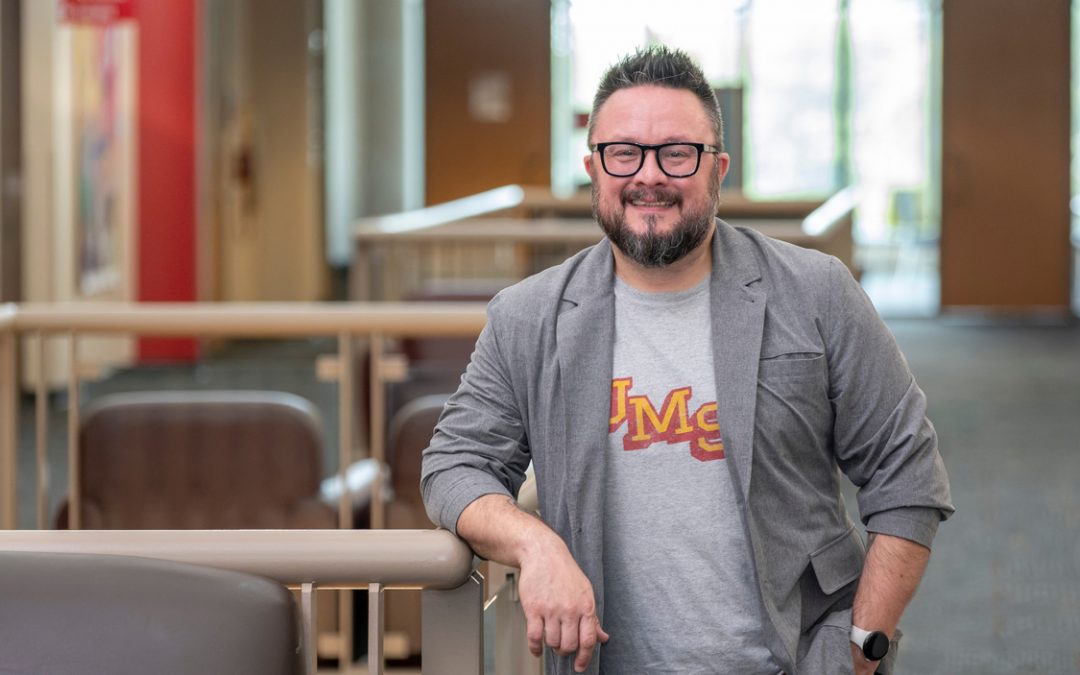
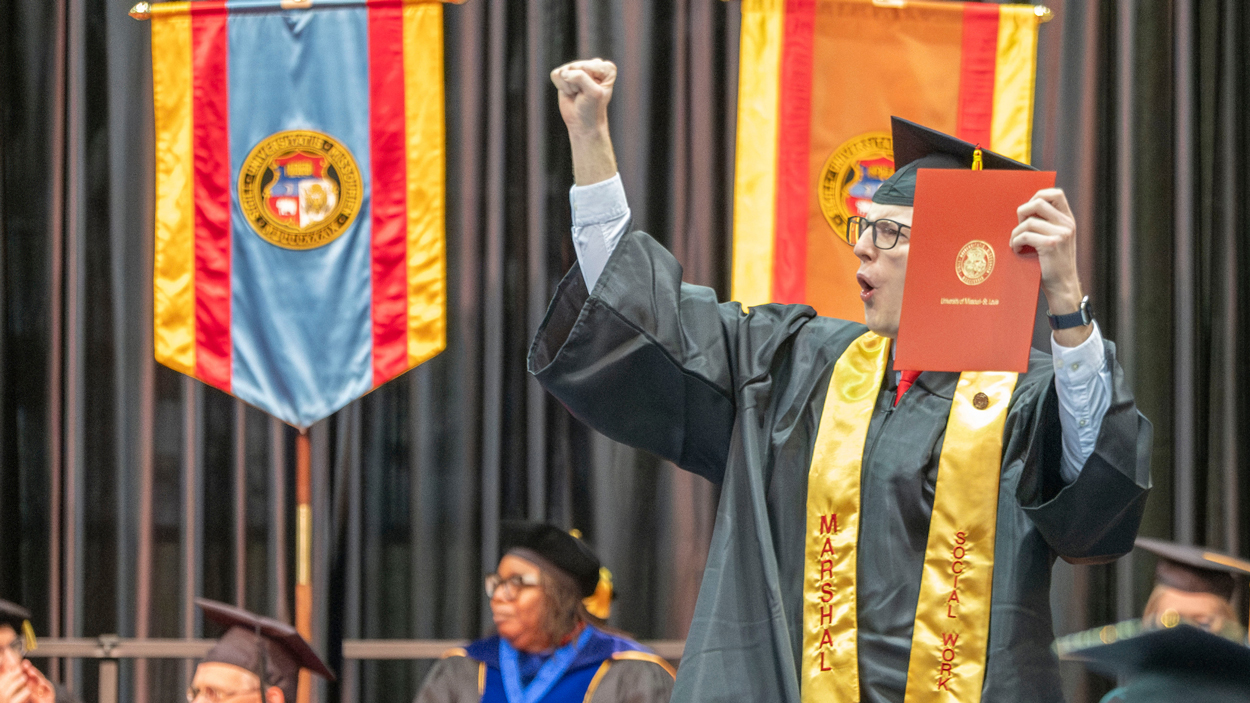
Joseph Govreau, student marshal and outstanding student in social work, celebrates during a commencement ceremony at the University of Missouri–St. Louis last year. UMSL recently aligned its social work and psychology programs within a unified administrative structure in the new School of Social Work, Psychological and Brain Sciences. (Photo by Derik Holtmann)
The professional disciplines of social work and psychology share complementary strengths including applied learning and research, clinical practice and community engagement.
The University of Missouri–St. Louis recently leveraged those shared assets by bringing together its social work and psychology programs in the new School of Social Work, Psychological and Brain Sciences. The university has aligned the academic programs within a unified administrative structure, which went into effect this semester.
Dean Sharon Johnson, who leads the newly expanded school, said mutual interests in community impact and intersecting areas of scholarship made for a good partnership. Johnson added that combining resources presents an opportunity for each side to further elevate the exceptional work they are already doing.
“We have similarities, and we have the ability to build on some existing strengths – the connection we have in terms of being community engaged, research, teaching,” she said. “It doesn’t completely overlap, but there are enough similarities that we will be able to strengthen both programs.”
Johnson pointed to the St. Louis Children’s Advocacy Center as an existing point of connection and said the school promises to open new avenues for psychology and social work faculty to work together and expand community outreach initiatives.
The creation of the new School meant bringing the Department of Psychological Sciences out of the College of Arts and Sciences and into the existing School of Social Work. That process began last fall and has been ongoing.
Johnson said much of the transition this past year was dedicated to documenting the administrative processes and personnel responsibilities that existed in the Department of Psychological Sciences. It was one of the largest programs in the College of Arts and Sciences, so there were many moving parts to survey.
“If there was an infrastructure in place, and we don’t have mirror resources, how do we then make sure all of those aspects are covered?” Johnson said. “The first part was really figuring out: Well, what are those things?”
The next major priority was migrating psychology degrees to the new School of Social Work, Psychological and Brain Sciences in the university course catalog and the Degree Audit Reporting System to ensure students’ credits are properly recorded. The transition team accomplished that goal in early August before the fall semester began.
Johnson said one of the last remaining transition pieces is determining the school’s governing framework. In practice, this means establishing new school-level committees focused on issues like promotion and tenure and making sure the school has equal representation across Faculty Senate and University Assembly committees.
Ultimately, the change is administrative in nature only. Johnson stressed that no degree programs have changed, and there are no plans to change them. UMSL students can still pursue a variety of degrees in the new school, and all programs will maintain their existing leadership. The only noticeable difference for psychology students will be the physical location of advising services, which will eventually move from Lucas Hall to the Social Sciences and Business Building after renovations are complete.
There are still details to be ironed out, but Johnson is optimistic about the future of the School of Social Work, Psychological and Brain Sciences.
“We were a strong school, but we were small,” Johnson said. “Psychological sciences was large, but visibility was shared with other units. Bringing our units together gives us the size, depth and visibility for greater impact. This should bring excitement to our alumni and spark renewed interest in our research, clinical practice and community engagement. We are excited about this new entity and how it elevates both programs within the university.”