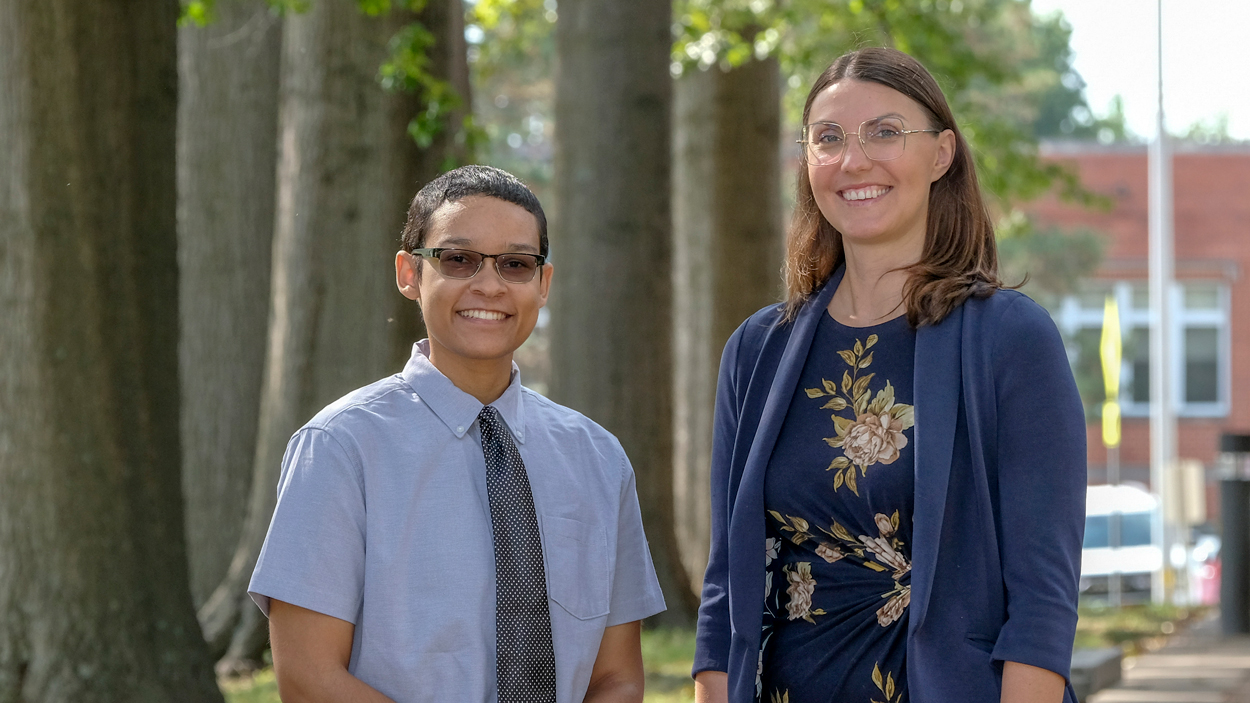
CJ Jones (left), a doctoral student in UMSL’s College of Education, and Agata Freedle, an assistant professor in the Department of Education Sciences and Professional Programs, received a grant through a research funding program launched by UMSL’s Center for Excellence in Financial Counseling that enabled their project on “Single Mothers’ Lived Experiences of Financial Barriers and Resilience in College.” The funding from CEFC’s inaugural program supported eight projects by faculty and students that examined financial challenges from a variety of perspectives. (Photo by Derik Holtmann)
CJ Jones couldn’t have anticipated that a program through the University of Missouri–St. Louis would provide the funding necessary to pursue a passion project. But given the longstanding relationship with the university, Jones also was not surprised by the high level of support.
Currently a doctoral student in the College of Education, Jones teamed up last fall with Agata Freedle, an assistant professor in the Department of Education Sciences and Professional Programs, to apply for a grant through a research funding program launched by UMSL’s Center for Excellence in Financial Counseling.
The center supported eight projects by faculty and students that examined financial challenges from a variety of perspectives. The projects brought together researchers from across the university to explore topics including financial literacy, financial resilience, access to financial services and financial counseling.
As one of the accepted proposals, Jones and Freedle were able to begin their research on “Single Mothers’ Lived Experiences of Financial Barriers and Resilience in College.” Along with team member Lindsay Serrano, they continue to recruit single mothers for interviews and focus groups about their experiences of financial challenges, coping and mental health in college.
“I’ve been a graduate research assistant for a while, so I’ve had the opportunity to participate in research, but this felt different,” Jones said. “It felt more like I was a co-investigator in the research, like I played an important part in every step of the process instead of jumping into a faculty member’s research project.”
That opportunity may not have happened without the monetary backing from the CEFC. For Jones – who as a high school student took advanced credit classes at UMSL before earning a bachelor’s in psychology and master’s in social work – it was just the latest example of the university investing in Jones’s academic and professional growth.
“I have over a decade of connection with UMSL, which I’m really proud of, and I think the reason I keep coming back is that I know that UMSL cares about the community,” Jones said. “I know that UMSL cares about its students, and it really opens the doors to just making a real difference in St. Louis and finding your voice as a professional, which I know that I have.”
All of the projects funded during the 2025-26 academic year created opportunities for students to become more deeply involved in research while producing educational resources and fostering partnerships with organizations in the St. Louis community. Five of the projects were completed during the academic year, two remain in progress and one was determined to be infeasible within its original scope and timeline.
For the CEFC, the range of projects reflected an effort to support research that could have an impact well beyond the university.
“The historic mission of the center has been to strengthen nonprofit financial counseling organizations and services in the community,” CEFC Director Mark Fetters said. “We want to take a more holistic approach to engaging with the campus and the broader community, supporting research that can inform financial counseling while also contributing to student education and development and financial well-being across the region.”
Jeffrey Promnitz’s project offered a clear example of how CEFC’s funding could connect research, student development and real-world financial challenges.
An adjunct faculty member in the Ed G. Smith College of Business and a student in UMSL’s DBA program, Promnitz used the grant to support his research on “How Key Decision-Makers Adopt Artificial Intelligence within the Affordable Multifamily Housing Sector.” The project aligned closely with his dissertation and his professional work as the CEO at Zeffert & Associates, a consulting firm specializing in affordable multifamily housing.
Through his research and professional work, Promnitz has seen how financial stability, housing and access to resources intersect. He said the CEFC’s role extends beyond simply funding research by helping connect researchers with the people and organizations who can put that work into practice.
“You get the research, you get the findings, and somebody else might think, ‘OK, that’s great, but why should I care?’” he said. “And it’s the center who then can take these findings and say, ‘Well, this is why you should care, this is what this means, and this is what it could do for you and for the community at large.’”
Another CEFC-funded project took a more direct approach to student financial well-being. Faculty and staff from the College of Business and UMSL’s Office of Inclusive Postsecondary Education worked together to develop a “Financial Wellness Lab” for students with intellectual and developmental disabilities.
The idea grew from conversations that Madeline Siener, OIPE’s coordinator of campus inclusion, and Glee Schmitt, academic support coordinator, had with students and families about learning practical money-management skills, including budgeting and writing checks. Developed with assistance from Antionette Sterling, Johnna Murray and Colleen Mpofu in the College of Business, the lab was piloted in spring 2026 as part of OIPE’s Succeed program, which supports students with intellectual and developmental disabilities as they build skills for independent living, learning, work and self-determination.
The grant helped fund a graduate student who contributed to developing the curriculum and workbooks, as well as the research evaluating the program. Students completed financial anxiety measures before and after participating, and the team found increased confidence in managing finances and reduced family anxiety around money.
The financial wellness lab is now embedded in the office’s programming as part of the Independent Living Lab that was already part of the students’ schedule. There are plans to involve incoming students throughout their two years in the Succeed program. The team also hopes to eventually make the lab available to other UMSL students.
“We’ve come a really long way in a very short amount of time,” Siener said. “It would not have been possible without the grant.”
Other projects that received funding from the CEFC include:
- “Let AI Help with Your Personal Finance Management,” Vivek Singh, assistant professor of information systems and technology
- “Financial Education in Buy Now, Pay Later Platforms,” Colleen Mpofu, assistant teaching professor of accounting, and Val Joyner, DBA class of 2027
- “Barriers to Financial Access Using National Data,” Yiuman Tse, endowed chair and professor of finance, and Timothy Dombrowski, associate professor of finance
- “Assessing the Impact of Financial Literacy Initiatives on Low-Income St. Louis Students,” Gaiyan Zhang, Curators’ Distinguished Professor of Finance and Finance Board Scholar
The CEFC is currently soliciting proposals for its 2026-27 Applied Research Grant Program, with an application deadline of Oct. 9. The opportunity is open to all UMSL faculty, regardless of discipline, for projects that advance financial well-being through research, education, community engagement, policy or financial counseling practice. More information is available here.